
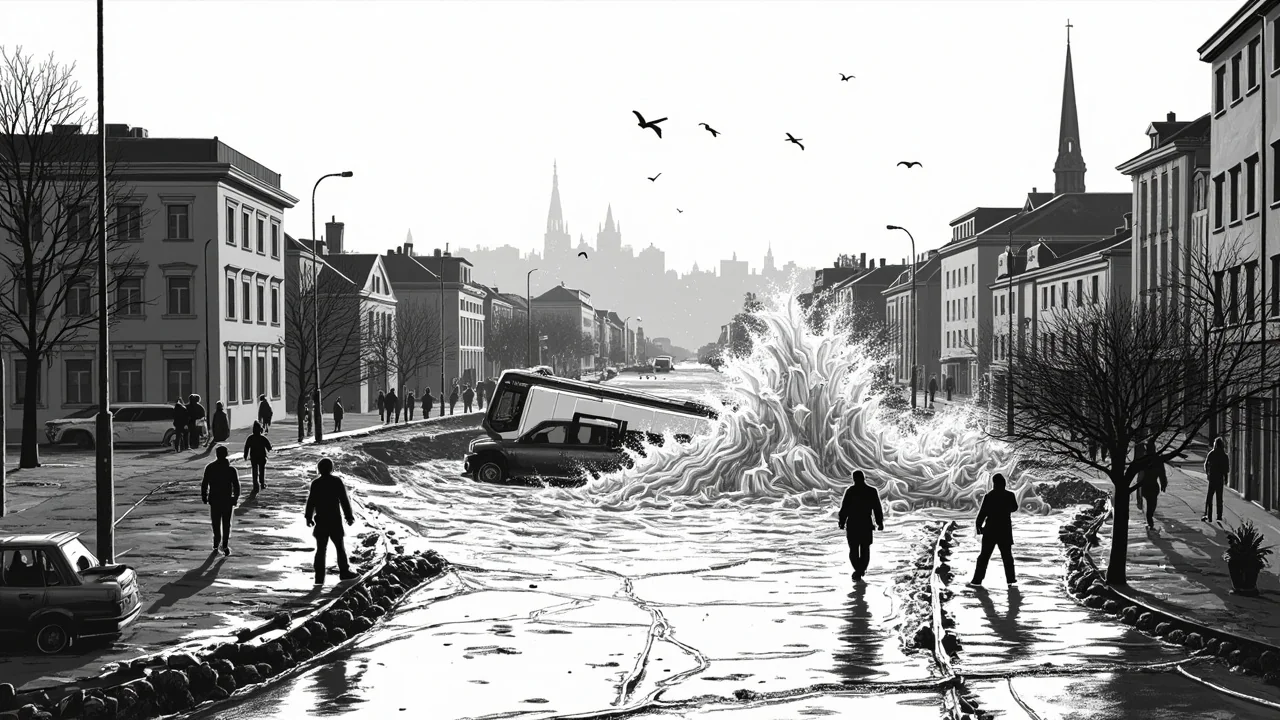
Norway's capital Oslo faced a significant infrastructure crisis early Saturday morning when a major water main ruptured near the Vulkan area. Emergency services were dispatched at 4:21 am following reports of a substantial leak, which police described as a suspected break on a primary water pipeline. The incident on Maridalsveien forced road closures, disrupted bus services, and highlighted the vulnerability of urban utilities during winter conditions.
Police confirmed the leak was stopped by 5:02 am, but large volumes of water remained on the road surface. Crews from Oslo municipality worked alongside emergency responders to manage the situation. Authorities warned that current weather conditions would likely create difficult driving conditions, particularly on the affected stretch of Maridalsveien, with no clear timeline for the road's reopening.
Immediate Impact on Transport and Services
The rupture's location on a key arterial road created immediate logistical challenges. Police closed Maridalsveien entirely, creating ripple effects across the city's morning transit network. Bus lines 34 and 54 were rerouted, skipping stops at Jakob kirke, Møllerveien, and Telthusbakken between Alexander Kiellands plass and Storgata. Public transport operator Ruter announced these disruptions would remain in effect until at least 11:30 am.
This incident underscores how a single point of failure in urban infrastructure can disrupt daily life for thousands. The Vulkan area, a former industrial zone transformed into a cultural and residential hub, depends on reliable access routes. The timing—early on a weekend morning—likely minimized commuter chaos but exposed the city's reliance on aging utility networks.
Winter Weather Compounds Infrastructure Challenges
Police specifically cited weather conditions as a complicating factor. Early March in Oslo brings freezing temperatures overnight, meaning spilled water from the rupture could quickly turn to ice. This creates hazardous driving conditions and complicates cleanup efforts. The incident serves as a stark reminder of the additional strain winter places on Norway's built environment, where frost heave and temperature fluctuations can stress underground pipes.
Norway invests heavily in infrastructure, but much of Oslo's subsurface utility network dates from the mid-20th century expansion period. While the country's oil and gas expertise drives advanced engineering in the energy sector, municipal water and sewage systems face different budgetary and maintenance priorities. A break in a main transmission line suggests either material fatigue, ground movement, or a combination of both.
Analyzing Oslo's Water Infrastructure Resilience
From a policy perspective, this event will likely trigger questions at Oslo City Hall about the state of the city's water distribution network. Major leaks, while infrequent, represent significant economic costs from water loss, repair work, and business disruption. They also test the coordination between municipal agencies, police, and fire services.
The response protocol appeared effective, with the leak contained within 41 minutes of the initial alarm. This indicates good valve placement and control systems. However, the prolonged road closure and transit impacts reveal the broader consequences of such failures. For a city that prides itself on efficiency and sustainability, maintaining invisible infrastructure is as crucial as building visible landmarks.
The Broader Context of Nordic Urban Maintenance
Scandinavian cities consistently rank high in global livability indexes, partly due to reliable infrastructure. Yet, this incident illustrates that no system is immune to failure. Compared to its Nordic neighbors, Oslo's topography and climate present unique challenges. The city is built around a fjord with varying bedrock and soil conditions, which can affect pipeline stability over decades.
Other major Norwegian cities like Bergen and Trondheim have also faced similar challenges with aging water networks. The national focus on offshore energy and Arctic development sometimes overshadows the less glamorous but critical work of maintaining urban water systems. This leak may prompt municipal officials to accelerate inspection and replacement schedules for critical mains, especially those under major thoroughfares.
Looking Ahead: Prevention and Preparedness
The immediate crisis has passed, but the aftermath involves assessment and prevention. Municipal crews will need to excavate the site, determine the exact cause of the failure, and complete repairs. This forensic engineering work is essential for preventing recurrences elsewhere in the network. Data from the break—such as pipe material age, pressure readings, and soil corrosion factors—will feed into asset management models.
For Oslo residents, the event is a temporary inconvenience. For city planners, it is a data point in the ongoing challenge of renewing infrastructure without paralyzing the city. The balance between proactive replacement and reactive repair is a financial and logistical puzzle. In the coming days, the municipality will need to communicate its findings and any planned investments to reinforce public confidence in the systems that deliver a fundamental resource: clean water.
Ultimately, the early morning rupture on Maridalsveien is more than a localized leak. It is a test of municipal response, a lesson in interconnected urban systems, and a prompt for evaluating the hidden networks that keep a modern capital functioning. As Oslo continues to grow, ensuring the resilience of these systems against both time and winter's chill remains a paramount, if unseen, priority.