
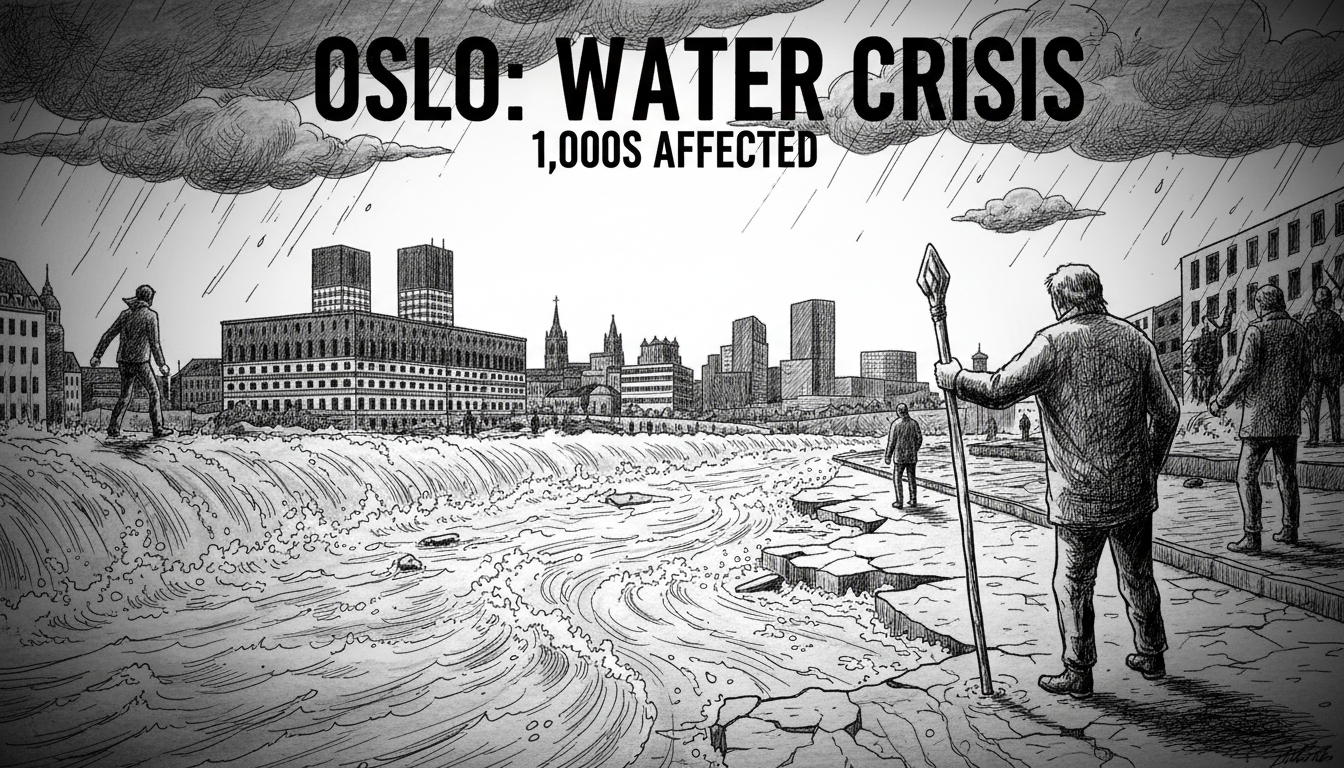
Norway's capital Oslo is grappling with a major infrastructure failure after a critical water main burst in the Årvoll neighborhood late Sunday night. The rupture sent torrents of water flowing through streets, blocking building entrances and flooding a residential block as temperatures plunged to -7°C. Emergency services, including police and fire crews, rushed to Øivinds vei in the Bjerke district to locate and contain the leak from what authorities confirmed was a failed primary distribution pipe.
"There are large amounts of water flowing down and blocking exit doors," said operations commander Aleksander Olsen in a statement. The immediate priority for municipal agencies and the fire department was gaining control over the situation, preventing further property damage, and addressing the severe icing hazard created by the freezing water. The incident highlights persistent vulnerabilities in the aging utility networks beneath one of Europe's wealthiest cities.
A Frigid Crisis Unfolds
The alarm was raised just before 10:40 PM on a quiet Sunday, a timing that likely limited direct human exposure but complicated the emergency response. With the city in a deep freeze, the cascading water from the broken main began forming sheets of ice almost immediately. This created a dual threat: structural water damage to buildings and treacherous, icy conditions on roads and pavements that could lead to accidents and falls for residents.
Oslo Police confirmed that the leak originated from a "hovedledning," or main pipeline. These large-diameter pipes form the arterial network of the city's water supply, carrying pressurized water from treatment plants to local distribution grids. A failure at this level indicates a significant breach, requiring extensive repair work. The water's intrusion into a residential block suggests substantial pressure and volume, pointing to a major rupture rather than a small crack.
The Aging Veins of a Modern City
This incident is not an isolated one but part of a broader, silent challenge facing Oslo and many other European capitals. Much of the city's water and sewage infrastructure was laid decades ago and is now reaching the end of its projected service life. While Norway invests heavily in visible public projects, the critical systems underground often receive attention only after a failure occurs.
"What we see in Årvoll is a symptom of a continent-wide issue," said Dr. Ingrid Solberg, a civil engineering professor specializing in urban infrastructure at the University of Oslo. "The pipes beneath our streets are aging out. In cold climates, the stress factors are multiplied. Ground freezing and thawing cycles exert physical pressure on pipes, and older materials become brittle over time. Proactive replacement is costly and disruptive, so too often, we operate on a 'fix-it-when-it-breaks' model, which ultimately risks greater disruption and higher costs."
Solberg notes that investment in digital monitoring systems, like acoustic sensors that can detect weaknesses in pipes before they burst, is increasing but not yet widespread. The financial calculus for municipalities is difficult: diverting funds from other services to preemptively replace infrastructure that might still have years of service left.
Immediate Response and Resident Impact
On the ground in Bjerke, the coordinated response followed standard crisis protocols. The fire service's initial role was to help locate the exact point of the breach—a task that can be difficult as water may travel along utility trenches before surfacing. Once located, crews from Oslo's municipal water utility, Vann- og avløpsetaten, would work to isolate the section by closing valves, a process that can shut off water to a wider area than just the leak site.
For residents in the affected block and surrounding buildings, the night brought uncertainty and inconvenience. Water entering a building poses immediate risks to electrical systems, personal property, and the structural integrity of walls and floors. The blocking of exit doors by water or ice also raised serious safety concerns, potentially hindering evacuation in a secondary emergency. Social media posts from the area showed significant water flow on streets, with emergency vehicle lights reflecting off the wet pavement and ice.
While no injuries were immediately reported, the secondary effects are significant. The forming ice will require extensive salting and sanding by municipal road crews to make the area safe for pedestrians and traffic. Residents in buildings with flooded basements or ground floors face a lengthy cleanup process, dealing with water damage and mold prevention.
A Policy Dilemma for City Hall
The burst pipe arrives at a time when Oslo's city government, led by Mayor Anne Lindboe of the Conservative Party, is navigating tight budgets and competing priorities. The city has ambitious climate goals, including a push for electric transportation and reduced emissions, which require substantial investment. Simultaneously, pressure mounts to maintain and renew basic infrastructure.
City councilor for environment and transport, Sirin Stav of the MDG (Green Party), oversees the water utility. In a statement last year regarding infrastructure budgets, she acknowledged the challenge: "We must balance the need for innovation and climate investment with the fundamental duty to maintain the systems that keep our city functioning daily. Safe, clean water is non-negotiable."
This incident will likely fuel debate in the Storting, Norway's parliament, about national guidelines and funding for municipal infrastructure. While local authorities manage water systems, the state provides grants and sets regulatory standards. Some politicians argue for a nationally coordinated acceleration of pipe replacement, similar to initiatives for road and railway maintenance.
Looking Ahead: Thaw and Consequences
The repair work in Årvoll will be urgent and complex. Crews must excavate the site, often in cramped conditions alongside other buried utilities like gas lines and fiber optic cables. The broken section of pipe will be replaced, a process that can take many hours or even days depending on the damage's extent. During this time, water supply may be interrupted or reduced for local residents, who will need to be notified and provided with alternative supplies if necessary.
Once the immediate crisis is over, the investigation will begin. The utility will examine the failed pipe segment to determine the cause of the rupture—whether it was material fatigue, corrosion, ground movement, or damage from earlier construction work. This forensics helps prioritize which sections of the network are most at risk.
For Oslo's residents, the event is a stark reminder of the city's hidden fragility. It raises practical questions about personal preparedness for utility outages and philosophical ones about how a society prioritizes invisible essentials. As climate change brings more extreme weather, including deeper freezes and rapid thaw cycles, the strain on this aging network will only increase. The flood in Årvoll is a warning shot. The question for policymakers is whether they will treat it as a one-off emergency or the inevitable result of deferred maintenance on the systems that truly hold the city together.
Will this cold night's flood lead to a warmer commitment to renewing the veins of the city, or will the lessons drain away until the next pipe bursts?