
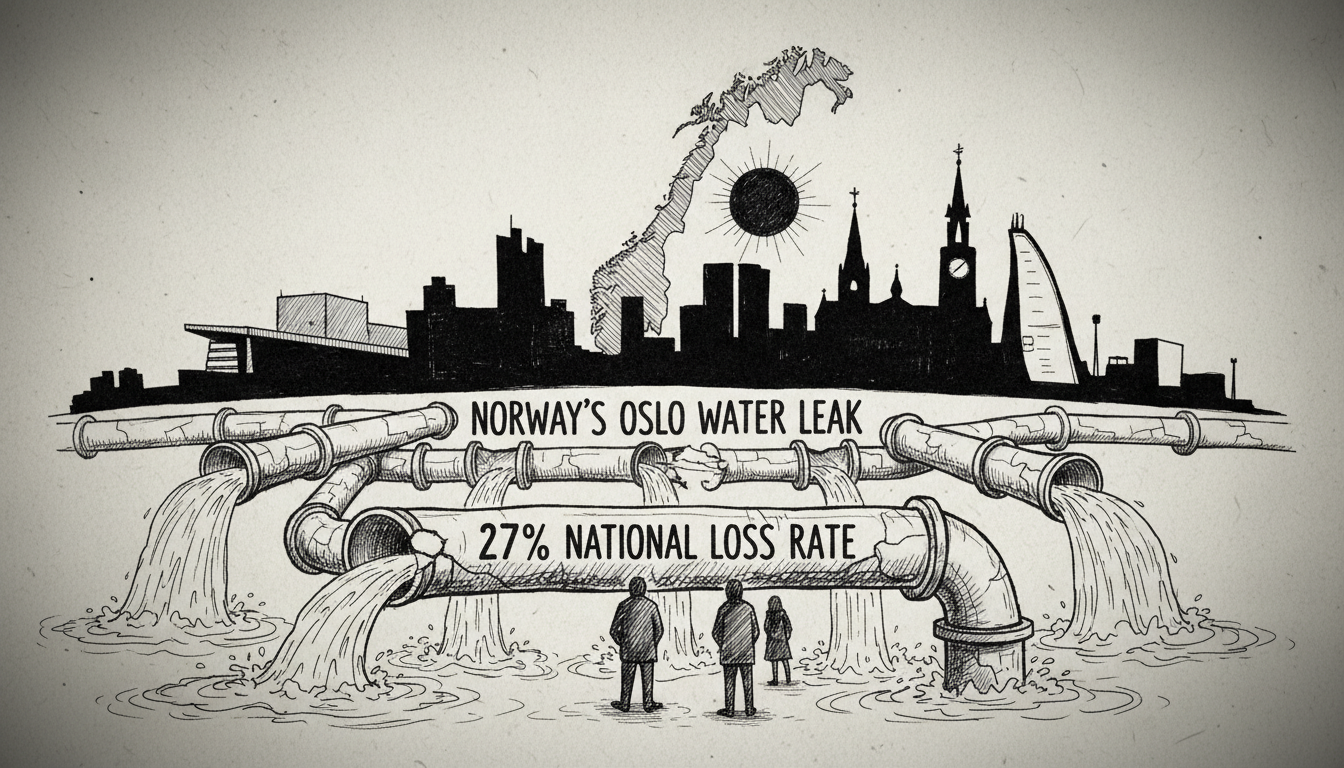
Norway's capital Oslo faced a significant water leak Sunday evening, with emergency services rushing to the Årvoll residential district. The incident highlights a persistent national challenge: aging water infrastructure. "The fire department and municipal resources are working to gain control of the leak," said operations manager Øyvind Hammervold in a statement just before 11 PM. While crews contained this specific breach, it serves as a stark reminder of the systemic issue draining Norway's resources.
A Recurring Challenge for an Aging System
Oslo's water supply, primarily drawn from the Maridalsvannet lake, flows through a vast network of pipes, many of which are decades old. Like numerous European cities, Oslo grapples with the constant need to monitor, maintain, and modernize this essential but hidden infrastructure. Water leaks are not uncommon, yet each event carries the potential for severe disruption. In residential areas like Årvoll—a neighborhood in the Bjerke district known for its apartments and green spaces—a major leak can force road closures, damage property, and cut off supply to hundreds of households.
The immediate response protocol worked. Specialized teams located the breach and stopped the flow. However, the underlying problem extends far beyond a single pipe failure. A 2021 report by the Norwegian Environment Agency revealed a sobering statistic: the average water loss due to leakage across Norwegian municipalities is approximately 27%. This means over a quarter of all treated, potable water is lost before it ever reaches a tap. For a nation that prides itself on efficiency and environmental stewardship, this figure represents a significant economic and ecological drain.
The High Cost of Hidden Failures
Experts in water management stress that reactive repairs, while necessary, are far more costly than proactive investment. "Every major leak you see reported is just the symptom," says Lars Holten, a civil engineer specializing in urban water systems. "The disease is an infrastructure network that is past its design life in many areas. The water loss statistics are a direct measure of investment delay." Holten points out that leaks cause more than just water waste. They can undermine road foundations, damage other buried utilities like electrical conduits, and in a worst-case scenario, compromise public health if contaminants enter the system.
Oslo municipality has not been idle. In recent years, it has allocated billions of Norwegian kroner to upgrade its water and sewage infrastructure. These projects are complex and disruptive, often requiring extensive excavation in densely populated areas. The work is also largely invisible to the public until a failure occurs. This creates a political and budgetary challenge: justifying massive expenditure on infrastructure that functions best when no one notices it.
Climate and Urban Pressure
Modern challenges are adding strain to old pipes. Climate change brings more frequent freeze-thaw cycles in winter, which can stress and fracture pipelines. Heavier, more intense rainfall events can also saturate soils, shifting ground conditions and putting pressure on underground networks. Simultaneously, Oslo's continued urban growth increases demand on the system. More residents and new developments mean the water network must work harder, often at higher pressures, which can exacerbate weak points in older sections.
Smart technology offers part of the solution. Advanced acoustic sensors can now be deployed to listen for the tell-tale sound of leaks within a pipe network. Automated metering infrastructure can help identify areas of unusual water loss. "We have the tools to move from reactive to predictive maintenance," Holten explains. "But it requires upfront capital investment. The return is seen in lower long-term repair costs, reduced water loss, and far fewer disruptive incidents for residents."
A National Infrastructure Crossroads
The Årvoll leak, while resolved, is a microcosm of a national issue. The 27% average loss rate indicates that many municipalities outside Oslo face similar or even greater challenges. Rural areas with dispersed populations often have an even harder time financing large-scale pipe replacement projects. The Norwegian government has various grant and subsidy programs aimed at supporting municipal infrastructure, but water systems compete for funding with roads, schools, and digital networks.
Investment in water infrastructure is also an investment in climate resilience. A robust, leak-free system is more efficient, requiring less energy to treat and pump water. It conserves a vital resource, which could become more precious in drier summers. Furthermore, it prevents the collateral damage to other infrastructure that major leaks cause. The question for policymakers at both the municipal and national level is one of priority and pace. Can Norway afford to continue losing over a quarter of its treated water?
Looking Beyond the Repair
For residents of Årvoll, normalcy will return as the repair site is cleared. The immediate crisis is over. Yet the episode provides a valuable, if unintended, public audit of the city's subterranean health. It makes the invisible visible. Each such event adds to the public and political case for accelerated renewal programs.
The path forward involves a combination of relentless, unglamorous pipe replacement and the integration of new monitoring technologies. It requires long-term budgeting that transcends election cycles, recognizing that water infrastructure is a multi-generational asset. As Oslo continues to grow and climate patterns shift, the pressure on its water arteries will only increase. The work to fortify them, though hidden from view, remains fundamental to the city's future. The true measure of success will be a decline in emergency call-outs and a reduction in that sobering 27% national loss figure. Until then, leaks like the one at Årvoll will continue to serve as costly reminders of work yet to be done.