
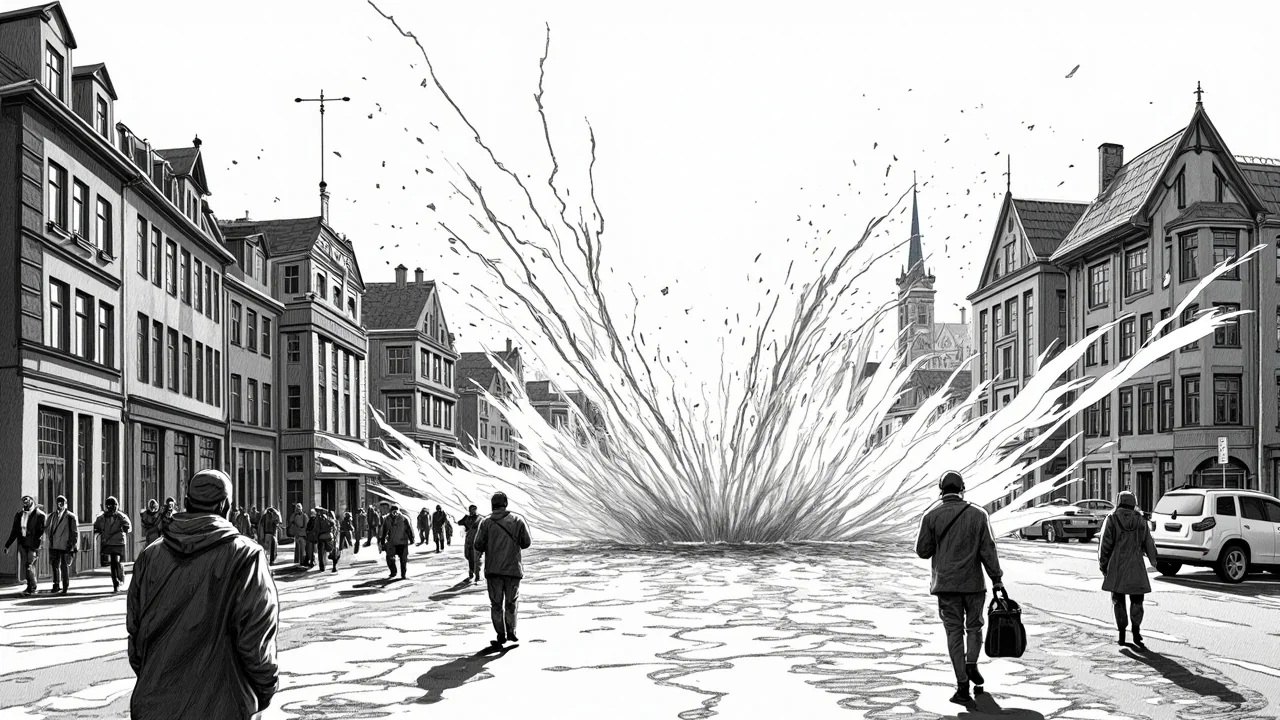
Norway's capital Oslo faced significant disruption early Saturday morning after a major water main rupture forced the closure of a key city artery. Police were alerted to the incident on Maridalsveien in the St. Hanshaugen district at 4:21 AM. Operations leader Alexander Østerhaug described it as a substantial leak, with immediate suspicion falling on a breach in a primary water pipeline. Crews from the Oslo municipality and the fire department worked swiftly to contain the situation, successfully stopping the flow of water by approximately 5:00 AM.
Initial assessments show limited property damage, with only minor water ingress reported in a single parking garage. The greater impact was on the city's infrastructure and early morning transit. The road closure spans from the Maridalsveien/Møllerveien roundabout to the intersection of Rosteds gate and Møllergata. The escaping water quickly froze on the cold asphalt, coating the street in a hazardous layer of black ice by dawn.
Public transport operator Ruter implemented immediate detours for bus lines 34 and 54. These buses are bypassing three stops between Alexander Kiellands plass and Storgata: Telthusbakken, Møllerveien, and Jakob Church. The incident highlights the vulnerability of urban infrastructure, even in a nation renowned for its engineering and water management.
A Frigid and Sudden Crisis
The rupture occurred during the coldest hours of the night, a factor that compounded the challenges for response teams and transformed the leak into an icing hazard. While the volume of water lost has not been officially quantified, the classification as a "substantial leak" from a main pipeline suggests a significant loss of resources. Oslo's water supply, largely drawn from the protected Maridalsvannet lake, is a point of municipal pride. This incident serves as a stark reminder that the distribution network beneath the city's streets remains subject to failure.
"The rapid response from municipal and fire services likely prevented more severe consequences," said a city engineer familiar with the network, who spoke on condition of anonymity as they were not authorized to comment. "The immediate priority is always to isolate the breach, which they achieved within an hour. The secondary concern in winter is always the ice it creates, which becomes a public safety issue in itself."
Infrastructure Under Pressure
This leak prompts difficult questions about the state of Oslo's subterranean infrastructure. Many European cities grapple with aging water and sewage systems, and Oslo is no exception. While Norway invests heavily in public works, maintenance of existing, out-of-sight networks can sometimes lag behind more visible projects. A water main break of this scale in a central location suggests a critical failure point, which will necessitate a thorough forensic investigation by Oslo Vann og Avløp (Oslo Water and Sewage Works).
The location on Maridalsveien is particularly disruptive. It is a crucial connector road between central Oslo and northern neighborhoods, used by buses, delivery vehicles, and commuters. Its closure creates a ripple effect through the city's traffic system, especially on a weekend when public transport relies heavily on bus routes due to reduced tram and metro frequency.
The Ripple Effects on City Life
Beyond the traffic detours, events like this disrupt the normal rhythm of the city. Local businesses along the closed stretch, from cafes to shops, face a sudden drop in foot traffic and accessibility. Residents in adjacent buildings were awakened not by alarms, but by the sound of rushing water and emergency service vehicles. While significant property damage was avoided, the psychological and practical nuisance is considerable.
"It's the kind of event that exposes the interdependencies of a modern city," notes Lars Holen, an urban planning analyst based in Oslo. "One pipe breaks, and suddenly a transport route is gone, bus schedules are rewritten, and people's daily routines are interrupted. It tests the resilience of municipal planning and real-time coordination between agencies like police, fire, transport, and the water utility."
The formation of black ice added a layer of danger, turning the area into a slip hazard for pedestrians and an impassable zone for vehicles. The fire department's confirmation that no building structural damage was found will be a relief to property owners, but the clean-up and repair operation will be extensive. Crews must now repair the ruptured pipe, assess the structural integrity of the roadbed, and clear the ice before the street can be safely reopened.
A Look at Oslo's Water Network
Oslo's drinking water is famously soft and of high quality, sourced from surface water in the protected forests surrounding the city. The network comprises over 2,000 kilometers of pipelines, with mains ranging from old cast iron to modern polyethylene. The age and material of the failed section will be a key focus of the upcoming investigation. Pressure fluctuations, ground movement due to frost, or material fatigue can all cause such failures.
Norway's strict environmental regulations mean that any spill, even of clean drinking water, is taken seriously due to potential runoff issues. In this case, the water flowed onto the street and presumably into storm drains, but the environmental impact is considered minimal compared to a sewage leak. The primary waste is the resource itself—treated, potable water lost into the gutter.
What Happens Next?
The immediate response phase has concluded. The leak is stopped, and the area is secured. The city now enters the restoration phase. Engineers will work to excavate the site, determine the exact cause of the rupture, and execute a repair. The road will remain closed for the duration, likely spanning several days. Commuters and residents must prepare for continued disruptions.
This event, while resolved efficiently, serves as a case study. It will undoubtedly lead to internal reviews at the water utility regarding inspection schedules and pipeline replacement priorities. For the public, it is a reminder of the complex, hidden systems that make urban life possible, and how quickly they can bring a piece of the city to a standstill when they fail. The quiet efficiency with which Oslo manages most days makes a sudden, icy breakdown on Maridalsveien all the more jarring. Will this incident trigger accelerated investment in the city's underground veins and arteries, or will it be remembered as just an isolated, cold morning's trouble?