
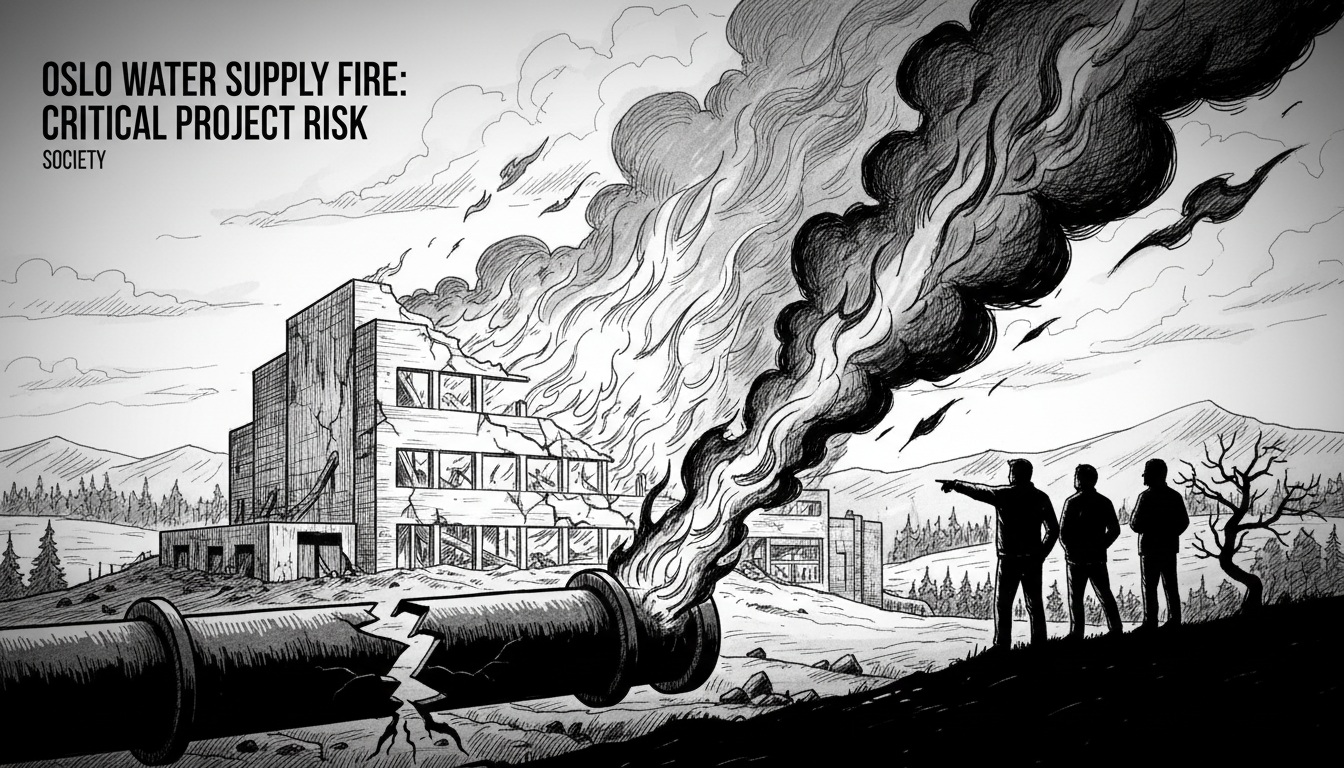
Norway's capital faces a potential setback to its most critical infrastructure project after a major fire erupted at the construction site for Oslo's new water supply system. Flames engulfed several office barracks at the Huseby site early Wednesday, sending thick plumes of smoke over the city's western districts. The Oslo Police District confirmed the blaze poses a direct threat to the construction zone for the multi-billion kroner project designed to secure drinking water for future generations.
Firefighters battled the intense fire, focusing on preventing its spread to adjacent construction materials and machinery. "There is likely no one inside, but the fire department is working to clarify this," police stated in their initial alert. The incident immediately raised alarms about possible delays and damage to a project deemed essential for the city's resilience. Oslo's current water supply relies on a vulnerable, century-old system from the Maridalsvannet lake.
A Blaze at the Heart of Oslo's Future
The Huseby site is a pivotal hub for constructing Oslo's new water supply, a project officially named the New Oslo Water Supply. This infrastructure endeavor represents one of the largest public works in the city's modern history. It aims to create a redundant, secure system drawing water from the Holsfjorden, a branch of the Tyrifjorden lake, through over 40 kilometers of tunnels to a new treatment plant at Huseby.
Project managers from Oslo Municipality's Water and Sewage Agency (Vann- og avløpsetaten) rushed to the scene as fire crews established a security perimeter. The immediate concern was the integrity of on-site engineering plans, specialized equipment, and the construction timeline. "Any fire at a site of this importance is a serious event," said a senior project engineer who requested anonymity due to the ongoing investigation. "Beyond the physical damage, the loss of administrative functions can halt coordination and delay critical path activities."
The Stakes of Securing Oslo's Water
Oslo's current water supply is remarkably pure but notoriously fragile. The single-source system from Maridalsvannet lacks a backup, making the city susceptible to contamination events or infrastructure failure. The new system is designed to provide an independent, parallel supply, dramatically increasing security for Oslo's nearly 700,000 residents and its businesses. The project, with an estimated budget exceeding 10 billion NOK, has been in planning for decades, with construction now in its most intensive phase.
Experts in critical infrastructure immediately highlighted the broader implications. "Fires at construction sites for essential utilities carry a multiplier effect," explained Dr. Lena Holm, a risk management professor at the University of Oslo. "The direct damage is one cost. The potential delay in bringing a risk-mitigating system online is another, often larger, risk exposure for the city. Every month of delay is another month the city relies on a single, unprotected source."
The fire's cause remains unknown. The Police Fire Service (Politiets brannvesen) will lead a technical investigation, examining possibilities from electrical faults in temporary site wiring to accidental ignition of flammable building materials. Construction sites are inherently high-risk environments, containing temporary heating units, fuel stores, and volatile compounds.
Project Resilience Under Scrutiny
This incident will inevitably trigger reviews of safety protocols across all phases of the massive water project. The New Oslo Water Supply involves multiple concurrent sites, from tunneling operations in the surrounding hills to the treatment plant construction at Huseby. A spokesperson for the Water and Sewage Agency stated that contingency plans were being activated to minimize disruption, including relocating site management functions.
The political dimension is also significant. The project enjoys broad support in the Oslo City Council (Byråd) and the Norwegian Parliament (Storting), given its fundamental role in public health and urban security. Key politicians from both the governing and opposition parties have called for a swift and transparent assessment. "This is about Oslo's basic security," said Marius Aarvik, a Conservative Party (Høyre) member of the Storting's Transport and Communications Committee. "We need to know what happened, how it affects the timeline, and what must be done to prevent a recurrence."
From an engineering perspective, the fire tests the project's built-in resilience. Modern major infrastructure projects are designed with contingency buffers, but unexpected events like a major fire can consume that slack. Project leads will now be assessing damage to temporary structures, surveying any heat or smoke impact on stored materials like pipes or electrical components, and recalculating schedules.
Looking Ahead: Recovery and Review
The coming days will focus on damage assessment and restarting safe operations. The fire service's primary goal was to contain and extinguish the blaze, preventing structural collapse that could hinder the investigation. Once the site is declared safe, forensic teams and insurance assessors will move in. The project's main contractors, a consortium of leading Norwegian construction firms, will be central to the recovery planning.
For Oslo's residents, the fire is a stark reminder of the complex, unseen infrastructure that sustains the city. While the municipal government was quick to reassure the public that the current drinking water supply remains unaffected and safe, the event underscores the urgency of completing the new system. The project is not just about growth; it is a fundamental upgrade to the city's defensive backbone against both accidental and deliberate threats.
Norway prides itself on meticulous planning and operational safety, particularly in large-scale industrial and construction projects. This incident at the Huseby water works will become a case study in how even the most carefully managed projects must navigate unforeseen crises. The true test will be how quickly and effectively the project team can adapt, learn, and rebuild, ensuring Oslo's water security is delayed as little as possible. The city's future, quite literally, depends on it.