
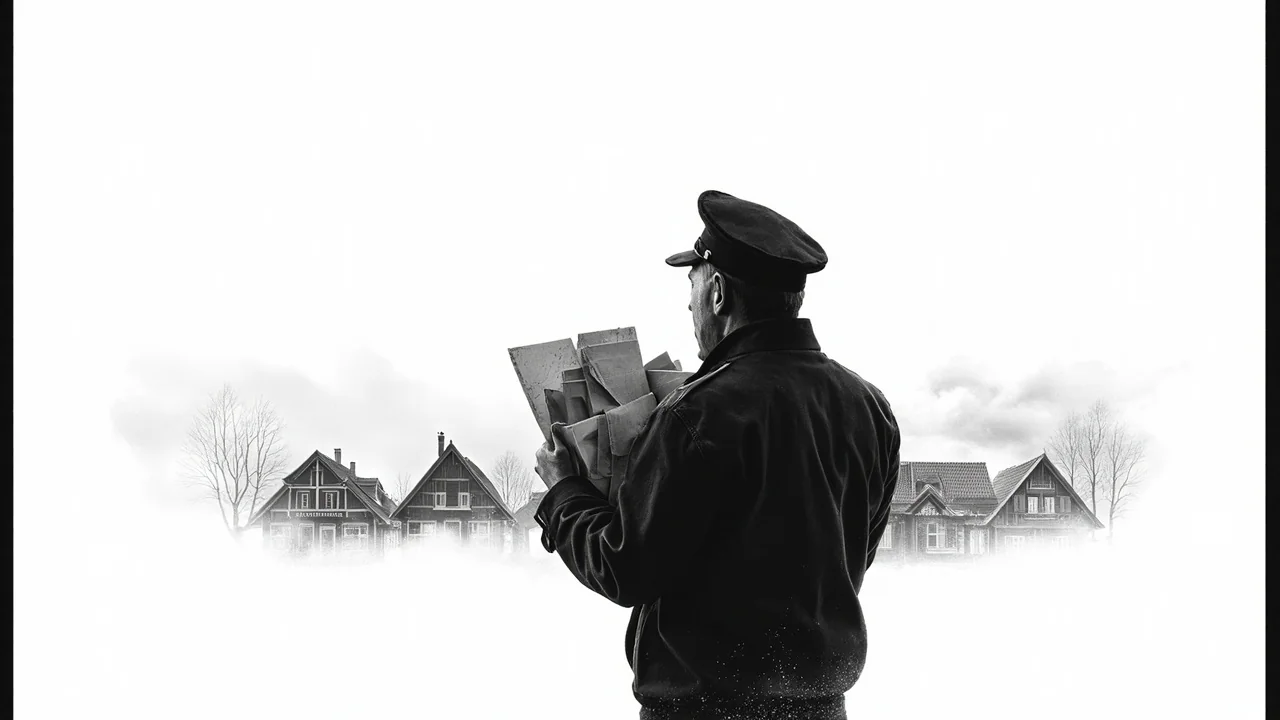
Norway's proposed postal reform threatens a vital national security asset: the intimate, human knowledge of its postal workers. As the government moves to cut home delivery to just one day a week, a critical debate has emerged over the future of the postal service. The conflict pits economic efficiency against a less tangible, but potentially lifesaving, form of preparedness. At its heart is the knowledge held by people like Iver Stabæk, a postal carrier in Røyken and Hurum, who knows roughly 5,000 households and 15,000 people on his route by heart.
The Human Database
Iver Stabæk represents a fading class of public servant. His role extends far beyond delivering letters and parcels. He possesses a detailed, living map of his community. This knowledge is not stored in a digital cloud but in memory, built through daily, personal contact. "For many of them I visit, I might be the only visitor they have that week," Stabæk explains, referencing his additional duties in the 'På dørterskelen' (On the Doorstep) project. This initiative in Asker municipality sees him delivering post and community information to residents over 75, providing both a service and a social check-in. The proposed postal law, aiming to adapt to a digital world with far fewer letters, would scale back such daily presence. A simple calculation suggests fewer carriers will be needed, risking the erosion of this human network.
From Postal Service to Civil Defense
The most forceful argument against a simple downsizing comes from the municipal sector. Gunn Marit Helgesen, chair of the Norwegian Association of Local and Regional Authorities (KS), agrees that one-day-a-week delivery is sensible but warns of catastrophic collateral damage. She frames the postal service not as a legacy business, but as a core component of national civil preparedness. "The postal service has a nationwide infrastructure," Helgesen states. "They have enormous competence about where all the inhabitants of this country live. So, in a war or crisis, the postal service and that competence would be absolutely crucial to provide important information to residents, but also possibly to deliver medicines and goods." Her concern is that cutting services without providing new, consolidated roles will cause an exodus of experienced staff, dismantling this irreplaceable human intelligence network precisely when Norway might need it most.
The 'On the Doorstep' Solution
KS has proposed a concrete solution to preserve this network while adapting to new realities. They advocate for a national rollout and funding of the 'På dørterskelen' project, currently a local initiative. This model redefines the postal carrier's role. They become a hybrid: part delivery agent, part municipal communicator, and part social contact for vulnerable groups. An evaluation of the project highlights its societal value, suggesting benefits like enabling older adults to live independently at home longer. Stabæk's experience confirms this. The recipients look forward to his visits, valuing that he does not rush. This transforms the economic argument. The question shifts from "Is it profitable to maintain a large distribution network?" to "What societal value does this network provide?" Helgesen argues for these broader socioeconomic gains that are not reflected on a balance sheet but strengthen community resilience.
The Inevitable Decline of the Letter
The government's proposal is not without logic. Physical mail volume has collapsed. Norway, like its Nordic neighbors, has become a digital society. The recent announcement that Denmark's postal service will end all letter delivery after 400 years underscores the regional trend. Maintaining a costly, daily delivery network for a shrinking number of envelopes is economically challenging. The reform aims to create a sustainable, modern postal service fit for the 21st century, focusing on parcels and essential mail. The dispute is not about whether change is needed, but about how to manage the transition. The core issue is whether to view the postal workforce as a cost to be minimized or as a strategic resource to be redeployed.
A Strategic Choice for National Security
This debate touches on a deeper Norwegian principle: dugnad, or community self-reliance. The postal carrier's knowledge is a form of decentralized, grassroots security. In a crisis where digital networks fail, this human map becomes operational. Knowing which house has a steep driveway, which resident is hearing-impaired, or which family has young children is intelligence that cannot be quickly replicated. Losing it would mean outsourcing a fundamental layer of community cohesion and crisis response. The 'På dørterskelen' model offers a path forward. It integrates the postal service into the welfare state's frontline, making carriers visible agents of the municipality. This provides job security for postal workers, a vital service for the elderly, and maintains that critical physical presence in every community.
The Road Ahead for Oslo's Decision
The Storting will now consider the proposed postal law. The outcome hinges on whether lawmakers are persuaded by the civil defense argument. Will they see the value in funding a transformed, multi-purpose postal service, as KS and the municipalities advocate? Or will they prioritize immediate cost-saving, accepting the gradual loss of a unique national asset? The carriers themselves, like Iver Stabæk, await the decision. Their daily rounds represent a thread connecting the state to the citizen, a thread that risks being severed not by a crisis, but by a policy shift. As Norway contemplates a future of more frequent extreme weather and heightened geopolitical tension in the Arctic, the man with 15,000 addresses in his head may be more valuable than ever. The question for Oslo is whether it recognizes that value before it quietly walks out the door, one retired postie at a time.