
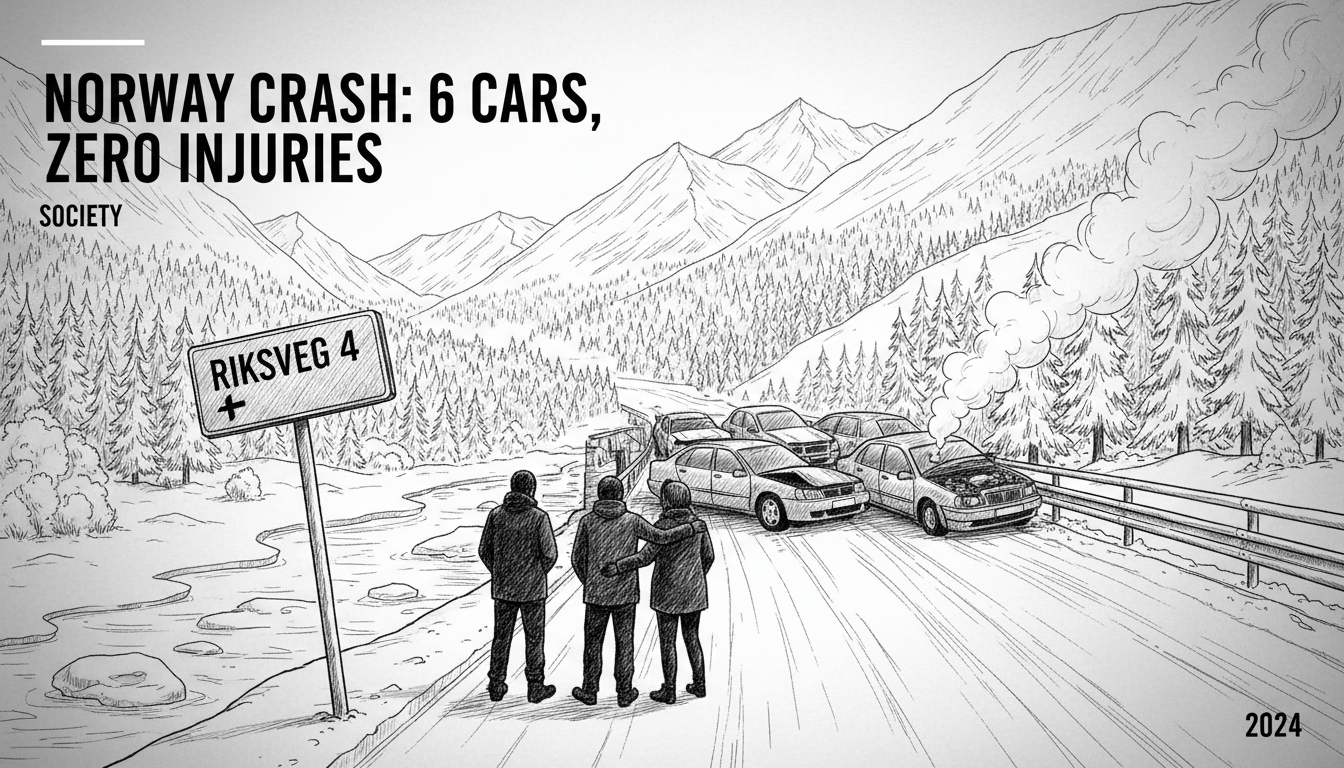
Norway's Riksveg 4 highway saw a six-car chain collision near Gjøvik on Tuesday afternoon, a dramatic incident that resulted in significant vehicle damage but, remarkably, no reported injuries. The accident occurred in the southbound lanes between Hunndalen and Raufoss, bringing traffic to a standstill during a period of extremely slippery winter conditions. Emergency services, including police and tow operators, were quickly on the scene to manage the wreckage and begin the lengthy clearance process.
A Narrow Escape on a Critical Corridor
The absence of serious injuries transforms this from a potential tragedy into a stark warning. Police confirmed the collision involved six passenger vehicles. The operational leader at the scene attributed the cause directly to "extremely slippery" road surfaces in the area. This stretch of Riksveg 4 is a vital artery connecting Oslo to the inland towns of Oppland, including Gjøvik and Lillehammer. Such incidents cause disproportionate disruption, stranding commuters and commercial traffic on a route with limited alternative options.
"When multiple vehicles are involved in a chain reaction, it's almost always a sign of drivers failing to adapt to the conditions," said a veteran traffic police officer, who requested anonymity as they were not the official spokesperson for this incident. "The safe stopping distance on ice is multiplied by ten. A few car lengths at 80 km/h is a recipe for exactly this kind of pile-up."
The Invisible Hazard: Black Ice and Winter Preparedness
Norwegian road safety experts consistently point to complacency as a key factor in winter accidents. After an initial heavy snowfall, drivers tend to be cautious. The greater danger often comes later, on roads that appear clear but are coated with nearly invisible black ice, or during periods of freezing rain. The conditions reported at Hunndalen—described as "svært glatt" or very slippery—are classic black ice scenarios.
"Modern cars with stability control and ABS can create a false sense of security," explained Lars Holen, a senior instructor with the Norwegian Council for Road Safety (Trygg Trafikk). "These systems help you maintain control, but they do not change the laws of physics. Your tires' grip on ice is minimal, regardless of the technology. The only effective strategy is to slow down dramatically and increase your following distance to an absolute minimum of five to six seconds."
This accident underscores a recurring seasonal challenge. Norwegian authorities invest heavily in winter road maintenance, with an extensive fleet of plows and salt spreaders. However, rapid temperature shifts and localized weather patterns can outpace treatment efforts, especially on critical highways like Riksveg 4 where traffic volume quickly wears away salt and gravel.
Economic and Logistical Ripple Effects
Beyond the immediate danger, accidents on this scale have tangible economic consequences. Riksveg 4 is a key route for freight moving between the Oslo port and inland industrial areas. Each hour of closure delays goods, increases costs for logistics companies, and disrupts just-in-time supply chains for businesses in the region. For local commuters, an accident like this can mean hours of detours on smaller, less-maintained county roads.
The clearance operation itself is a major logistical undertaking. Removing six damaged vehicles requires multiple tow trucks and flatbeds. Police must document the scene for insurance and potential liability claims, which involves measuring skid marks and vehicle positions. Debris from broken lights, bumpers, and glass must be swept from the roadway to prevent further tire damage or accidents. On a busy highway, this process can easily take two to three hours, even for a well-coordinated response.
A National Conversation on Winter Driving Culture
This incident near Gjøvik is not an isolated event but part of a seasonal pattern. It reignites the annual debate about winter driving competence in a country that should, by reputation, excel at it. While Norwegians grow up with winter, the proliferation of studded winter tires—which are legal and highly effective—can sometimes lead to overconfidence. Experts note that studs improve acceleration and braking on ice, but they do not make a car invincible, particularly in cornering.
Insurance data reveals that multi-vehicle collisions spike during the first sustained period of icy conditions each year. Many drivers have not yet adjusted their summer driving habits. The Norwegian Public Roads Administration (Statens vegvesen) runs annual awareness campaigns, emphasizing speed adjustment, distance, and smooth inputs for steering and braking. Their central message is simple: "Folk, det er dere som er trafikken"—People, you are the traffic.
The Aftermath: Cleanup and Reflection
By late afternoon, authorities had cleared the wreckage and reopened the southbound lanes of Riksveg 4. The damaged vehicles were transported to secure yards for inspection. Police will review the incident, though with no injuries, the investigation will likely focus on reinforcing preventive messaging rather than pursuing serious charges. The financial costs, borne by insurance companies and the drivers involved, will be considerable.
For the six drivers who walked away from crumpled metal on an icy highway, the event serves as a visceral, expensive reminder of winter's power. Their experience echoes across the country as temperatures drop. It highlights the narrow margin between a routine commute and a catastrophic collision. As one driver involved in a similar past incident noted, "You hear the brakes, you feel the impact, and in that moment, you understand completely what they mean by 'adapted to conditions.' It's a lesson you only need to learn once."
The Gjøvik chain collision ultimately stands as a success story for vehicle safety standards—modern car design likely prevented injuries—but a cautionary tale about driver judgment. It underscores that in Norway's long winter, the most critical safety feature is not found in the vehicle's specifications, but in the mindset of the person behind the wheel. As the dark season continues, the question remains: will this close call lead to changed behavior, or will it be forgotten until the next screech of brakes on an icy road?