
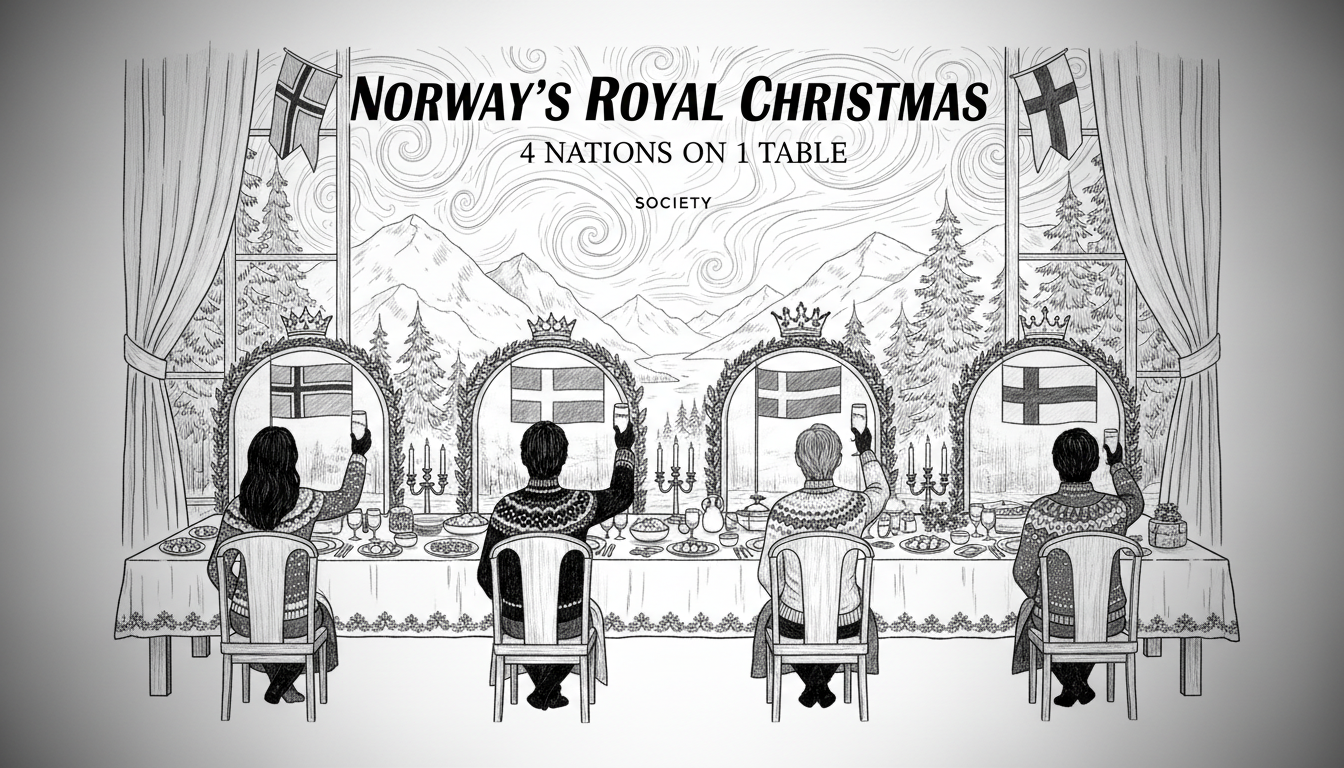
Norwegian Royal Family Christmas celebrations blend four national heritages into a single holiday season at their private mountain lodge. For over a century, the sovereigns have retreated to Kongsseteren on Voksenkollen, a gift from the Norwegian people following the 1905 dissolution of the union with Sweden. This year, King Harald V and Queen Sonja will uphold that tradition, while Crown Prince Haakon and Crown Princess Mette-Marit celebrate at their cabin in Uvdal. The precise location for Princess Märtha Louise remains undisclosed, adding a quiet note of privacy to the family’s public schedule.
These carefully curated plans, confirmed by the Royal Palace, offer a glimpse into a monarchy that balances public symbolism with cherished private rituals. On Christmas Day, the King and Queen will attend a festive service at Holmenkollen Chapel, a visible act connecting them to the capital’s community. The remainder of their holiday, however, unfolds behind the wooden walls of Kongsseteren, a villa steeped in history and purpose-built for winter.
A Lodge Forged in National Unity
Kongsseteren is more than a royal residence; it is a physical emblem of modern Norway's founding era. The Norwegian people presented the lodge to King Haakon VII and Queen Maud in 1906, a coronation gift affirming their acceptance of a new Danish-born monarch. This gesture cemented the bond between a young nation and a royal house chosen to embody its independent spirit. The villa’s primary use during the winter, and especially at Christmas, transforms it from a historical artifact into a living symbol of continuity.
"The choice of Kongsseteren is deeply significant," explains a historian specializing in modern Norwegian monarchy. "It roots the current family in the legacy of Haakon VII, who is revered for his steadfast leadership during World War II. Celebrating there is an act of historical remembrance, reinforcing an unbroken line of national stewardship." The lodge’s location above Oslo provides literal and figurative elevation, a retreat that allows the family to step away while remaining symbolically close to the heart of the nation.
A Culinary Tapestry of Heritage
The royal Christmas menu provides the most flavorful evidence of the family's multinational roots. Palace confirmations detail a festive spread that navigates the North Sea and the Scandinavian peninsula. Traditional Norwegian staples like pinnekjøtt (steamed and salted lamb ribs), lutefisk (lye-treated cod), and crispy pork belly ribbe anchor the feast. They are joined by Norwegian coastal specialties such as rakfisk (fermented fish) and cloudberries (multer).
Yet the table extends beyond Norway's borders. From the United Kingdom, the heritage of Queen Maud and later Queen Sonja brings plum pudding and mince pies. The family’s Swedish and Danish lineage, tracing back to Haakon VII himself, introduces Swedish Christmas ham and Danish roast duck. This is not a fusion meal served simultaneously, but a deliberate rotation of traditions across the holiday season, honoring each strand of the family’s ancestry.
"This culinary practice is a masterclass in soft diplomacy," notes a commentator on European royal affairs. "It visually and culturally represents the Nordic union that exists in their bloodline. It connects them personally to Norway, Sweden, Denmark, and the UK, making them living symbols of regional kinship." The menu is a silent, powerful communication of identity, demonstrating that the monarchy can embody a distinctly Norwegian role while acknowledging its broader historical connections.
Ritual, Privacy, and Public Connection
The separation of the core family units during Christmas—the King and Queen at Kongsseteren, the Crown Prince and his family in Uvdal—reflects a modern approach to royal life. It allows for intimate, multigenerational celebrations while maintaining the primacy of the sovereign’s traditional holiday seat. The attendance at Holmenkollen Chapel on Christmas Day is the key public gesture, a moment of shared faith and tradition with citizens.
The unresolved question of Princess Märtha Louise’s plans underscores the family's negotiated balance between public interest and private life. Her relationship with American shaman Durek Verrett has sparked public debate, making their holiday plans a subject of curiosity. The Palace’s silence on the matter is a deliberate boundary, protecting a sphere of personal freedom even as other details are willingly shared.
This balance is critical to the monarchy's enduring popularity. The public receives enough detail to feel included in the national story—the location, the menu, the church service—but the intimate emotional core of the family celebration remains protected. This fosters a sense of respectful connection rather than intrusive familiarity.
The Monarchy's Enduring Seasonal Role
In a nation known for its egalitarian values, the royal Christmas serves a unifying function. The traditions performed at Kongsseteren echo those in millions of Norwegian homes: the specific foods, the importance of family, the retreat to a hytta (cabin). The royals mirror the national culture, validating it through their example. Yet, they also elevate it by weaving in their unique trans-Scandinavian narrative.
As Norway continues to navigate its identity as a progressive, oil-rich nation with deep traditional roots, the monarchy provides a thread of consistency. The annual journey to Kongsseteren is a ritual of stability. The meal that honors four countries is a reminder of Norway's interconnected European history. In an era of rapid change, these constants hold significant, quiet power.
What does the future hold for these traditions? Crown Prince Haakon will one day inherit Kongsseteren and its attendant rituals. The challenge for the next generation will be to preserve the meaningful heritage while allowing the celebrations to evolve naturally, ensuring the royal Christmas remains a relatable, yet distinctly special, part of Norway's national story. The continuation of this century-old practice depends on its ability to feel both timeless and genuinely personal, a celebration of family that also happens to be a celebration of nation.