
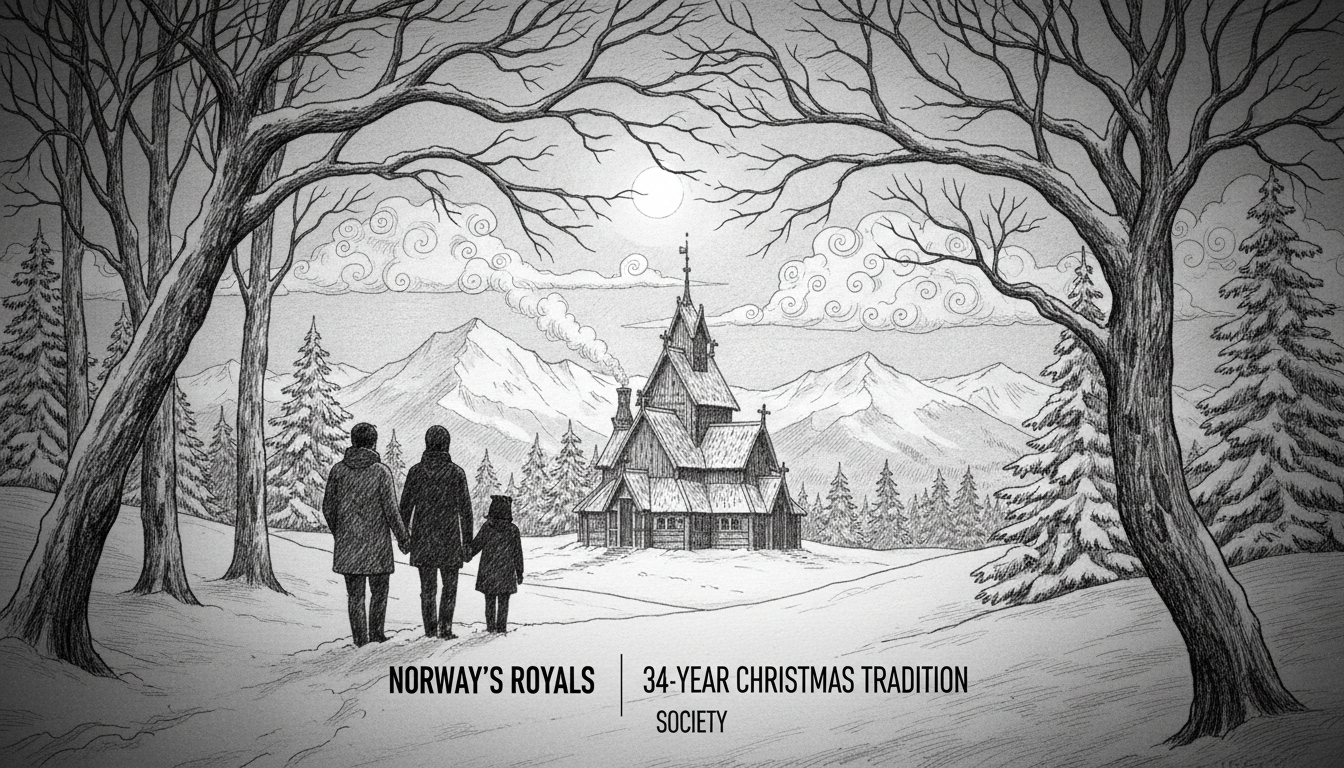
Norway's King Harald V and Queen Sonja attended a Christmas Day service at Holmenkollen Chapel in Oslo, continuing a personal tradition that has spanned the entirety of their 34-year reign. Their daughter, Princess Märtha Louise, and her partner, American self-help author Durek Verrett, also joined the congregation for the annual festive service. The event offered a public glimpse of family unity and royal tradition during a season that holds profound cultural significance in Norway.
Dressed in dark winter coats, the royal couple arrived at the distinctive wooden chapel under grey December skies. They greeted well-wishers and clergy before entering the building, which sits on the scenic Holmenkollen ridge overlooking the capital. The service itself was a traditional Norwegian julegudstjeneste, featuring Christmas hymns and a sermon focusing on peace and goodwill. This public appearance, one of the few scheduled during the holiday period, underscores the ceremonial role of the monarchy as a symbol of continuity.
A Chapel Steeped in National History
The choice of Holmenkollen Chapel is itself deeply symbolic. The original chapel, constructed in 1932, was a cherished Oslo landmark until it was destroyed by an arsonist's fire in 1992. Its reconstruction, completed in 1996, was a national project that resonated with the public. The current building faithfully replicates the original's rustic, pine-clad architecture, making it a poignant symbol of resilience and restoration. For the King and Queen, who have witnessed Norway's evolution over three decades, attending service here connects their personal faith to a narrative of national recovery and stability.
“The royal family’s participation in these fixed, annual traditions is incredibly important,” said a royal commentator based in Oslo. “It is not about politics or power. It is about providing a predictable rhythm to national life. In a world of constant change, seeing the King and Queen at the same chapel, for the same service, year after year, offers a deep sense of reassurance.” The commentator noted that such appearances reinforce the monarchy’s constitutional role as a unifying figure above the daily fray of political debate in the Storting.
Family Dynamics in the Public Eye
The presence of Princess Märtha Louise and Durek Verrett added a contemporary layer to the traditional event. The Princess, the eldest child of the monarchs, formally stepped back from her official royal duties in 2022 to focus on her commercial activities and life with Verrett. Her relationship with the controversial spiritual guide has been a subject of intense media scrutiny and public discussion, testing the modern boundaries of a traditional institution. Their attendance at a family-oriented Christmas service presents a picture of familial cohesion, despite the controversies that have sometimes surrounded them.
This visual of family togetherness is strategically significant. King Harald, who will turn 87 on February 21st, has faced serious health challenges in recent years, including heart surgery. Queen Sonja has been a constant pillar of support. The line of succession is clear, with Crown Prince Haakon next in line, but public events that include the wider family help solidify the monarchy's image as a durable institution capable of navigating modern complexities. The princess's decision to attend, alongside her partner, signals a private reconciliation of her personal path with her family's public obligations.
The Monarchy's Enduring Role in Norwegian Society
Analysts point to high public trust metrics for the Norwegian royal family as evidence that this model of a ceremonial, publicly accessible monarchy remains effective. King Harald’s own carefully crafted speeches on themes of inclusion and national identity, such as his powerful 2016 declaration that “Norway is you and me,” have cemented his personal popularity. The Christmas service is a non-verbal extension of that ethos—a demonstration of shared national values like family, tradition, and reflection. It contrasts with the more politically charged events that define the parliamentary calendar, offering a moment of apolitical unity.
The monarchy’s calendar is a tapestry of similar symbolic acts: Constitution Day celebrations on May 17th, the opening of the Storting, and national remembrance ceremonies. The Holmenkollen Christmas service is a quieter, more personal entry in that annual cycle. It connects the royal household to the private celebrations happening in homes across Norway, where church attendance on Christmas Day remains a common tradition, particularly in rural areas. By participating, the royals align themselves with the lived experience of their citizens.
Looking Ahead: Tradition in a Changing Nation
The longevity of this specific tradition—34 consecutive years—now covers a significant portion of modern Norwegian history. It began in the early post-Cold War era and has persisted through periods of immense economic change, driven by oil and gas wealth, and evolving social norms. The monarchy has adapted subtly during this time, becoming more openly expressive of modern Norwegian values while holding fast to its ceremonial core. The challenge for the institution, as Crown Prince Haakon prepares for his future role, will be to maintain this balance.
The serene image of the royal family at Christmas may seem detached from the pressing policy issues debated in government buildings just a few miles away, from energy policy in the Arctic to managing the nation’s sovereign wealth fund. Yet, supporters argue this separation is precisely its strength. In a fragmented media landscape, the monarchy provides a rare, shared cultural touchstone. The Christmas Day service, with its simple message of peace and its backdrop of a rebuilt national landmark, encapsulates that function perfectly. It is a brief pause, a moment of consistency before another year of inevitable change begins.