
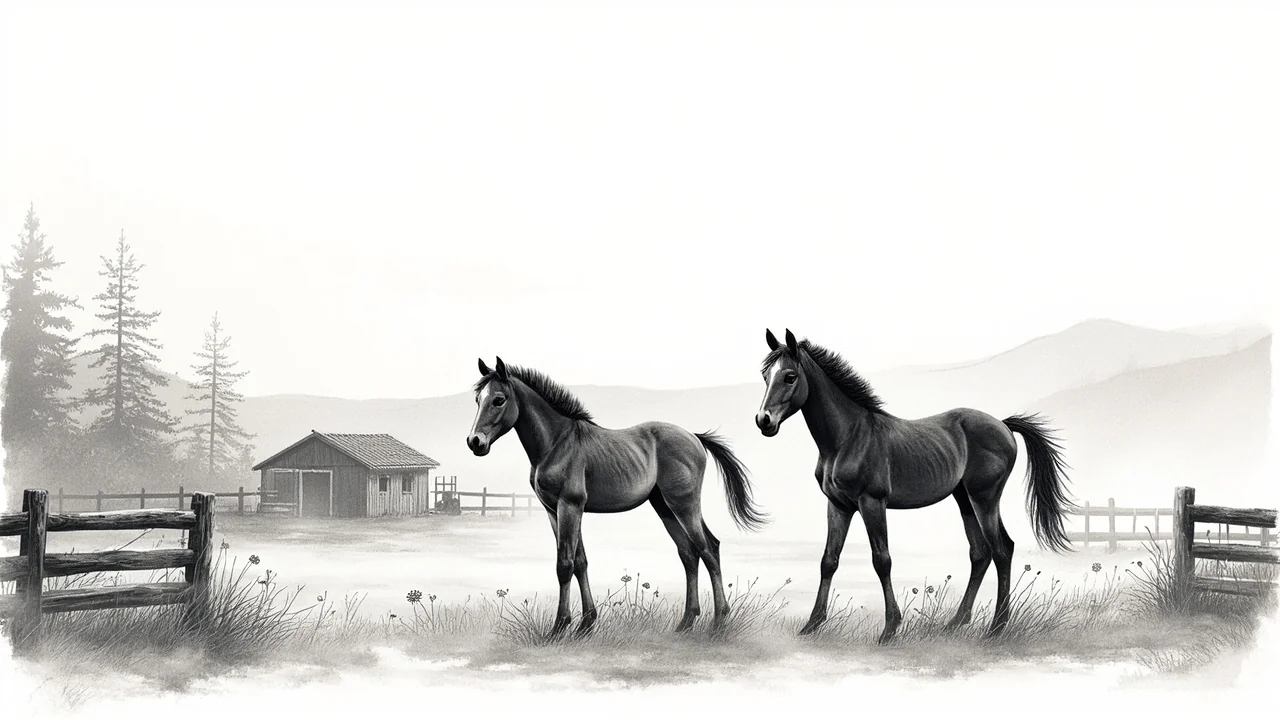
Norway's quiet Saturday evening in Moss was disrupted by two unexpected fugitives. Police received multiple reports around 6 PM of loose horses causing traffic trouble near the Rygge Storsenter shopping center. The foals, later identified as coming from the Bredsand area, were seen galloping towards the residential neighborhood of Øreåsen.
"They are running around and creating trouble in traffic," wrote operations manager Håkon Hatlen in the Øst police district's internal log. The search for the animals' owner began immediately. Within minutes, police confirmed they had spoken to the owner, who was en route to retrieve her wayward horses. The scene shifted from a busy commercial zone to a quiet suburban area, where the story took an unusual turn.
A Stable Refuge in Unstable Times
Approximately forty-five minutes after the initial alert, police provided an update with photographs. One of the young horses had sought and found an unlikely sanctuary: a local kindergarten on Øreåsen. The image of a foal standing calmly inside a fenced kindergarten playground, far from its pasture, captured national attention. It presented a stark contrast to the earlier reports of chaos on the roads.
"If anyone knows who owns the horses, it would be nice if the police are contacted," Hatlen added to the log, a standard procedure to confirm ownership and responsibility. The incident, while resolved without injury, highlights a recurring issue in Norwegian communities where urban and rural spaces meet. Loose livestock, though uncommon, presents real dangers on modern roadways.
The Broader Context of Animal Control
This event in Moss is not an isolated case in Norway. Every year, police districts, particularly in regions with significant agricultural activity bordering towns, handle incidents involving escaped farm animals. Cows, sheep, and horses can wander onto roads, creating significant hazards for motorists and risking serious injury to themselves. The Norwegian Food Safety Authority (Mattilsynet) and local municipalities enforce strict regulations on fencing and animal containment.
Owners are held financially and legally responsible for any damage or accidents caused by their animals. A horse or cow colliding with a vehicle can result in catastrophic outcomes. The quick response by Moss police to secure the area and locate the owner likely prevented such a scenario. Their use of official logs and public communication followed established protocols for managing non-criminal public safety incidents.
Analysis: When Country Life Meets City Limits
As a correspondent who typically analyzes parliamentary debates and energy policy, this incident offers a different lens on Norwegian society. It underscores the ongoing negotiation between Norway's deep-rooted agricultural traditions and its modern, urbanized infrastructure. Towns like Moss have expanded, bringing housing developments closer to farmland that has existed for generations.
This proximity can lead to friction. The sound of tractors early in the morning, the smell of manure fertilization, and occasionally, escaped animals, are realities for suburban dwellers. Most conflicts are resolved amicably through long-established community ties and a general Norwegian ethos of practical problem-solving. The police role is often that of a mediator and facilitator in these situations, rather than an enforcer of punitive measures, unless negligence is proven.
The choice of refuge by the foal—a kindergarten—is symbolically rich. Kindergartens in Norway represent safety, care, and community. They are fenced, secure environments for the nation's youngest citizens. That a frightened animal instinctively sought out such a place resonates with a public that values both its connection to nature and its meticulously organized society. The event, while minor, touches on deeper themes of belonging and security.
Legal and Practical Implications for Owners
From a legal standpoint, the owner of the horses in Moss faces potential consequences. Under Norwegian law, specifically the Animal Welfare Act and road traffic regulations, owners must ensure their livestock cannot access public roads. Failure to do so can result in fines. If the animals had caused a traffic accident, the owner could be liable for extensive damages under the principles of negligence.
Practically, the incident serves as a reminder to all animal owners to regularly check fence lines, gates, and enclosures, especially during seasonal changes when animals may be more restless or when ground conditions can weaken fencing. The police did not indicate any suspicion of intentional release, suggesting a simple failure of a gate or fence. The owner's prompt cooperation in retrieving the animals is a mitigating factor that authorities will consider.
A Peaceful Resolution and Community Response
Ultimately, the story of the runaway horses ended peacefully. The owner arrived at the kindergarten and safely retrieved both foals. No children were present at the time, as the incident occurred on a Saturday evening. No property damage was reported beyond the initial traffic disruption. The kindergarten playground, designed for children's play, was unharmed by its four-legged visitor.
The community reaction online and in local conversation was largely one of amusement and relief. The inherent innocence of the situation—young animals lost and seeking shelter—prevented any real outrage. In a news cycle often dominated by political strife and international crises, a tale of foals finding temporary shelter in a playground provided a moment of levity. It is a uniquely Norwegian problem: not a crisis of state, but a manageable incident handled with efficiency and a touch of whimsy.
Reflections on a Quaint Disturbance
This episode in Moss will soon fade from public memory, a minor entry in a police log. Yet, it encapsulates a certain Norwegian reality. It demonstrates the high level of public trust in authorities, where citizens promptly report loose horses as a civic duty. It shows the integrated nature of police work, which encompasses everything from major crime to herding livestock. Finally, it reflects a society where such an event is noteworthy precisely because it is out of the ordinary, a reminder of the rural heartbeat that still pulses close to the surface of even suburban life.
As Norway continues to debate its future—in the Storting over oil licenses, in boardrooms over renewable energy investments—life in its towns and cities continues with its own rhythm. Sometimes, that rhythm is interrupted by the clip-clop of hooves on asphalt, a brief and charming anachronism that prompts a smile and a sigh of relief when it ends safely. The question it leaves us with is how long such pastoral interruptions can persist as the country's landscape and demographics continue to evolve. For one Saturday in Moss, at least, the countryside paid a brief, unforgettable visit to the town.