
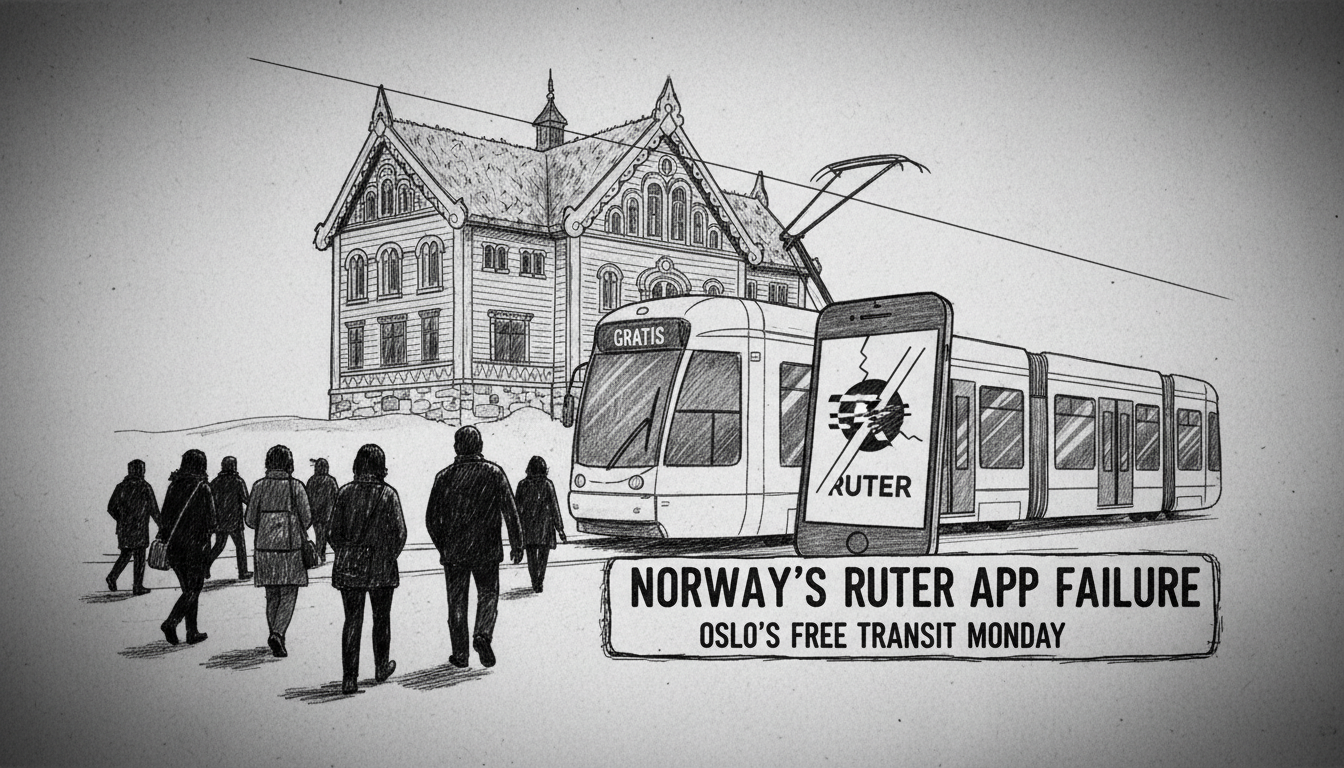
Norway's Ruter app crashed on Monday morning. The failure of Oslo's primary public transport ticketing platform meant thousands of passengers could travel for free. The widespread outage lasted for several hours during the morning commute. It exposed the vulnerabilities of a transit system now overwhelmingly dependent on a single digital tool.
For commuters, the immediate effect was simple: no tickets, no fines. The app's complete failure to process payments or display valid tickets meant conductors and inspectors had no way to verify fares. Social media filled with reports of free rides on buses, trams, and the T-bane metro. While some regular users saw it as a lucky break, the incident sparked immediate concern among technology and transit analysts. They questioned the resilience of a system where 70% of all tickets are purchased digitally.
A Single Point of Failure
The Ruter app is not just a convenience; it is the backbone of modern transit access in the Norwegian capital region. Ruter serves roughly 390 million passenger journeys annually across a vast 4,800 square kilometer network. The authority's own data shows digital channels, primarily its app, account for approximately 70% of all ticket sales. This heavy reliance turned a software glitch into a systemic transport event. The outage halted digital ticket sales and invalidated pre-purchased mobile tickets during the failure window.
“This incident is a stark reminder of the fragility of digital-first infrastructure,” said a technology resilience consultant who has worked with Nordic transport agencies. “When you channel the majority of your transactions through one application, its failure isn't an inconvenience. It becomes a critical service breakdown with direct financial and operational consequences.” Ruter has not disclosed the estimated revenue loss from the hours-long outage.
The Push for a Digital-Only Future
The outage presents a paradox for Ruter and Oslo's vision of a seamless smart city. Ruter has ambitious goals, including operating a fully electric, emission-free public transport system by 2028. Digital integration is a key part of this green and efficient future. The app reduces paper waste, streamlines operations, and provides valuable data on travel patterns. However, Monday's failure highlights the risk of moving too fast without adequate safeguards.
Customer tolerance for such disruptions may be limited. In 2023, Ruter's customer satisfaction score was 75 out of 100. Incidents like the app crash directly threaten that score. For passengers, the lack of a reliable offline fallback—such as widespread availability of physical tickets or contactless bank card tapping at all gates—creates anxiety. “What if my phone battery dies? What if there’s no signal? Now we can ask, what if the app itself fails?” said one commuter at the Nationaltheatret station. “You’re just stuck.”
Expert Calls for Redundancy and Resilience
Transit technology experts argue the solution isn't to abandon digital tools, but to build smarter, more resilient systems. “The lesson here is redundancy,” said a professor of urban mobility at a Norwegian university. “A robust system needs multiple, parallel paths for a passenger to validate a fare. The app can be the primary method, but it cannot be the only method. Physical ticket machines, contactless credit card payments at all validators, and even SMS ticketing for basic phones provide crucial backup layers.”
This approach is common in other major European cities, where contactless bank card payments often function as a universal, app-independent backup. While Oslo's system is advanced, its dependence on a proprietary app creates a unique vulnerability. The incident also raises questions about crisis communication. During the outage, information was scattered across social media and word-of-mouth, with no immediate, system-wide announcement to all passengers about the ticketing hiatus.
The Broader Nordic Tech Dilemma
The Ruter app failure is a microcosm of a broader challenge facing the Nordic region. Norway and its neighbors are global leaders in digital adoption and cashless societies. This brings immense efficiency but also concentrates risk. From banking to transit to public services, a digital outage can freeze everyday life. For a tech hub like Oslo, which promotes itself as a center of innovation, such events are a reputational sting. They underscore that software, at its core, is fallible and requires physical-world contingency plans.
Norwegian tech startups in the mobility sector are watching closely. Many are building solutions on top of or in competition with public infrastructure APIs. “Stability and trust are everything,” said the CTO of an Oslo-based mobility-as-a-service startup. “If the foundational digital infrastructure provided by public authorities is seen as unstable, it hinders the entire ecosystem. It makes consumers wary of adopting new digital services, even from private companies.”
Looking Ahead: A Test for Ruter's Response
Ruter's next steps will be closely monitored. The authority has stated it is investigating the root cause of the crash. The true test will be in the action plan it develops. Will it invest in bolstering the app's backend stability alone? Or will it diversify the ticketing portfolio, ensuring that a software crash never again means a total collapse of fare collection? Implementing widespread contactless bank card payments across the entire network would be a significant but logical step toward resilience.
The incident also serves as a case study for other Norwegian and Scandinavian cities undergoing digital transformation. Bergen, Trondheim, and Stockholm all have similar digital dependencies. Oslo's trouble provides a valuable, if unwelcome, lesson for them all. It proves that in the race toward a fully digital future, building a reliable escape hatch back to the analog world is not a sign of low ambition. It is a mark of responsible engineering and thoughtful service design.
As Oslo continues its journey to become a greener, more connected city, the balance between innovation and reliability will be crucial. The goal of a fully electric transit fleet by 2028 is groundbreaking. But for the public, a dependable ride every single morning is what builds lasting trust. Monday's free rides were a short-term gift for commuters, but they came at a high cost to the system's perceived reliability. How Ruter responds will determine whether this event is remembered as a minor glitch or a pivotal moment that reshaped Oslo's approach to digital transit.
Will Norway's love affair with digital efficiency now include a stronger commitment to analog backup? The answer will define the resilience of its smart cities for years to come.