
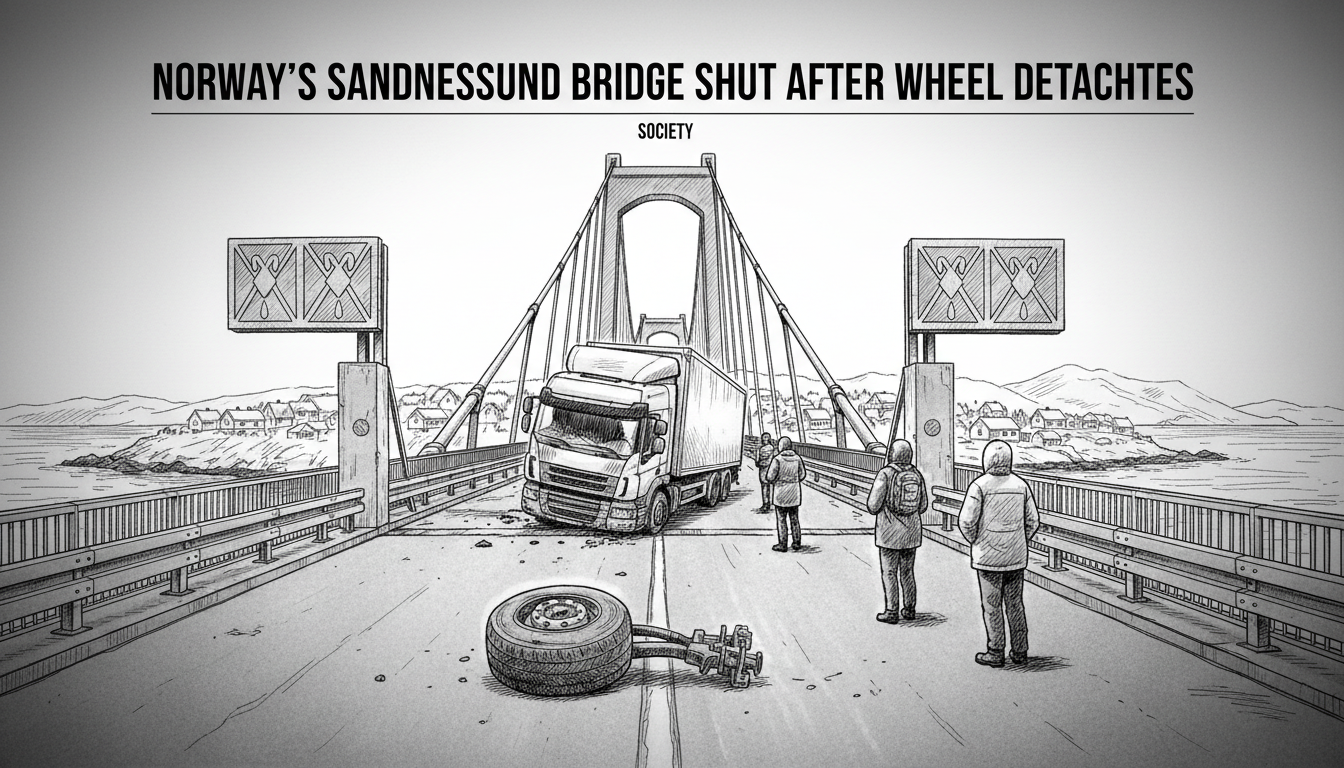
Norway's critical Sandnessund Bridge connecting Tromsøya and Kvaløya was shut for hours after a minibus lost a wheel, striking two other vehicles. The incident on the 1,220-meter suspension bridge caused significant material damage but, remarkably, no injuries. Police worked urgently to reopen the vital transport link, highlighting the fragility of Arctic infrastructure.
A Narrow Escape on a Northern Artery
Emergency services responded to the Sandnessund Bridge (Sandnessundbrua) following reports of a detached wheel from a minibus. The loose wheel collided with two other vehicles traversing the bridge during the incident. Police logs confirmed officers were on scene immediately, prioritizing reopening the route. "Police are on site. Working to open the bridge as soon as possible," authorities stated in their initial report. The swift closure and response prevented any physical injuries, a fact police later confirmed. The focus then shifted to assessing the structural and material damage caused by the uncontrolled projectile on the confined bridge deck.
This was not a minor disruption. The Sandnessund Bridge, opened in 1974, is one of two primary road links between the island of Tromsøya—home to the city of Tromsø—and the larger island of Kvaløya. Its closure effectively severs a major artery for commuters, businesses, and services. Over 10,000 vehicles cross this bridge on an average day, traveling between homes, the city center, Tromsø Airport, and industrial areas. An unplanned closure creates immediate and costly congestion on alternative routes, underscoring the region's dependence on just a few critical infrastructures.
The Economic and Logistical Ripple Effect
While the wheel detachment was a mechanical failure, its location turned it into a major logistical event. Accidents on bridges, especially long-span suspension bridges like the Sandnessund, have disproportionate consequences. There are no shoulders for easy recovery, limited diversion points, and the potential for secondary collisions is high. The closure triggers a cascade of delays. Public transport buses are rerouted, freight deliveries are stalled, and access to key facilities is compromised.
For the local economy, every hour of closure has a tangible cost. The Tromsø region is a hub for Arctic tourism, fisheries, and research. Delays in transporting goods, from fresh seafood to critical supplies for research stations, translate into financial losses. Furthermore, the incident raises indirect questions about maintenance regimes for both public infrastructure and commercial vehicle fleets operating in harsh northern climates. The extreme weather of Northern Norway, with its salt, humidity, and freeze-thaw cycles, places exceptional strain on both bridges and vehicles, potentially accelerating wear on components.
Expert Perspective on Infrastructure Vulnerability
Transportation engineers note that incidents involving detached parts are particularly dangerous on bridges. "A bridge is a constrained environment," explains a Norwegian road authority consultant familiar with Arctic infrastructure. "There is minimal space for evasive action, and debris cannot easily leave the roadway. What might be a minor incident on an open highway becomes a major hazard on a bridge, often resulting in a full closure for safety investigations and cleanup."
The Sandnessund Bridge, while not old by modern engineering standards, is approaching its 50th year of service. It was designed for the traffic volumes and vehicle weights of the 1970s. While undoubtedly maintained and assessed regularly, its age invites scrutiny of its resilience to both increasing traffic and the cumulative effects of the Arctic environment. This event will likely prompt reviews by both the Norwegian Public Roads Administration (Statens vegvesen) and local police regarding heavy vehicle checks and bridge incident response protocols.
A History of Connecting Communities
To understand the bridge's importance, one must look at its history. Before the Sandnessund Bridge opened, the connection between Tromsøya and Kvaløya relied on ferries. The bridge's construction in 1974 was a transformative project for regional development, enabling the expansion of residential areas on Kvaløya and solidifying Tromsø's position as the unofficial capital of Arctic Norway. Its 417-meter main span was a significant engineering achievement for its time in northern Norway.
The bridge is more than concrete and steel; it is a sociocultural link. It binds the urban center of Tromsø with the more suburban and rural communities on Kvaløya, facilitating daily life for tens of thousands. Its iconic presence in the Tromsø sound is a fixture of the local landscape. Therefore, any threat to its operability is felt acutely across the community, reminding residents of their geographical constraints and the engineered solutions that overcome them.
Looking Ahead: Safety and Resilience
The incident concluded with the road being reopened and the case reported for further investigation. The police will typically examine whether the minibus had valid roadworthiness certificates (EU-kontroll) and if negligent maintenance played a role. The vehicle owner or operator could face fines or liability for the damages caused.
On a systemic level, this event feeds into an ongoing national conversation in Norway about infrastructure maintenance. The country's challenging geography, with its countless fjords, islands, and mountains, necessitates an extensive network of bridges, tunnels, and ferries. Maintaining this network, particularly in the north, is a perpetual and costly challenge. Climate change introduces new variables, with more frequent freeze-thaw cycles and extreme weather events potentially stressing aging infrastructure.
The Sandnessund Bridge accident, though resolved without injury, serves as a stark reminder. It highlights how a single mechanical failure can immobilize a key transport node, with economic and safety ramifications far beyond the immediate scene. It reinforces the need for rigorous vehicle maintenance standards and proactive, well-funded infrastructure stewardship—especially in remote regions where alternatives are few. As Norway continues to develop its northern territories and the Arctic gains geopolitical significance, the reliability of such lifelines becomes not just a local concern, but a matter of national interest. Will this near-miss prompt a renewed focus on the inspection and hardening of Norway's critical northern bridges? The answer will determine the resilience of Arctic communities for decades to come.