
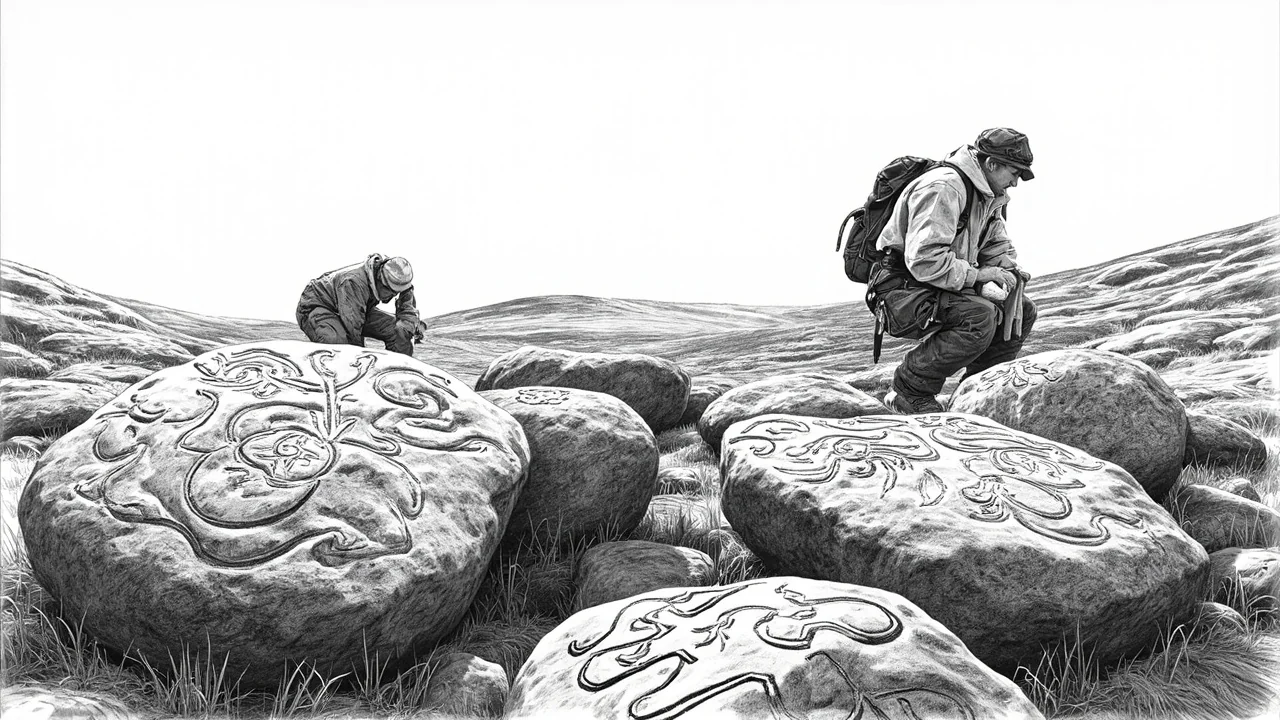
Norwegian archaeologists are using smartphone apps to uncover a hidden world of ancient rock art. The technology reveals faint paintings invisible to the naked eye, leading to over a thousand new discoveries kept secret to protect them. This digital revolution is transforming our understanding of prehistoric Scandinavia.
Senior researcher Jan Magne Gjerde spotted a faint red streak on granite while surveying a remote landscape. To an untrained eye, it looked like natural discoloration. Gjerde pulled out his phone and opened a specialized color-enhancing application. The screen displayed a clear, deliberate painting—a reindeer or an elk—hidden for millennia. "It tingles through your whole body," Gjerde said, describing the moment of discovery. "You are the first to see it after someone found it worthy to paint onto the rock thousands of years ago."
This scene repeats across Norway. Archaeologists from the Norwegian Institute for Cultural Heritage Research (NIKU) are finding ancient art at an unprecedented rate. The discoveries are so numerous and vulnerable that their exact locations are a closely guarded secret. The policy aims to prevent vandalism and unauthorized visits that could damage the fragile sites.
A Digital Archaeology Revolution
The key tool is not a traditional brush or trowel, but a smartphone. Archaeologists use readily available photo-editing apps or custom software to manipulate images in the field. They adjust contrast, saturation, and color channels. This process brings forth pigments that have faded to near-invisibility over centuries. Red ochre, a common prehistoric paint, becomes vividly clear on a phone screen long before it is discernible to someone standing at the site.
This method represents a significant shift in fieldwork. "We are essentially giving ourselves digital super-vision," explained a NIKU field technician. "What would take days of careful examination in different lights, we can now assess in minutes." The technology allows teams to survey larger areas more efficiently. They can photograph rock surfaces and review the enhanced images later, prioritizing potential sites for detailed documentation. This efficiency is crucial in Norway's vast and rugged terrain.
The Scale of Secrecy
The sheer volume of new finds necessitates confidentiality. While major, stable sites like the Alta rock art in Finnmark are World Heritage Sites and publicly known, these new discoveries are different. They are often isolated, single figures or small groups painted on exposed rock faces. They lack physical protection. Publishing coordinates or detailed directions would expose them to immediate risk.
"Our primary duty is preservation," stated a NIKU department head. "Documentation is vital, but it is meaningless if the artifact is destroyed. Secrecy, for now, is our most effective conservation tool." The locations are recorded in secure, non-public databases. Only accredited researchers with specific conservation goals are granted access. This protocol balances the advancement of knowledge with the practical need to protect a non-renewable cultural resource.
Local heritage authorities in counties like Nordland and Troms confirm the trend. They report a dramatic increase in reported and documented sites over the past five years, directly correlating with the adoption of digital enhancement techniques. The discoveries are not confined to one region. They span from the southern coasts to the far north, suggesting a more widespread and continuous practice of rock painting than previously mapped.
What the Art Reveals
The newly revealed art provides fresh data on prehistoric life in Northern Europe. The motifs are familiar—reindeer, elk, bears, human figures, geometric patterns, and boats. Their importance lies in their distribution and context. Finding similar artistic conventions across vast distances helps archaeologists trace communication networks and cultural connections among ancient hunter-gatherer societies.
"Each new panel is a sentence in a story we are still learning to read," said Gjerde. The placement of the art is also telling. Many new finds are located near ancient shorelines or along inferred migration routes for animals. This positions the art as more than decoration. It likely served as territorial markers, ritual sites, or hunting-related symbolism. The act of painting in a specific, often dramatic landscape location was as significant as the image itself.
The technology also allows for new analysis of known sites. By applying digital filters, researchers can detect earlier, overlaid paintings or identify the work of individual artists based on stroke patterns. This can help establish a chronology for sites used over generations.
The Ethical Digital Dilemma
The success of this digital method presents an ethical challenge. Public interest in archaeology is high, and there is a natural desire to share breakthroughs. However, full transparency could be catastrophic for the artifacts. The institute faces a dilemma: how to disseminate knowledge without enabling damage.
Their current strategy involves sharing the "what" but not the "where." They publish analyses, discuss the types of figures found, and explain the technological methods. They release generalized regional maps without pinpoint accuracy. The goal is to engage the public in the narrative and scientific value of the finds while physically safeguarding them. This approach is debated within the heritage community. Some argue for greater openness to foster public stewardship, while others insist on strict secrecy as the only viable option.
There are also technical debates. Some purists caution against over-reliance on digital enhancement, warning it could lead to false positives or misinterpretations of natural stains. The standard practice now requires that any digitally identified figure must be cautiously verified through traditional visual inspection under optimal lighting conditions before final confirmation.
The Future of Hidden History
The next phase involves more than discovery. Photogrammetry and 3D laser scanning are being used to create millimeter-accurate digital models of the new sites. These models are invaluable. They provide a permanent record that can be studied remotely by international experts. They can also monitor minute changes in the rock surface over time, tracking erosion or potential vandalism.
These digital twins could eventually form the basis of virtual public access. Imagine exploring a precise 3D reconstruction of a secret rock art site from your home. This technology offers a potential future path where conservation and education are not mutually exclusive. The physical site remains protected and unknown, while its digital replica can be shared globally.
The work in Norway underscores a global shift in archaeology. Technology is not just for analysis in a lab. It is now a primary field tool that expands human perception. It allows researchers to see the unseen, revealing messages from the past that were meant to endure but have been worn thin by time. The silent granite landscapes of Norway, it turns out, are vast outdoor galleries. Their exhibition is only now beginning, viewed through the lens of a smartphone screen, one enhanced color at a time. The greatest challenge may no longer be finding history, but deciding how to keep it safe once it's found.