
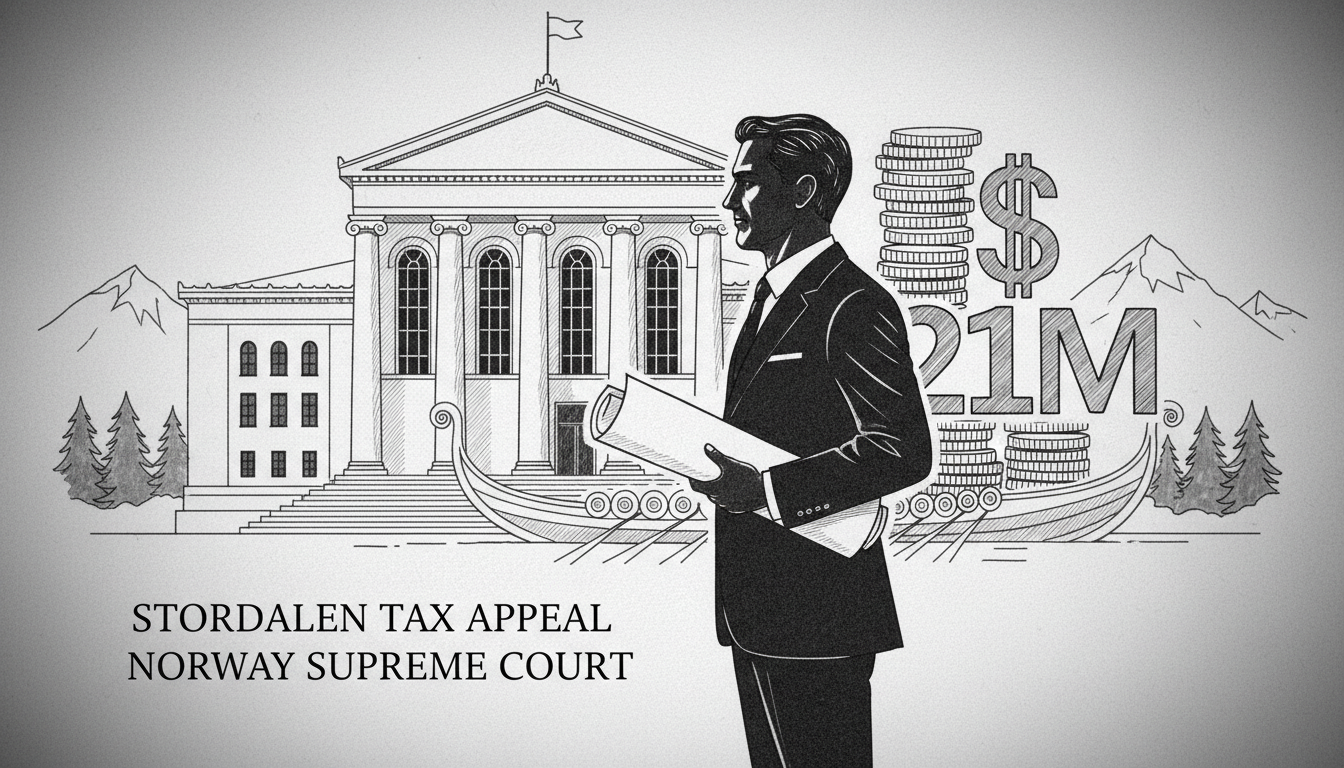
Norway's billionaire hotel magnate Petter Stordalen is taking his fight against a 230 million kroner ($21 million) tax claim to the country's highest court. The appeal follows consecutive losses in both the Oslo District Court and the Borgarting Court of Appeal. The case centers on the taxation of 795 million kroner in dividends Stordalen withdrew from his property company Oslo Properties, now Strawberry Fields, following its acquisition in 2013.
A High-Stakes Legal Battle Over Dividends
The Supreme Court's decision to hear the case places a spotlight on Norway's complex rules governing dividend taxation for major shareholders. Stordalen's legal team argues the tax assessment is incorrect, while the Norwegian Tax Administration maintains its position is firmly grounded in law. A Supreme Court ruling could establish a binding precedent for how similar transactions are treated, affecting other high-net-worth individuals and corporate structures across the Nordic region.
"This is not just about one individual's tax bill," said tax law professor Henrik Aarbu from the Norwegian School of Economics. "The Supreme Court's interpretation could clarify the boundaries of dividend taxation versus capital gains, a distinction with significant financial consequences. It touches on fundamental principles of how investment and ownership are taxed in Norway."
The core dispute involves the characterization of funds extracted from Oslo Properties. The state contends the 795 million kroner constitutes taxable dividends. Stordalen's position, which has so far failed to convince two lower courts, likely involves alternative interpretations, potentially arguing the sums represented a return of capital or were part of a broader corporate restructuring.
The Broader Context of Norwegian Wealth Taxation
This legal challenge arrives amid ongoing political debate about wealth, inequality, and tax fairness in Norway. The country maintains a progressive tax system with a wealth tax, but the taxation of capital income versus wage income remains a perennial topic. Dividends are typically taxed at a flat rate, but specific circumstances, such as the size of the holding and the company's financial history, can trigger different assessments.
Financial analysts are watching the case closely. "For international investors looking at Norway, clarity and predictability in tax law are crucial," noted senior analyst Kari Larsen at DNB Markets. "A definitive ruling from the Supreme Court reduces uncertainty. Whether it is seen as favorable to investors or as reinforcing strict enforcement will depend on the verdict's wording."
The case also highlights the resources required to pursue multi-year litigation through all three judicial tiers. The costs, both legal and in deferred tax payments, are substantial. This path is generally only viable for claims involving very large sums, making such Supreme Court cases rare but highly influential bellwethers for tax policy application.
Implications for Corporate Strategy and Ownership
Beyond the immediate tax liability, the outcome may influence how Norwegian entrepreneurs and investors structure their holdings. The distinction between active business income, capital gains, and dividends can dictate corporate decisions on profit distribution, reinvestment, and sale. A ruling that broadens the definition of taxable dividends could lead to more conservative financial strategies among closely-held companies.
The company at the heart of the case, Strawberry Fields (formerly Oslo Properties), is a key part of Stordalen's Strawberry Group empire. The group controls a vast portfolio of hotels across the Nordics, including the Clarion, Comfort, and Quality brands. The group's property holdings, often held in separate entities like Strawberry Fields, are fundamental to its operational and financial model.
Tax authorities globally are increasingly scrutinizing the movements of capital within corporate groups owned by wealthy individuals. The Norwegian Tax Administration has invested in specialized audit units focused on large taxpayers and complex structures. This case represents a test of their interpretation and enforcement approach.
What the Supreme Court Must Decide
The Supreme Court accepts only a small fraction of the appeals it receives, typically selecting cases that involve novel legal questions, significant public interest, or conflicting lower court judgments. Its acceptance of Stordalen's appeal indicates the justices have identified a legal principle requiring national clarification.
The court will not re-try the factual evidence. Instead, it will examine whether the lower courts correctly applied the law. The justices will analyze sections of the Norwegian Tax Act concerning income from capital and dividends, potentially reviewing legislative history and the intent behind the rules.
"The legal technicalities are complex, but the underlying question is straightforward," explained Professor Aarbu. "When does a distribution from a company cease to be a return on investment and become a taxable event for the shareholder? The line isn't always clear, especially in transactions following an acquisition."
A ruling in favor of the state would affirm the current enforcement stance and likely conclude the matter for Stordalen, barring an appeal to the European Court of Human Rights on procedural grounds, a lengthy and uncertain path. A ruling in Stordalen's favor would overturn the prior decisions and force a recalculation of his tax liability, possibly with implications for others in similar situations.
A Final Verdict with National Resonance
The Supreme Court's deliberation comes at a time of heightened scrutiny on wealth and contribution. While Norway's oil fund has created vast national wealth, discussions about individual fortunes and their tax treatment remain sensitive. The court's ruling will be dissected not just by tax lawyers and accountants, but by politicians and the public.
The final decision, expected in several months, will provide legal certainty but may not settle the political debate. Regardless of the outcome, the case underscores the intricate dance between private capital formation and public revenue collection in one of the world's most prosperous economies. For Petter Stordalen, the stakes are a personal tax bill of nearly a quarter-billion kroner. For Norway, the stakes are a precedent that will shape the landscape of investment and taxation for years to come.
Will the Supreme Court draw a definitive line in the sand, or will the interpretation of dividend wealth remain a contested frontier? The justices now hold the answer.