
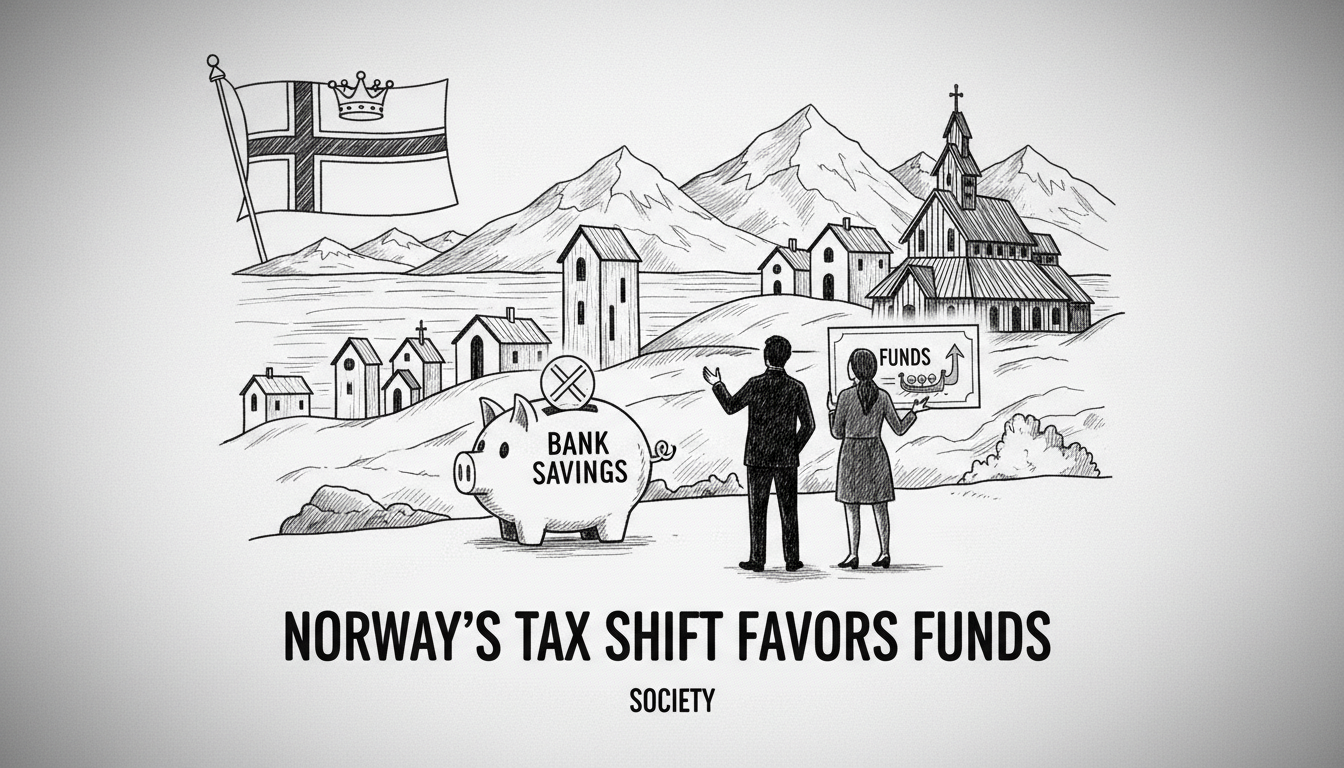
Norway's new 2026 tax policy is poised to redefine personal finance, creating a direct competitor to the traditional savings account. The change makes low-risk liquidity funds significantly more attractive by altering when tax is paid. This shift capitalizes on compound interest effects and could redirect billions of kroner from bank vaults into the capital markets. As of October, Norwegian households held 1540 billion NOK in non-term savings and current accounts, according to Statistics Norway data. The average interest rate on those accounts was 2.8 percent. Meanwhile, data from the comparison site Finansportalen indicates that over time, the lowest-risk liquidity funds have offered returns close to 5%. The gap between these figures is the central battleground in a quiet revolution for Norwegian savers.
The Mechanics of a Tax Advantage
Starting January 1, 2026, the Norwegian government will implement a crucial tax change for bond funds. Currently, tax on interest income from these funds is levied annually, even if the investor hasn't sold their holdings. The new rule defers this tax liability until the investor sells the fund units. This technical adjustment delivers two powerful benefits. First, it allows the untaxed returns to compound over time, a powerful effect known as interest-on-interest. Second, it can result in a lower effective tax rate over the long term, as the tax is paid later. This fundamentally alters the math for conservative savers. Investment director Robert Næss at Nordea is clear on the impact. "Yes, I absolutely think so. This is an opportunity to get a slightly higher return," he said regarding bond funds becoming a viable alternative to bank savings.
Liquidity Funds: The New Savings Account?
The primary beneficiary of this rule change is the liquidity fund, known in Norwegian as 'likviditetsfond'. These are bond funds with the lowest possible risk rating, typically a 1 on a scale of 1 to 7. They invest in high-quality, short-term debt from banks and other financial institutions, offering stability similar to a savings account but with a different risk profile. "In practice, we assume there is no risk with liquidity funds," Næss explained, noting their composition of bank loans with guarantees. Their historical performance, nearing 5% returns, presents a compelling case against the average savings account rate. However, they are not a perfect clone. Withdrawals take several business days to process, unlike the instant access of a standard savings account. Crucially, they are not covered by the Banks' Guarantee Fund, which protects up to 2 million NOK per depositor per bank. This trade-off between yield, access, and security is at the heart of the decision for every saver.
Digital Tools and the Informed Saver
This policy shift arrives amid a broader digital transformation of Norway's financial landscape. The Norwegian Consumer Council recommends using Finansportalen to compare interest rates and fees before investing. This online portal is part of a suite of digital tools empowering consumers to make smarter financial choices, a trend accelerated by Oslo's growing fintech hub. The move towards fund-based saving also aligns with a national push for greater financial literacy and investment diversification. While equity funds remain the standard recommendation for long-term horizons, liquidity funds now offer a middle ground for medium-term savings or emergency funds where higher returns are desired with minimal volatility. Savers must be diligent about management fees, which can erode the interest rate advantage, making comparison platforms essential.
A Broader Trend in Nordic Savings
Norway's tax adjustment reflects a larger Nordic trend of modernizing savings infrastructure to improve capital allocation. With vast sums sitting in low-yield accounts, governments and financial innovators see an opportunity. The change incentivizes moving capital into funds that can finance business and infrastructure projects, potentially boosting economic dynamism. It also places more responsibility on individuals to navigate their options. For the average person, the choice is no longer simply between banks but between different financial products with varying structures. This evolution mirrors developments in neighboring Sweden and Denmark, where fund-based savings and investment apps have gained substantial traction. The policy effectively uses the tax code to nudge citizens towards investment vehicles that historically offered better inflation-adjusted returns than deposit accounts.
What Savers Should Do Now
Financial advisors suggest a measured approach. For funds not needed immediately, allocating a portion to low-cost liquidity funds from 2026 could enhance returns with controlled risk. It is critical to understand the fee structure, as even small annual charges impact net returns. Using Norway's digital comparison tools is a necessary first step. The Norwegian tech ecosystem, particularly in Oslo, continues to develop solutions that simplify this analysis, from robo-advisors to streamlined investment platforms. This tax change is not a recommendation to empty savings accounts, which still provide essential instant access and guarantee protection. Instead, it introduces a powerful new tool for the portion of savings earmarked for goals months or years in the future. The landscape of personal finance in Norway is becoming more nuanced, offering more choices and requiring more engagement from savers than ever before.
The Future of Norwegian Personal Finance
The 2026 tax rule is more than a minor adjustment; it is a signal. It signals a move towards a more market-oriented savings culture, supported by digital tools and clearer incentives. The ultimate success of this policy will be measured in whether it helps Norwegians preserve and grow their wealth more effectively in an era of economic uncertainty. Will the traditional savings account become a relic, or will it adapt? As tech startups in Oslo and beyond build simpler gateways to these funds, the barrier to entry will continue to fall. This shift represents a significant moment where tax policy, financial innovation, and consumer behavior intersect. The result will likely be a more diversified and potentially more resilient personal savings landscape for Norway.