
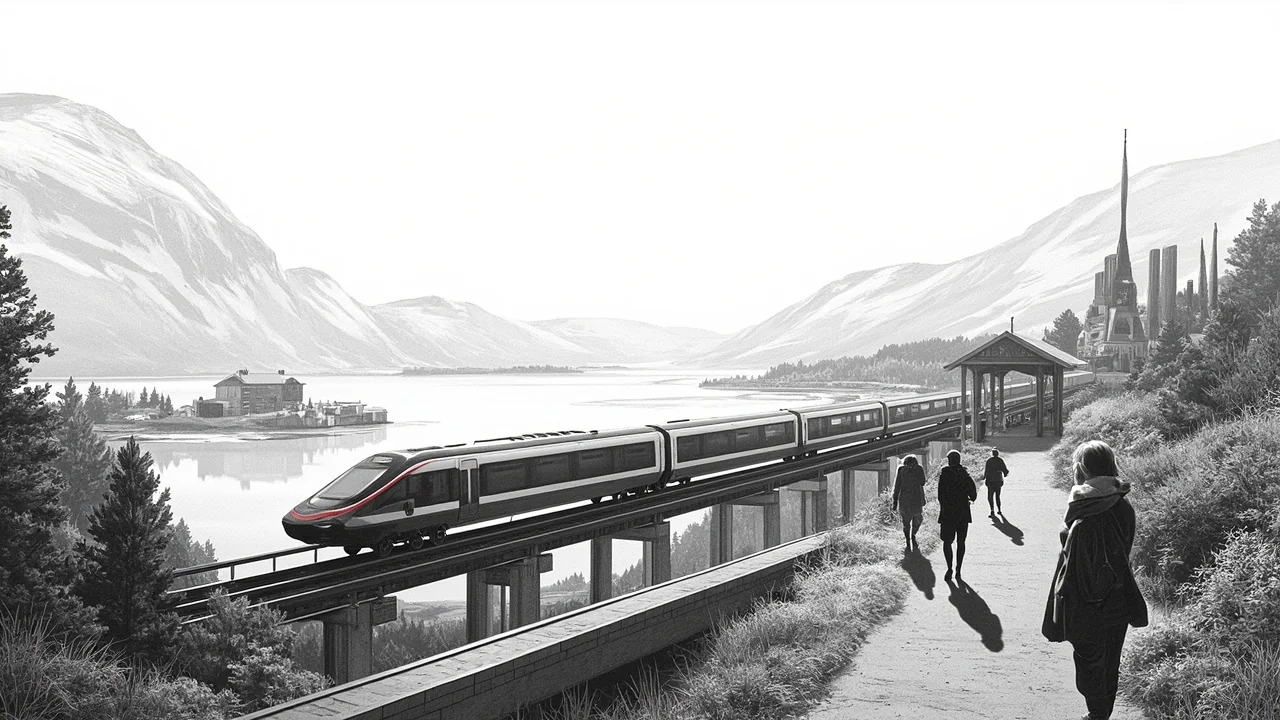
Norway's 10.2 billion kroner plan to quadruple train frequency on a critical commuter line is stalled, leaving thousands of passengers waiting another year for promised improvements. The ambitious upgrade from one to four trains per hour between Tønsberg and Oslo is postponed from December 2026 to December 2027 due to late-arriving rolling stock from manufacturer Alstom.
For the 12,000 daily commuters on the Vestfold Line, this delay represents another chapter in a long story of infrastructure promises and operational frustrations. The postponement strikes at the heart of the government's Intercity strategy, a flagship policy designed to shift transport from road to rail across Norway's busiest corridors.
"We would have liked to have a contract with Vy for four trains per hour starting this December, but the risk is too high that it won't work when we don't have enough trains in place," said acting railway director Marit Rønning in a statement. She emphasized that the agency is working on a phased solution: first implementing three trains per hour in 2027, then increasing to four by December of that same year.
A Domino Effect of Delays
The core problem lies with the French manufacturer Alstom. The company is supplying 36 local trains and 19 regional trains for the Norwegian network, which were already one year behind schedule. In autumn 2025, Alstom warned of further production delays adding another half year. This logistical bottleneck means the new double-track line, a massive construction project winding through the picturesque coastal landscape of Vestfold, will operate below its designed capacity for an extended period.
Rønning tried to strike an optimistic note for the future. "When we get them in place, travelers will get a significantly better train service, both in terms of punctuality, travel time, space on board, and the number of departures," she said. The railway directorate is now intensely focused on predictability. "We are very keen to be able to give passengers a predictable and reliable train service," Rønning assured.
Infrastructure Waiting for Technology
This delay highlights a recurring tension in major transport projects: shiny new infrastructure is useless without the vehicles to run on it. The state has already invested the colossal sum in building a new double track all the way to Tønsberg. This stretch is also the third in the country slated to use a new digital signaling system, which is itself scheduled for completion by the end of 2026.
The parallel delays create a complex puzzle. The digital system is meant to allow trains to run closer together, safely increasing capacity. Yet, even if the signaling is ready, the physical absence of the new Alstom trains makes the full service upgrade impossible. It forces authorities to explore stopgap measures, potentially using existing older rolling stock to offer a partial frequency increase in the interim.
Political and Economic Repercussions
From a political perspective, this setback is awkward for the government. The Intercity investment is a central pillar of Norway's climate and transport policy, aiming to make rail competitive with car travel for medium-distance journeys. The Tønsberg-Oslo corridor, serving a major regional city and numerous smaller communities along the Oslofjord, is a key test case. Repeated delays risk eroding public confidence in the state's ability to deliver large-scale transit projects.
Economically, the implications are significant. Reliable, frequent rail service is a catalyst for regional development. Businesses in Tønsberg and neighboring towns like Holmestrand and Skoppum count on efficient connections to the capital. Prolonged uncertainty about travel times and service quality can influence corporate location decisions and dampen growth in areas supposedly earmarked for a transport-led boost.
The Manufacturer's Role and National Strategy
The dependency on a single foreign manufacturer, Alstom, raises questions about supply chain resilience in national infrastructure planning. Norway's railway modernization is tethered to the production schedules and fortunes of a multinational corporation headquartered in Saint-Ouen, France. This incident may fuel ongoing debates about whether Norway should develop more domestic industrial capacity for specialized transport equipment, though the niche market makes this economically challenging.
Analysts point out that Norway's rolling stock renewal was long overdue, creating a "bow wave" of demand that the global market is struggling to meet. Many European countries are simultaneously upgrading their fleets, straining manufacturing capacity and leading to widespread delays. Norway's experience is not unique, but it is particularly acute on routes where infrastructure readiness and public expectation are high.
What Comes Next for Commuters
In the immediate term, the railway directorate's task is damage control. Their goal of introducing three trains per hour in 2027 as a stepping stone is a pragmatic, if disappointing, compromise. It requires careful operational planning to integrate the new timetable with existing services on the shared rail network approaching Oslo Central Station.
Passenger advocacy groups have expressed frustration, noting that punctuality issues on the line are already a daily headache. The promise of four modern, frequent trains was seen as the light at the end of the tunnel. Now, that light has been pushed a year further down the track.
The coming months will see intense scrutiny of Alstom's production milestones. Norwegian authorities will likely increase pressure and oversight to ensure no further slippage. Meanwhile, commuters on the Vestfold Line will continue packing into the existing service, watching the new, unused tracks beside them and waiting for the day the full promise of their 10.2 billion kroner investment finally rolls into the station. The delay is a stark reminder that in modern rail transport, breakthroughs in concrete and steel must be perfectly synchronized with advancements in manufacturing and delivery—a coordination that has, for now, been derailed.