
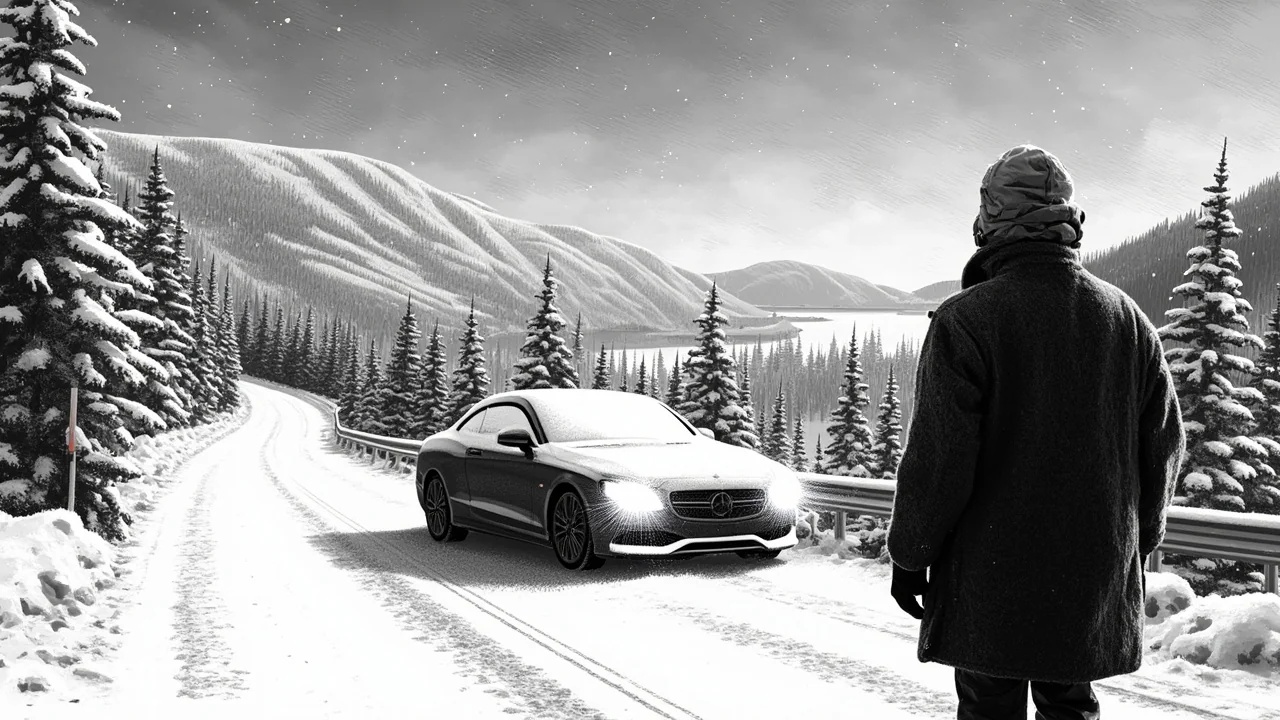
Norway's winter roads present a new technological hazard for drivers. Modern LED headlights, a standard feature on most new cars, do not generate enough heat to melt snow and ice. This creates dangerously obscured lights, a problem now being targeted by traffic authorities with fines up to 4000 NOK.
Roy Harald Holm, acting department director at the Norwegian Public Roads Administration, confirms the trend. "In our roadside checks, we inspect vehicle lights. In recent years, LED lights on cars and trailers have become common, which we see can create challenges," Holm said. He warns that obscured lights drastically reduce a vehicle's visibility to others, especially in poor weather, increasing the risk of collisions.
The Cold Truth About Modern Lights
Traditional halogen bulbs acted as miniature heaters. Their significant waste heat would quickly melt snow and ice from the lens cover after a short drive. This incidental benefit has disappeared with the shift to LED technology. Light-emitting diodes are highly efficient, producing bright white light while using minimal energy and generating almost no heat. This efficiency comes with a winter drawback: they are passive in the face of accumulating snow.
"Since LED lights do not emit heat, the snow that settles on them does not melt either. This can create dangerous situations in traffic," Holm explained. The problem affects both the driver of the vehicle and others on the road. For the driver, snow-covered front lights reduce the illuminated area of the road ahead. For other motorists, a car with its rear lights or brake lights obscured becomes a ghostly silhouette in snowstorms or twilight.
A Clear and Present Danger on Nordic Roads
The danger is particularly acute for vulnerable road users. "With snow and ice on the front lights, you will have reduced visibility and problems detecting especially soft road users along the way," Holm stated. Pedestrians, cyclists, and motorcyclists wearing dark clothing can vanish from a driver's view if the headlight beam is partially blocked. The issue is compounded by Norway's long periods of winter darkness, where functioning lights are not just a convenience but a critical safety requirement.
Jan Harry Svendsen from the Norwegian Automobile Federation (NAF) provides practical advice for drivers. His main tip is regular maintenance to prevent ice from bonding strongly to the lens. "Scrape gently and make sure to wash the lights regularly. Then the ice won't stick so easily," Svendsen advised. He also cautions against aggressive scraping, as modern headlight lenses are often made of polycarbonate plastic with a protective UV coating, not glass. Harsh scraping can cause micro-scratches that diffuse light and ironically make ice adhesion easier in the future.
The 4000 NOK Rule and Proactive Checks
The legal consequence for neglected lights is straightforward and costly. Driving with faulty lights, without mandatory lights illuminated, or without sufficient visibility can result in a simplified fine of 4000 kroner. Authorities are not just focusing on completely broken lights. A light that is functionally working but physically obscured by snow or ice falls under the "insufficient visibility" clause. This makes a simple snow brush a valuable tool for avoiding a substantial penalty.
Holm's recommendation to drivers is clear. "Remove the snow from the lights before you drive. If you are going to drive a long way, it is wise to take some breaks along the way to ensure that the lights on both the car and trailer are visible to other road users." For snow, a soft brush is sufficient. For ice, careful scraping or using a de-icing spray is recommended. The advice extends to trailers, which are often forgotten during pre-trip checks.
A Broader Lesson in Tech Adaptation
This situation highlights a broader theme in Norway's digital transformation and tech adoption. The country is a leader in adopting efficient technologies, from electric vehicles to smart city solutions. However, this case shows how a straightforward upgrade—replacing hot, energy-hungry bulbs with cool, efficient LEDs—can have unintended consequences in a specific environmental context. It represents a small but telling example of how innovation must be considered within the framework of local conditions, especially in a nation defined by its harsh climate.
Norwegian tech startups and innovation labs, particularly those in Oslo's growing tech districts, often focus on solving climate and energy challenges. This winter lighting issue is a real-world example of a problem where a tech solution created a new practical challenge. It invites consideration for future automotive design—perhaps integrating gentle heating elements specifically for lens de-icing, or developing new hydrophobic lens coatings that repel snow and ice.
For now, the solution remains manual and low-tech. It serves as an annual winter reminder that advanced technology does not absolve users of basic maintenance and situational awareness. As Nordic technology trends push towards greater efficiency and automation, the human element—the driver with a snow brush—remains irreplaceable for safety. The 4000 NOK fine is a sharp incentive to remember that even the most advanced car is subject to the oldest of Norwegian laws: the law of winter.