
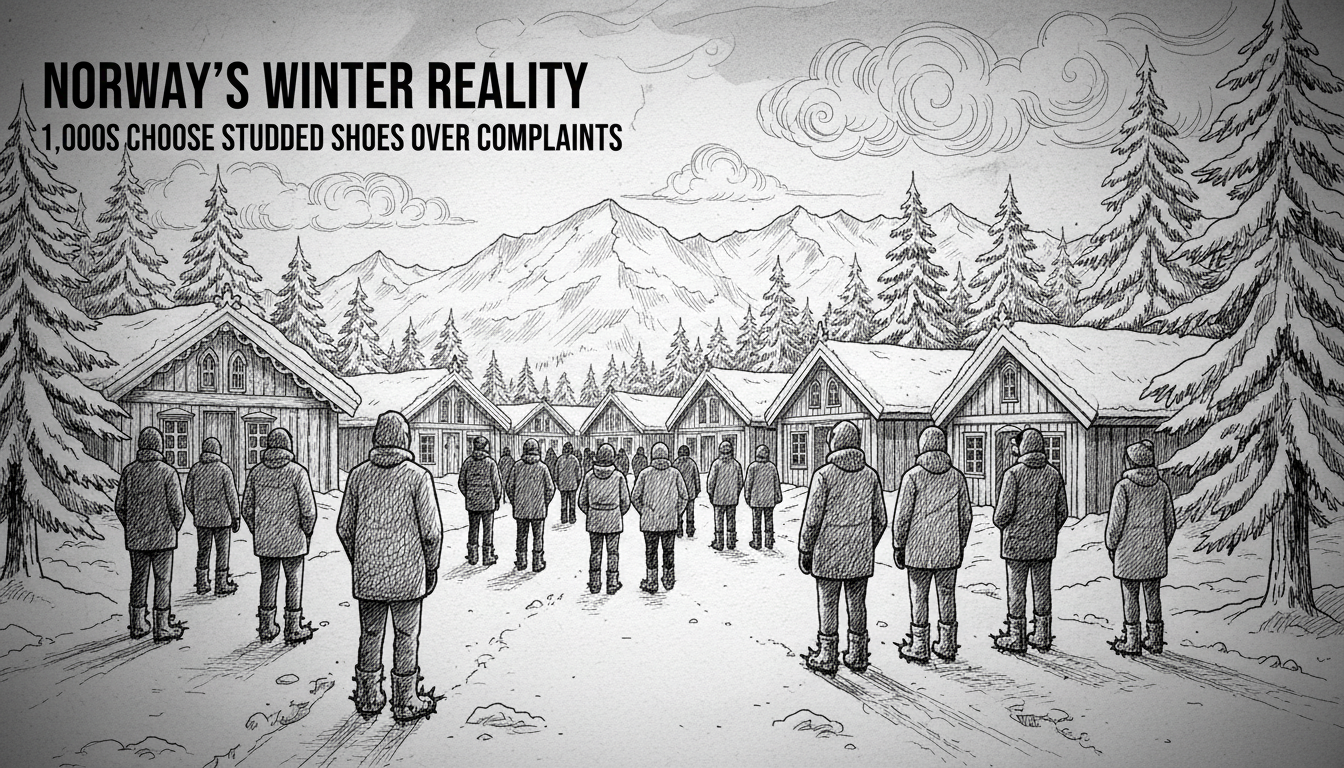
Norway's icy winter streets are prompting a pragmatic national response. While municipalities like Bergen deploy crews from state-owned Mesta to clear tram stops and pathways, thousands of Norwegians are taking personal safety into their own hands. The simple solution? A pair of studded shoes, or 'brodder'.
On a cold Saturday morning in Bergen, Erik Tveiten is already hours into his shift for Mesta, chipping ice and salting stops for the city's light rail system. "We hack away ice and salt. If we do a good job now, making it clear before the next snowfall, we do ourselves a big favor," Tveiten says. His focus is preventing the worst-case scenario: snow falling on top of untreated ice. Meanwhile, retirees Mona Lill and John Ole Paulsen are walking from Haukeland to the Nordnes peninsula, equipped with their own studded footwear. Their philosophy is straightforward. "You can't sit inside and complain that the municipality isn't salting," states John Ole. His wife adds the crucial caveat: "But you must have studded shoes today."
This scene encapsulates a fundamental aspect of Norwegian winter life: shared responsibility. Municipal services work within logistical and financial constraints, while citizens adapt using practical, readily available tools. The Paulsens, who wear out about one pair of studded soles per year, represent a widespread attitude. For them, buying grips from the agricultural supplier Felleskjøpet and attaching them to worn-out shoes is a routine part of seasonal preparation.
The High Cost of Slippery Streets
This personal vigilance is backed by stark data. Falls on ice and snow represent a significant public health burden in Norway each winter. Research from SINTEF, one of Scandinavia's largest independent research organizations, consistently highlights the issue. Icy conditions lead to thousands of injuries annually, ranging from fractures and sprains to more serious head trauma, particularly among the elderly. These accidents result in substantial costs for the healthcare system, lost workdays, and personal suffering.
Municipalities face a constant battle against rapidly changing coastal weather, where temperatures often hover around freezing, creating persistent black ice. Companies like Mesta, contracted for maintenance, prioritize key transit corridors, hospital access routes, and public transport hubs. As Erik Tveiten notes, the light rail operator is "very concerned that passengers don't fall," leading to daily rounds at all stops. However, covering every sidewalk, footpath, and residential street in a city like Bergen is an impossible task. The resource allocation debate is perennial, often flaring up after particularly bad ice periods or high-profile accidents.
Studded Shoes: A National Winter Staple
The Norwegian response has been to democratize safety technology. Studded rubber overshoes and removable ice grips are sold in supermarkets, sports shops, and hardware stores across the country. Sales figures reliably spike during forecasts of prolonged icy weather. The products are simple, effective, and relatively inexpensive. For many, like the Paulsens, they are as essential as a winter coat.
Public health campaigns from the Norwegian Directorate of Health and safety organizations repeatedly emphasize personal preparedness. The message is clear: checking the weather forecast and choosing appropriate footwear is a critical first line of defense. Experts point out that while municipal salting improves conditions, it is not a complete solution. Salt loses effectiveness below certain temperatures, and its environmental impact drives limits on use. Studded shoes provide reliable traction regardless of temperature or treatment status.
Beyond the City: A Cultural Mindset
This practice extends beyond urban centers. In rural areas, where distances between homes are greater and municipal services are thinner, personal responsibility for safe passage is even more deeply ingrained. The concept of 'dugnad' – communal, voluntary work – often extends to clearing shared driveways or footpaths. The underlying principle is the same: waiting for an external authority to solve a common problem is less effective than taking proactive, collective action.
The sight of Norwegians of all ages attaching ice grips to their boots is a quintessential winter image. It reflects a broader cultural trait of practicality and self-reliance, forged by the demands of the climate. It is not seen as a failure of public services, but rather as a sensible adaptation to environmental reality. Investing in a good pair of 'brodder' is a wise and expected individual choice, complementing public efforts.
The Limits of Self-Reliance
However, this system has its limits and critics. The onus on individuals can disproportionately affect vulnerable groups, including the elderly on fixed incomes, those with mobility issues, or people unfamiliar with winter conditions. Not everyone can safely navigate to a store to buy grips, nor can everyone afford them, though costs are generally low. There is an ongoing discussion about whether municipalities should do more, especially in high-traffic pedestrian zones and outside care homes.
Furthermore, the effectiveness of municipal work depends heavily on forecasting and timing. Pre-salting before a frost can prevent ice formation, but an unexpected freeze after rain can catch crews off guard. Mesta and similar operators rely on detailed weather services to deploy resources efficiently. When conditions change faster than forecasts predict, the public infrastructure of salt bins and grit becomes vital, allowing citizens to address immediate hazards in their immediate vicinity.
A Balanced Approach to Winter
The Norwegian model, as observed on that Bergen Saturday, presents a balanced approach. It combines targeted, professional ice removal for critical infrastructure with a widespread cultural adoption of personal safety gear. Erik Tveiten and the Mesta crews perform their systematic, preventative work on the transit network. Simultaneously, John Ole and Mona Lill Paulsen equip themselves for their walk, taking control of their own safety on treated and untreated paths alike.
This duality may be key to managing winter in a challenging climate. It spreads the responsibility and the solution, avoiding a scenario where public services are overwhelmed by demand and where citizens feel helpless. The result is a society that continues to function, albeit more carefully, through the icy months. The next time temperatures dip near freezing in coastal Norway, the sound of metal studs on pavement will be a common rhythm—a sound of pragmatic adaptation, not complaint.
As winter tightens its grip, the question remains: is this blend of public service and personal responsibility the most effective model, or does it let authorities off the hook for ensuring universally safe passage? For now, on the streets of Bergen and beyond, the 'brodder' remain a trusted answer.