
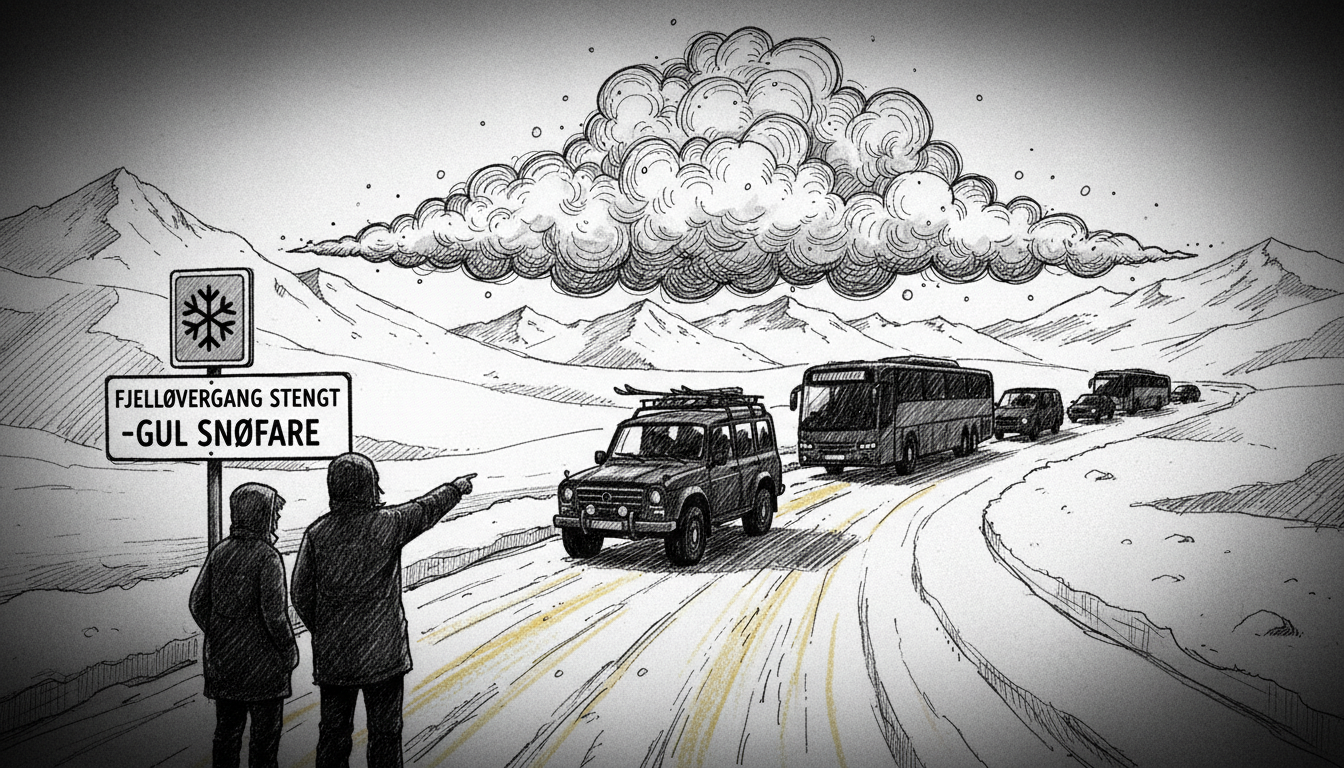
Norway's Meteorological Institute has issued a yellow weather warning for severe snowdrift, expecting 30 cm of snow to disrupt mountain passes across Southern Norway on Thursday. The alert, active from 10:00 to 22:00, signals significant transport delays and hazardous driving conditions for a region where winter mobility is a daily challenge. Authorities warn of sudden road closures and the potential implementation of convoy driving as visibility drops and snow packs on roadways.
Travel Chaos Grips Key Routes
Major mountain crossings, including the E134 over Haukelifjell and the RV7 over Hardangervidda, are directly in the path of the predicted snowfokk. The Norwegian Public Roads Administration (Statens vegvesen) has urged drivers to postpone non-essential travel. 'Snøfokk gives locally reduced visibility and snow that compacts on the road surface,' the Institute's warning states. 'Roads may be closed, and convoy driving may be introduced at short notice. Dress for the conditions.' This immediate impact on the national road network threatens to isolate communities and delay freight.
The yellow warning represents a moderate danger level, but in Norway's rugged terrain, its effects are severe. Kolonnekjøring, or convoy driving, is a critical safety measure. When enforced, vehicles must wait for a snowplow lead car and follow in a single-file line at low speed. This process can create waiting times of several hours. The decision rests with local road managers who monitor real-time wind speed, snowfall intensity, and visibility.
The Science Behind the Snowfokk
A snowfokk event is distinct from a simple snowstorm. It occurs when strong winds lift fallen or falling snow, creating blowing clouds that drastically reduce visibility and cause rapid, uneven drifts across roads. Meteorologists note that wind speeds exceeding 15 meters per second are often the primary driver, more than precipitation volume alone. The conditions forecast for Southern Norway's mountainous regions are a classic recipe for this phenomenon: a potent low-pressure system driving moist air against the steep terrain.
'This is a typical but potent winter situation for our interior and mountain areas,' explained a senior meteorologist with the Institute. 'The public must understand that a yellow warning, while not the highest level, requires serious preparation. The difference between manageable travel and a dangerous situation can be a matter of a few kilometers or a slight increase in wind.' The Institute's three-tiered public warning system—yellow, orange, red—is designed for clear communication, yet officials consistently note that many drivers underestimate yellow alerts.
Emergency Services on Standby
Local emergency services and volunteer organizations, particularly the Norwegian People's Aid (Norsk Folkehjelp) and Red Cross, are preparing for increased call-outs. Their primary concern is motorists stranded in sub-zero temperatures. The standard advice is for every winter vehicle kit to include a thermal blanket, warm clothing, food, water, and a fully charged phone. 'The greatest risk is people becoming trapped in their vehicles between closed road sections,' said a regional emergency coordinator. 'Preparedness in your car is your first line of defense.'
These weather events also test Norway's famed winter resilience infrastructure. Municipalities deploy heavy snow-clearing equipment, but during active, intense snowfokk, plowing becomes ineffective. The focus shifts to safety over accessibility. This operational reality often frustrates travelers but is a non-negotiable safety protocol. The economic impact, though localized, is felt by logistics companies and businesses dependent on reliable road transport over the mountains.
A Nation Accustomed Yet Alert
Norway manages hundreds of similar events each winter. The systems are robust, yet each storm carries unique risks. This particular warning affects a swath of Sør-Norge, home to popular ski resorts and vital east-west transport corridors. The timing, on a weekday, complicates commercial logistics and daily commutes for those living in alpine communities. Experts point to these events as a key reason for Norway's continuous investment in tunnel networks, like the world's longest road tunnel, the Lærdal Tunnel, which provides an all-weather alternative to the treacherous mountain pass above.
The weather warning also serves as a public reminder of the power of nature in a country where geography dictates life. Norwegians generally heed official advice, a cultural trait built on harsh experience. As the storm develops, traffic information websites like vegvesen.no will see a twentyfold increase in visits. The dialogue between forecasters, road authorities, and the public represents a well-rehearsed winter ballet, aiming to minimize risk despite the inevitable disruption.
Looking Beyond the Storm
The yellow warning is expected to lapse by late Thursday evening, but cleanup operations will continue into Friday. Road crews will work to clear drifts and re-establish normal traffic flow. The Norwegian Meteorological Institute advises citizens to monitor updates, as warnings may be escalated to orange if conditions deteriorate beyond forecasts. For now, the message is clear: respect the yellow, prepare for delays, and understand that in the Norwegian mountains, weather holds the ultimate veto over travel plans. This event underscores the perpetual balance the country strikes between maintaining a mobile society and yielding to the formidable forces of its winter climate. Will this season's pattern of frequent snowfokk events influence long-term infrastructure planning?