
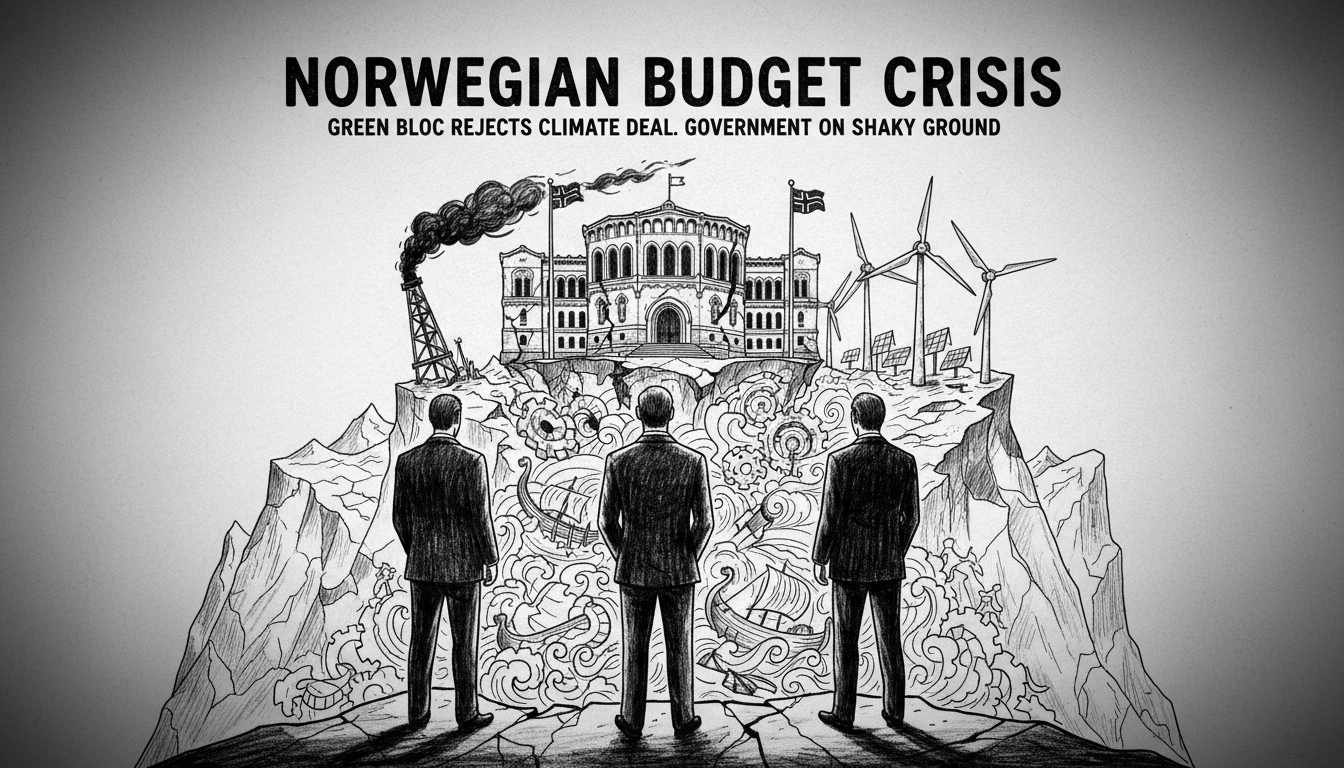
Norway faces a potential government crisis after two key coalition partners refused to support the minority government's budget proposal. The Socialist Left Party and the Green Party both walked away from negotiations, citing inadequate climate measures and fiscal irresponsibility. This leaves the Labor Party, Center Party, and Red Party with a budget agreement that lacks a parliamentary majority in the Storting. The standoff centers on oil policy and social spending, testing the stability of Prime Minister Jonas Gahr Støre's administration.
Green Party leader Arild Hermstad stated his party received full backing from its national board to hold firm on its demands, even if it triggers a cabinet question from the Labor Party. He framed the decision as a choice between temporary political chaos and permanent climate chaos. 'The question is whether it is not better to have a few weeks of government chaos rather than governing on autopilot into permanent climate chaos,' Hermstad said during a meeting. He indicated willingness to return to talks if the government would discuss strengthening the budget for climate, nature, and low-income citizens.
A representative from Akershus, Kristin Seim Buflod, expressed strong support for the party's stance. 'We cannot let ourselves be pushed around in this manner here,' Buflod stated. The Green Party was also explicit that it would under no circumstances support giving the Progress Party government power, drawing a clear line against the conservative opposition.
The Socialist Left Party leader, Kirsti Bergstø, echoed concerns about governance. She called the minority budget proposal 'completely irresponsible' and lacking in predictability or safe stewardship. Bergstø argued there was still time to negotiate a broader agreement. 'I wanted us to continue the negotiations until we actually reached the goal. We had time for that,' she said. The party had requested an extension of talks before the three-party deal was finalized.
Deputy leader and parliamentary leader for the Labor Party, Tonje Brenna, defended the process. She stated the Labor Party had been clear about its limits regarding oil policy and the use of the Oil Fund. 'We have deadlines that are important for democracy and to ensure a responsible budget process,' Brenna wrote in a message. The agreed budget between the three parties includes several key allocations: 3 billion kroner to strengthen municipal finances, 1.1 billion for county municipalities, 600 million for increased staffing in kindergartens, and 1 billion for an aid package to Gaza. It also allocates 500 million to hospital finances, rejects increases to gasoline and diesel taxes, and bans seabed mining for the entire parliamentary period.
The immediate implication is legislative uncertainty. Norway's budget must pass the Storting to fund government operations. A rejected budget can lead to a vote of no confidence, potentially collapsing the government. This scenario would force either a reshuffle or new elections. The core conflict reflects a deeper tension in Norwegian politics between economic management tied to offshore oil and gas revenues from fields like Johan Sverdrup and Troll, and accelerating the green transition. The Labor Party's traditional base expects stable welfare funding, while its left-wing allies demand faster climate action, creating a nearly impossible balancing act for Støre. The coming days will show if last-minute talks can salvage a majority or if Norway enters a period of political instability, with direct consequences for energy investment in the North Sea and Arctic policy direction.