
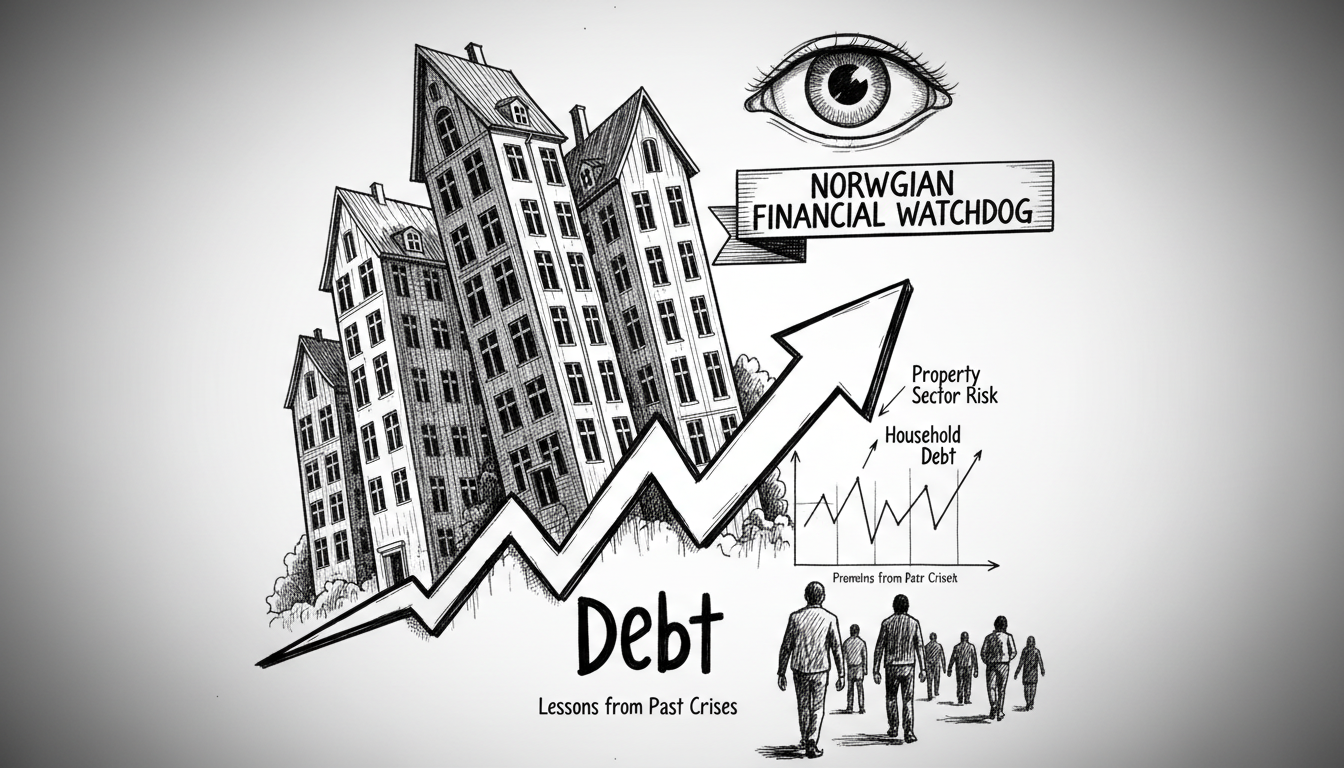
Norway's financial regulator has issued a stark warning about growing vulnerabilities in the property development sector. The Financial Supervisory Authority of Norway, known as Finanstilsynet, released its biannual financial stability report. The report highlights high household debt and elevated commercial and residential property prices as the system's main weaknesses. Geopolitical tensions and increased trade barriers are also creating significant uncertainty, the watchdog stated.
Analysts at the authority note that companies focused on property development are facing mounting challenges. Their data shows developers with a high risk of bankruptcy now hold an increasing share of the sector's total debt. Many of these actors also have weak debt-servicing capacity. This situation could lead to increased losses on loans to property developers. Some banks have already recorded substantial lending losses in this area.
Per Mathis Kongsrud, the Director of the Financial Supervisory Authority, emphasized the scale of the exposure. 'Our analyses show that the risk within property development has increased,' Kongsrud said in a statement. 'Lending to this industry constitutes a significant portion of Norwegian banks' corporate portfolios. After turnover and operation of real estate, it is the industry banks have the greatest exposure to,' he explained.
The watchdog simultaneously sought to reassure the public about the broader banking system's health. It underscored that Norwegian banks remain solid, with lending losses still at low levels overall. This dual message reflects a common regulatory approach: flagging specific sector risks while maintaining confidence in the financial infrastructure.
Household debt remains a persistent concern. The regulator reiterated that Norwegian household debt burdens are high, even though they have decreased slightly in recent years. Data from the authority's 2025 mortgage survey reveals the average loan-to-value ratio for new home loans has actually increased. This metric is a key indicator of risk for both borrowers and lenders.
Kongsrud connected current conditions to historical lessons. 'Experience from previous crises shows it can be particularly challenging to handle events that are reinforced by, or originate in, imbalances in one's own economy,' he noted. 'High debt burdens and high loan-to-value ratios increase the risk for both the borrower and the lender,' he concluded.
This report arrives during a period of global economic recalibration. High interest rates, designed to combat inflation, have cooled overheated property markets worldwide. Norway, with its historically strong economy and high home ownership rates, is not immune. The warning serves as a preemptive measure, urging banks to maintain strict lending standards. It also signals to developers that the era of easy credit and soaring valuations may be over for now.
The property sector's health is a critical bellwether for the broader Nordic economy. Construction and real estate drive substantial employment and investment. A downturn can ripple through related industries like manufacturing, retail, and professional services. For international observers and investors, this report highlights the nuanced challenges facing even stable, well-regulated economies like Norway's. It underscores that macroeconomic stability requires constant vigilance against sector-specific bubbles and debt accumulation.