
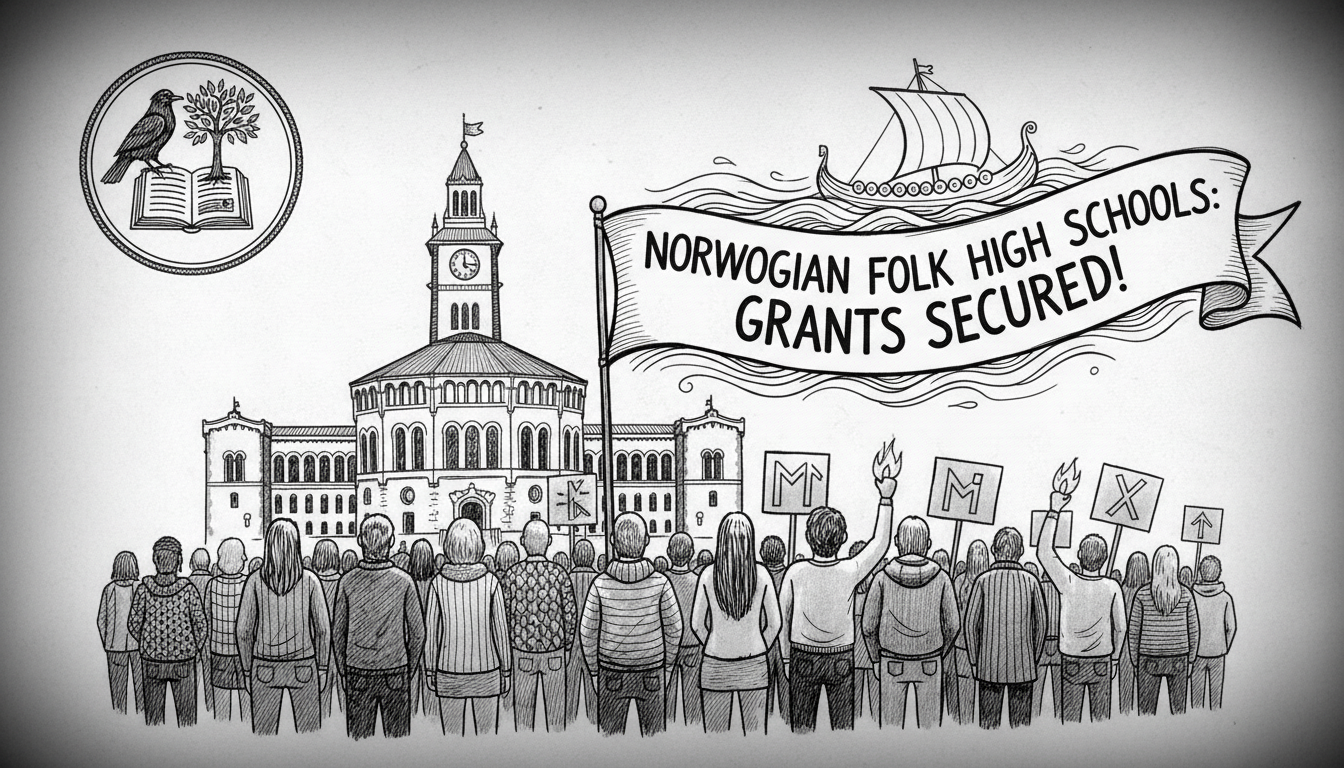
Students and administrators at Norway's folk high schools are celebrating a major political victory. The government's proposal to slash a crucial student grant has been reversed in the final budget negotiations. This decision prevents a significant financial burden for thousands of young Norwegians seeking this unique form of education.
The initial government budget proposed cutting the portion of a student loan that converts to a non-repayable stipend from 40 percent to just 15 percent. This would have cost each student nearly 40,000 Norwegian kroner extra. The proposal sparked immediate and widespread backlash.
Over 35,000 people signed a petition against the cuts, which was delivered to politicians at the Storting building in Oslo. The campaign, led centrally by the folk high school organization, gained substantial media attention. Most coverage was highly critical of the government's plan.
Haldis Brukbæk, rector at Romerike Folkehøgskole, expressed the collective relief. 'We were genuinely worried and quite shocked when the proposal came. It was like a bolt from the blue,' Brukbæk said in a statement. She emphasized the economic importance of the stipend for accessibility. 'It's about personal finances. While we believe folk high school has such great value that it's worth paying for, it's also crucial that the offer is available to everyone. Then the costs naturally matter a great deal.'
Student Jorunn Hake, 19, who helped deliver the petition, shared her experience. 'I've always liked to engage in politics, and I think education is very important for society. Many of the politicians thought it was good that we got involved, and they agreed this is an important issue,' Hake said. 'It's fun to see that trying to accomplish something politically can actually make a difference.'
The reversal was secured through an agreement by the opposition red-green parties. Center Party leader Trygve Slagsvold Vedum celebrated the outcome with students at the Storting. 'We are incredibly glad that the proposal for cuts is now reversed in the final budget proposal,' Vedum stated.
This episode highlights the enduring cultural and political value placed on the folk high school system in Norway. These schools are a distinct Nordic institution, offering a gap year focused on personal development, practical skills, and communal living rather than formal academic credit. Brukbæk, with 35 years in the system, calls it 'the diamond' of the education system. 'It's a unique Nordic phenomenon where you get to use a year to develop as a person, just because you want to learn,' she explained.
The political pushback was swift because the proposal seemed contradictory. It came shortly after the passage of a new folk high school law, which gave the impression of strong governmental support. The sheer scale of the protest demonstrates the deep-seated public attachment to this educational model. It is seen not as a mere 'gap year' but as a formative experience that builds confidence and social understanding.
For international observers, this is a classic example of Nordic consensus politics in action. A government proposal perceived as undermining a cherished social institution was met with organized civil society pressure and cross-party political compromise. The final state budget is set for formal adoption. The outcome ensures that this traditional, state-supported path for youth development remains financially viable for families across Norway's economic spectrum, from Oslo to the remote fjord communities.