
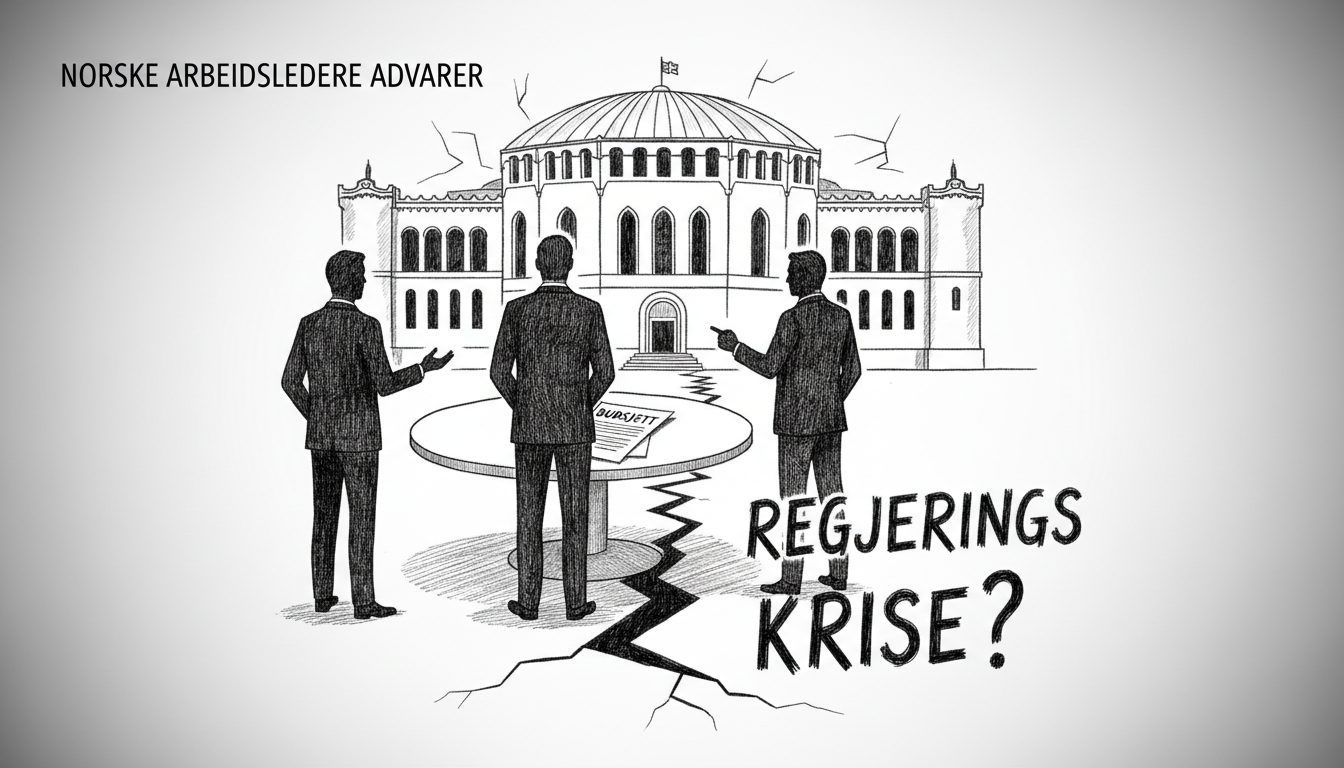
The new leaders of Norway's most powerful labor organizations have issued a stark warning against triggering a government collapse. They made the statement during their first joint interview ahead of next year's major wage negotiations. The comments place them directly into the heart of the ongoing budget crisis in Oslo.
Harald Solberg, head of the employer federation Norsk Industri, stated his position clearly. He said a parliamentary majority carries an obligation. When parties have supported Jonas Gahr Støre as Prime Minister, it is difficult to understand creating a crisis on the current budget basis. Solberg leads the largest federation within the Confederation of Norwegian Enterprise (NHO). His counterpart, Christian Justnes of the Norwegian United Federation (Fellesforbundet), echoed the sentiment. Justnes stated that the last thing Norway needs now is a government crisis. The majority has a responsibility to deliver a national budget.
This stance from an NHO leader is notable. Employer organizations are often assumed to favor a conservative government. Solberg emphasized his organization works in a politically color-blind manner. He said the most important factors for industry are predictability and competitive framework conditions. A potential government crisis would not build that predictability, he argued. The two men met in rainy weather near Frogner Park and the NHO headquarters on Majorstuen.
Justnes, a Labor Party (Ap) member slated to join the party's central committee, offered a political analysis. He warned that pushing the crisis too far could lead to a government shift. This could result in policies far from what the Socialist Left (SV) and Green (MDG) parties desire. Alternatively, it could force the Støre government to resign if it fails to pass a budget. Today, no conservative majority exists to form an alternative government. This political maneuvering forms the backdrop for the critical wage talks set for the coming spring.
Next year is a main settlement year in Norway's coordinated wage model. In these talks, parties can introduce heavy principled issues like pension reforms. The state pension agreement (AFP) could land on the negotiation table. Typically, Norsk Industri and Fellesforbundet lead the so-called front-sector negotiations. These talks set the pattern for wage growth across Norway's entire economy, both private and public sectors. The model's core principle balances wage increases against international competitiveness.
Norwegian firms competing internationally cannot afford wage growth exceeding that of foreign rivals. If that happens, they risk losing contracts and may be forced to lay off workers. Justnes stated a clear message from his union's rank and file. Real wage growth is the top priority. Members expect wages next year to rise more than prices. Solberg, the employer representative, listened but did not agree. He noted that real wage growth was record high recently and appears set to remain very high. He acknowledged several prior years with negligible real wage growth but called the coming talks demanding. Industry has had good years, but uncertainty is now much greater, he said.
The two leaders acknowledged their competing mandates. Justnes must push wages up, while Solberg must restrain increases to maintain competitiveness. Justnes described this as a slightly caricatured but accurate view of their roles. He stressed a shared responsibility not to push things to extremes. Solberg predicted tough talks and increasing tension as the settlement deadline approaches. He affirmed the strength of the front-sector model. It ensures employees get fair wage development without employers negotiating away jobs.
Building personal chemistry is crucial for such negotiations. The two new leaders, who only met in August, are working on their relationship. A planned walk around Sognsvann lake was shortened to a brief tour in Frogner Park due to intense rain. Solberg said he has come to know Justnes as a very tidy and accessible leader. Justnes said the chemistry is good, describing Solberg as suitably informal and someone you can joke with. They have shared a dinner with wine and a beer, a tradition their predecessors often followed.
Their new roles as wage settlement chiefs follow the resignations of their predecessors, Jørn Eggum and Stein Lier-Hansen. Justnes believes they have inherited a role to be continued. Sometimes you fight, he said, and that will happen for them too. They will not be their predecessors but will seek solutions together. Solberg added they must find their own path without comparing too much to the past. They must look forward for solutions good for wage formation and the front-sector.
The intervention by these powerful labor market figures highlights the high stakes in Oslo. A budget crisis could destabilize the delicate political balance supporting Prime Minister Støre's coalition. It also threatens the economic predictability that Norway's export-dependent industries, including the crucial oil and gas sector in the North Sea, rely upon. The calm, consensus-driven Norwegian model faces a serious test this autumn, with implications stretching from the Storting building to oil platforms in the Troll and Johan Sverdrup fields.