
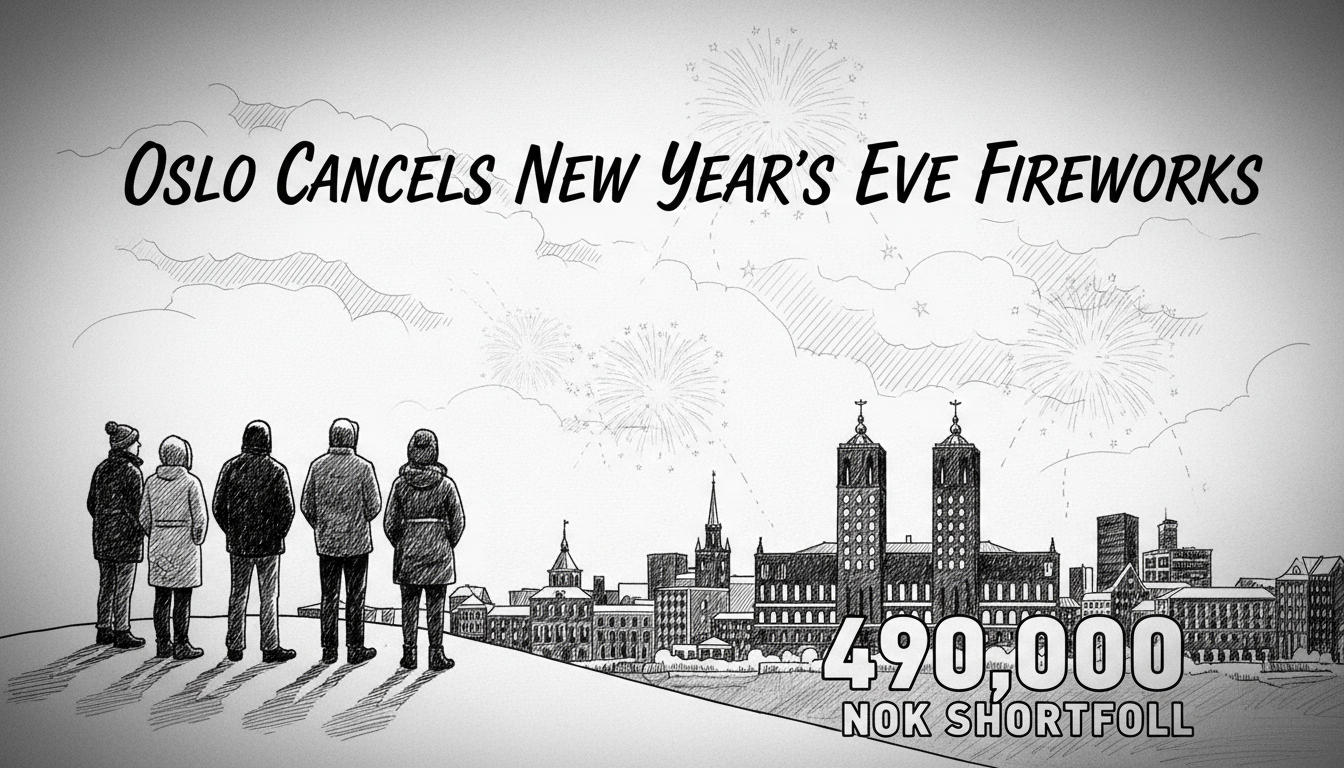
Oslo's city center will remain dark on New Year's Eve after a crowdfunding campaign to finance a public fireworks display failed dramatically. The campaign aimed to raise 490,000 Norwegian kroner but secured less than 95,000 kroner, forcing organizers to cancel the event and refund all contributions. This cancellation marks a significant shift for the Norwegian capital's traditional celebrations and follows a direct suggestion from city council leader Eirik Lae Solberg that private actors, not the municipality, should fund the spectacle.
"It may be that this came a little late, but with the amount that has been raised, it will unfortunately not be possible to have a large joint fireworks display in Oslo city center," said Madlena Tsvetkova Nielsen, daily manager of Pyroteknikk AS, the company that launched the fundraising drive. The campaign was hosted on the Norwegian platform Spleis. Nielsen expressed disappointment, noting they had hoped for greater involvement from local businesses. "We took the city council leader at his word and took the initiative, so that more could join in," she said.
A New Funding Model Fizzles Out
The failed initiative represents the first major test of a new model for financing public festivities in Oslo. In the lead-up to 2026, Solberg, a Conservative (H) politician, publicly proposed that entities other than the city government should organize and pay for New Year's fireworks and shows. The Pyroteknikk campaign was a direct response to that challenge. Its stark shortfall—raising only 19% of its target—suggests limited public and corporate appetite for privately funding a large-scale civic event traditionally associated with municipal responsibility.
All donated funds will be returned to contributors, as stipulated in the Spleis campaign's terms. "The money will be returned to everyone who has contributed, as stated in Spleisen: 'If enough money is not raised to carry out the fireworks, the money will be refunded,'" Nielsen confirmed. This outcome leaves Oslo without a coordinated central display, likely fragmenting celebrations to smaller, private gatherings across the city's boroughs.
Shifting Attitudes Toward Tradition
The cancellation occurs amid a growing national and international debate about the place of fireworks in modern urban celebrations. Critics point to significant environmental concerns, including air pollution from particulate matter and the littering of public spaces and waterways with plastic debris. Safety is another persistent issue, with emergency services often dealing with injuries each year. Furthermore, the loud explosions cause severe distress to pets, wildlife, and individuals with PTSD or noise sensitivity.
In recent years, several Norwegian municipalities have restricted or banned consumer fireworks. Some have replaced traditional displays with drone light shows or laser projections, which offer visual spectacle without the associated noise and pollution. Oslo's own debate has intensified, with political parties and citizen groups increasingly questioning the sustainability of the practice. The lack of financial support for this campaign may reflect these changing public sentiments as much as it does a failure of the funding model itself.
The Government's Role in Public Celebration
This episode raises fundamental questions about the role of local government in providing shared cultural experiences. Is a major New Year's Eve celebration a public good that the municipality should fund, or is it an optional entertainment that can be left to the private market? Eirik Lae Solberg's position clearly leans toward the latter. However, the market's response—in this case, the donating public and businesses—has been tepid.
"Crowdfunding for a once-a-year, non-essential public event is inherently challenging," said Lars Mjøset, a sociologist at the University of Oslo who studies public culture. "It lacks the immediate reciprocity of funding a community project. When a city withdraws from funding a tradition, it signals that the tradition's value has diminished in the eyes of the government. The public often internalizes that signal, leading to the kind of poor response we've seen here."
Mjøset argues that shared celebrations like national day or New Year's Eve are part of a city's social infrastructure. They foster community cohesion and a sense of shared identity. "The question for Oslo is what kind of shared identity it wants to project. A sustainable, quiet identity, or a traditional, explosive one? The funding model is secondary to that core political decision," he added.
Looking Ahead to a Quieter New Year
For residents and visitors this New Year's Eve, the experience will be markedly different. Instead of crowds gathering around the inner fjord to watch a synchronized display, celebrations will be decentralized. Some restaurants and hotels may host private shows, and individuals will still set off legal consumer fireworks in their neighborhoods. However, the loss of a central, unifying event changes the character of the night.
City officials have not yet indicated if they will revisit the funding policy for future years. The failure of this private initiative could pressure the city council to reconsider its withdrawal of public funds. Alternatively, it may embolden those seeking a permanent move away from fireworks altogether, potentially opening the door for the city to fund an alternative, eco-friendlier spectacle.
The Oslo case is being watched closely by other Scandinavian cities grappling with similar dilemmas. Copenhagen and Stockholm have also faced public pressure to modify or cancel their displays. Oslo's experiment in privatization may serve as a cautionary tale about the difficulties of transferring long-standing public traditions to a crowd-funded model without a clear consensus on their continued value.
As the refunds are processed and the fireworks remain in their boxes, Oslo steps into the new year with a quieter, darker skyline. The silence over the city is not just an absence of sound, but a tangible result of a political calculation, a lukewarm public response, and a society reevaluating its rituals. Whether this becomes a permanent change or a one-year hiatus may depend on who, if anyone, is willing to pay for the bang next time.