
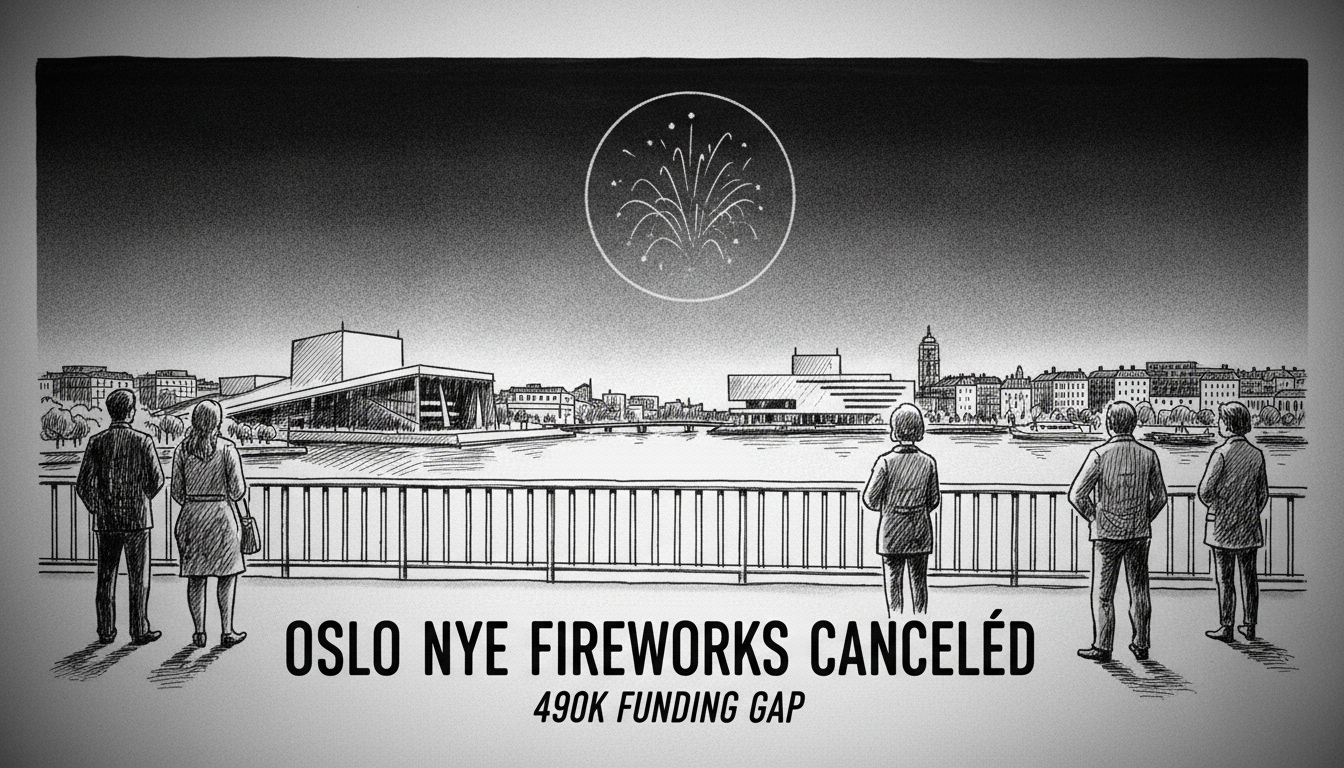
Oslo's New Year's Eve fireworks display is canceled after a crowdfunding campaign raised only 94,917 kroner, falling 395,083 short of its 490,000-kroner goal. For the first time in recent memory, the Norwegian capital will greet the new year without a central, public pyrotechnic show. This decision directly impacts thousands of residents and tourists who traditionally gather along the Oslofjord for the celebration.
The cancellation follows a direct challenge from Oslo's City Council leader, Eirik Lae Solberg of the Conservative Party. He urged private actors to fund the display instead of using municipal money. Pyroteknikk AS took up the call but its public funding experiment failed spectacularly. All donated funds will now be returned to contributors.
The Funding Fiasco Unfolds
Madlena Tsvetkova Nielsen, daily manager of Pyroteknikk AS, confirmed the cancellation. "It may be that this came a little late, but with the amount collected, it will unfortunately not be possible to have a large common fireworks display in Oslo city center," she said. The company launched a campaign on the Norwegian crowdfunding platform Spleis in October. Their goal was to secure 490,000 kroner to produce a professional show for the city.
Public response was tepid. Only 94,917 kroner trickled in from a mix of private citizens and small businesses. Nielsen expressed disappointment that larger commercial entities did not participate. "We took the council leader at his word and took the initiative, so that more could jump on board. We had hoped to get business and industry involved in the collection," she stated. The clear message from the public: they were not willing to pay directly for a event they previously expected the city to provide.
A Shift in Municipal Policy
The backdrop is a significant policy shift by Oslo's city government. For years, the municipality partially or fully funded the New Year's Eve spectacle. Council Leader Eirik Lae Solberg explicitly suggested that other actors beyond the commune should arrange fireworks and shows for the 2026 New Year's entrance. His 2024 statement was interpreted as applying immediately, creating a funding vacuum for this year's event.
This move aligns with broader political debates in Norway over public spending on cultural events. It also intersects with growing environmental and safety concerns regarding fireworks. Several other Norwegian municipalities, including Bergen and Tromsø, have implemented restrictions on private fireworks sales and use. Oslo itself has debated bans in residential areas due to noise pollution and risk of injury.
Expert Analysis: The Crowdfunding Test for Public Goods
Dr. Lena Holm, a cultural policy researcher at the University of Oslo, says this case highlights the limits of crowdfunding for core public celebrations. "New Year's Eve fireworks are often seen as a public good—a shared experience that fosters community identity," Holm explains. "Crowdfunding works best for niche projects with dedicated supporters. When you test broad public appeal for a traditional event, the results can be stark. This shortfall suggests people view this as a municipal responsibility, not a voluntary extra."
Environmental economists point to another layer. Professor Arne Jensen, who studies sustainable event management, notes the changing public perception. "The debate around fireworks has intensified. There is real awareness now of particulate matter pollution, its impact on air quality, and the distress it causes wildlife and pets," he says. "When a city withdraws funding, it doesn't just signal budgetary priorities. It can also quietly advance an environmental agenda by letting the tradition fade through market forces."
The Safety and Silence Debate
Fireworks have long been a contentious issue in Norwegian cities. The Norwegian Directorate for Civil Protection reports hundreds of minor injuries each New Year's Eve. Insurance claims for property damage from stray rockets are common. Many animal welfare organizations, like Dyrepolitiet, actively campaign for bans, citing the terror experienced by pets and wildlife.
In Oslo, the silent skies this year will provide a real-world experiment. Will residents miss the traditional bangs over Akershus Fortress and the Oslofjord? Or will they embrace quieter alternatives? Some city districts may still host small, private displays, but the iconic central show is gone. This could set a precedent for other major cities in Scandinavia observing Oslo's experience.
Comparative Trends in the Nordics
Norway is not alone in reevaluating fireworks. Denmark's Copenhagen has significantly scaled back its public display, investing instead in laser light shows. Sweden's Stockholm has moved fireworks further from the city center to reduce disturbance. Finland's Helsinki maintains a large show but couples it with strong public messaging about safety and environmental impact.
Within Norway, the approach is fragmented. The municipality of Stavanger still funds a large display. Trondheim has shifted to a decentralized model with several smaller shows. The lack of a national policy leaves each city to navigate public expectation, cost, and ethical concerns. Oslo's failed crowdfunding attempt may discourage other councils from similar experiments.
What Replaces the Rockets?
City officials have not announced alternative plans for the New Year's Eve celebration in downtown Oslo. Traditionally, the fireworks were the climax of an evening that included live music and gatherings at locations like Karl Johans gate. Without the central pyrotechnics, restaurants and private event organizers may see increased demand.
Cultural analysts suggest this could be a moment for innovation. "Cities worldwide are exploring drone light shows, projection mapping on buildings, or enhanced musical performances," says Dr. Holm. "These can be visually stunning without the noise pollution and air quality issues. However, they require significant investment and technical expertise—investment that crowdfunding clearly didn't secure."
Implications for Future Celebrations
The cancellation raises fundamental questions about the role of local government in funding communal rituals. Is a New Year's fireworks display a essential public service or a discretionary luxury? Oslo's conservative-led council has signaled its stance. The public's reluctance to pay directly offers a counterpoint.
This episode may influence upcoming municipal budgets and political debates. Political parties on the left have already criticized the council leader's approach, calling it an abandonment of civic duty. The discussion will extend beyond fireworks to other publicly-funded festivals and events. How should a modern, environmentally-conscious city celebrate?
As Oslo prepares for a quieter New Year's Eve, the echoes of this decision will linger. The failed 490,000-kroner campaign has illuminated more than just dark winter skies. It has revealed a gap between political vision and public willingness to pay, setting the stage for a deeper conversation about shared values and shared costs in Norway's capital.