
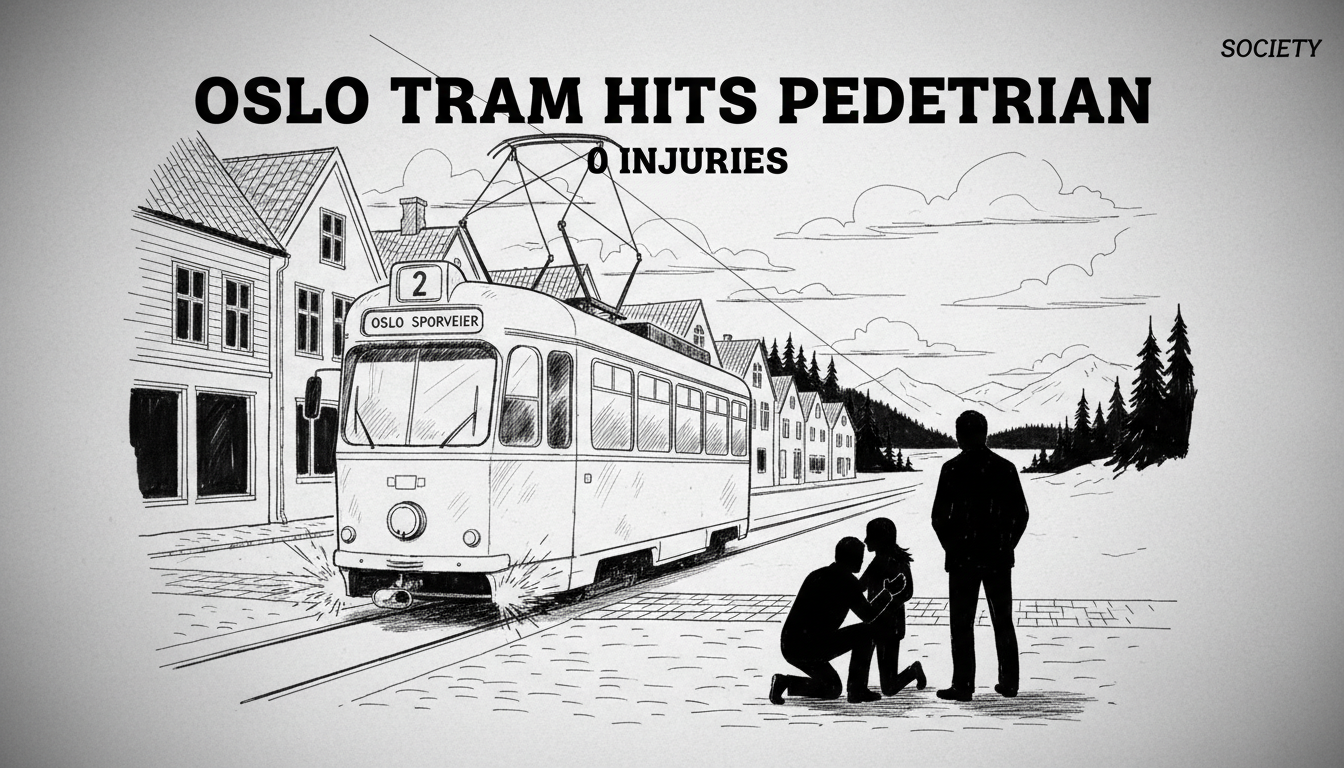
Oslo's 6-line tram network recorded a pedestrian incident at the Nationaltheatret transportation hub this week, with no injuries resulting from the contact. Police confirmed reports that a person was hit by a tram while crossing the street, according to statements from Sporveien, Oslo's public transport operator. The individual involved was not harmed, turning what could have been a tragedy into a mere close call in the heart of Norway's capital.
This event underscores the persistent interface between historic tram systems and modern urban foot traffic. For a network that carries over 200,000 passengers on an average weekday, such incidents, while infrequent, prompt rigorous scrutiny of safety protocols. Sporveien press officer Tone Tuhus stated the tram made contact with a pedestrian crossing the road, emphasizing that no medical attention was required. The efficiency of Oslo's emergency response ensured the scene was cleared swiftly, with minimal disruption to the bustling hub.
The Trikken's Enduring Role in Urban Life
Oslo's tram, affectionately called 'trikken', is more than mere transport; it is a moving landmark. Since its inception in 1875 with horse-drawn carriages, the network has evolved into a fully electric system spanning 131 kilometers of track. It serves as the circulatory system for the inner city, connecting neighborhoods like Grünerløkka, Majorstuen, and the waterfront Aker Brygge. The tram's integration into Oslo's fabric is so complete that its routes often dictate urban rhythm and pedestrian flow. Yet, this intimacy with city life brings inherent risks, as tracks and platforms merge seamlessly with sidewalks and crosswalks.
Modern trams are quieter and larger than their predecessors, factors that transportation experts cite as double-edged swords. Their reduced noise can surprise pedestrians, while their extended overhang—the part of the vehicle that extends beyond the rails—creates a wider danger zone. At junctions like Nationaltheatret, where multiple tram lines converge with bus and metro services, the complexity of movement multiplies. This hub is not just a station but a critical nexus for over 100,000 daily commuters, making vigilant traffic coexistence non-negotiable.
Safety Campaigns and Pedestrian Awareness
Norwegian authorities have long prioritized education alongside engineering. The Norwegian Public Roads Administration, in collaboration with Sporveien, routinely launches campaigns highlighting specific tram-related dangers. One recurrent message focuses on the 'silent approach' of new Škoda ForCity models, advising pedestrians to look both ways even when they hear nothing. Another targets distracted walking, particularly smartphone use near tracks. Data from similar campaigns in Bergen and Trondheim suggest a 15% reduction in near-misses after public awareness drives, though Oslo-specific annual incident figures are closely held by Sporveien for operational reasons.
Expert analysis points to behavioral economics as key. Professor Lars Ingvarsson, a transport safety researcher at the University of Oslo, notes, 'People often misjudge a tram's stopping distance. A vehicle weighing 40 tonnes cannot brake like a car. At 30 km/h, it needs nearly 40 meters to halt—a fact many pedestrians underestimate, especially when rushing.' He stresses that infrastructure adjustments, like raised platforms and dedicated signal phases for trams, have improved safety but cannot eliminate human error. The Nationaltheatret incident, where the pedestrian was crossing legally but within the tram's path, exemplifies this gray area.
Comparative Urban Transport Safety
How does Oslo's record compare? Cities with extensive tram networks, like Amsterdam, Zurich, and Melbourne, face analogous challenges. Statistics from the European Transport Safety Council indicate that Oslo's rate of serious injuries involving trams is below the European median, attributed to lower speeds in core zones and strict traffic calming measures. For instance, Oslo enforces a 30 km/h speed limit for trams in congested areas, a policy adopted after city council debates in 2019. In contrast, some European capitals still permit trams to travel at 50 km/h in central districts, leading to more severe outcomes when collisions occur.
Norway's broader commitment to Vision Zero—a policy aiming to eliminate all traffic fatalities and serious injuries—shapes these approaches. The Oslo City Government, led by the Labour Party, has allocated substantial funds from the national budget to separate tram tracks from pedestrian pathways. Projects like the ongoing redesign of Stortorget square aim to create clearer spatial divisions, reducing conflict points. However, heritage conservation laws in areas like the Nationaltheatret, surrounded by historic buildings, can limit such physical interventions, forcing reliance on behavioral solutions.
Policy Implications and Future Investments
The non-injury incident at Nationaltheatret arrives amid parliamentary discussions on Norway's next National Transport Plan. The Storting is set to debate increased funding for Oslo's public transport infrastructure, with proposals focusing on automation and sensor technology. Some politicians from the Conservative Party advocate for AI-assisted collision avoidance systems on trams, similar to those tested in Helsinki. Others, like Green Party representatives, push for further pedestrianization of city centers, effectively removing trams from the busiest streets—a controversial idea given the trikken's symbolic and practical role.
Sporveien's own strategy documents reveal plans to invest 500 million kroner in safety upgrades over the next five years. This includes installing additional warning lights at crossings and enhancing driver training simulations that focus on pedestrian detection. The economic rationale is clear: each accident, even without injury, causes service delays, repair costs, and potential liability. For a system funded largely by taxpayer subsidies and ticket revenues, efficiency and safety are intrinsically linked to public trust and operational viability.
A Close Call with Broader Lessons
This event may have ended without physical harm, but it serves as a microcosm of urban living in Scandinavia's fastest-growing capital. Oslo's population is projected to reach 800,000 by 2040, intensifying pressure on all transport modes. The tram incident at Nationaltheatret reminds us that infrastructure must evolve with demographic shifts. As Norway continues to balance its oil-rich heritage with green urban ambitions, the trikken stands as a test case for sustainable mobility—where safety records must keep pace with expansion dreams.
In the end, the silent alarms triggered by such close calls resonate in planning offices and political chambers alike. Will Oslo's blend of technology, education, and design be enough to prevent a future incident from having a different outcome? The answer lies not just in policy, but in the daily choices of every pedestrian who shares the city with these historic steel giants.