
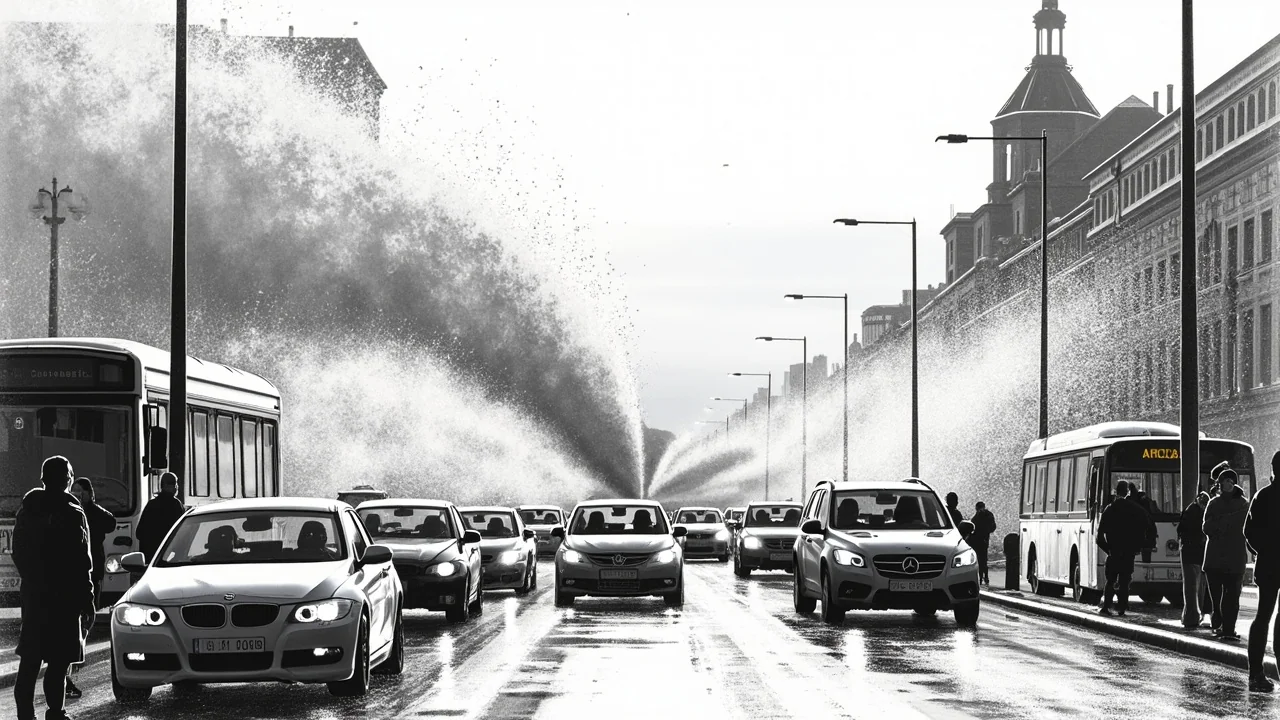
Oslo traffic faced severe disruption early Thursday when a major water main ruptured on a key northern artery. The rupture on Maridalsveien sent torrents of water across the road surface, prompting police to close the route entirely during the morning rush. Authorities halted the flow by 5:02 AM, but the incident has ignited fresh debate over the city's aging underground infrastructure.
The Oslo Police District announced the closure at 4:21 AM, blocking traffic from the Maridalsveien/Møllerveien roundabout down to the intersection of Rosteds gate and Møllergata. In a statement, police warned drivers of hazardous conditions. "Due to current weather conditions, it is likely this will lead to difficult driving conditions, particularly in Maridalsveien," the statement said. The leak occurred as temperatures hovered around freezing, raising immediate concerns about ice formation on the saturated road.
Crews from the municipal water and sewerage agency, Oslo VAV, responded to isolate the broken section. The swift shutdown prevented widespread flooding but left a significant repair task. Maridalsveien is a primary conduit for traffic moving from the northern suburbs into central Oslo, passing near the bustling Grünerløkka district. The closure created immediate congestion on alternative routes like Trondheimsveien and Ring 2.
Infrastructure Under Scrutiny
This incident is not isolated. Oslo's water distribution network, like that of many European cities, contains pipes over a century old. The section in Maridalsveien is part of a system critical for transporting water from the Maridalsvannet lake, the city's main drinking water source. While annual replacement rates have increased, the network remains vulnerable. A 2022 report by the Norwegian Water Association highlighted that pipe failures cause the loss of nearly 300 million liters of drinking water annually across Norway.
"Every rupture is a signal," said Lars Holm, a civil engineering professor at the University of Oslo. "We are facing a systemic challenge where incremental maintenance is no longer sufficient. The economic cost of traffic disruption alone from these breaks often exceeds the price of proactive replacement." Holm points to the need for accelerated investment in pipeline mapping and renewal, especially along major transport corridors.
Political Repercussions and City Response
The break occurred at a politically sensitive time. The City Council's urban environment committee recently debated a multi-billion kroner proposal to modernize core utilities. This event will likely strengthen the argument for faster investment. The governing Labour Party and the opposition Conservatives have both called for more robust infrastructure spending in recent budget negotiations.
"This morning's chaos shows what's at stake," said city council representative Mari Strand from the Conservative Party. "We cannot have vital traffic links and our drinking water supply threatened by pipes that have long passed their lifespan. This must be a wake-up call for prioritizing this unseen, but essential, infrastructure."
The City's Vice Mayor for Environment and Transport, Sirin Hellvin of the Green Party, acknowledged the pressure. "Our teams acted quickly to secure the area and stop the leak. We are committed to the renewal program, but it is a massive undertaking that must be balanced with other city needs. Each event like this informs our priority lists," she stated.
The Ripple Effects of a Rupture
Beyond the traffic snarls, a breach in a main transmission line poses other risks. It can allow contaminants to enter the drinking water system if pressure drops significantly. Oslo VAV has protocols to flush and test water quality following such repairs, a process that can take several hours. Residents in the adjacent neighborhoods were advised to run their taps for a few minutes once water service was fully restored.
The economic impact extends beyond municipal repair costs. The Norwegian Confederation of Enterprises estimates that major traffic disruptions in Oslo can cost the regional economy millions of kroner per hour in lost productivity and delayed logistics. For businesses relying on just-in-time deliveries in the inner city, a closed arterial road has immediate consequences.
Furthermore, such incidents test the city's crisis coordination. The police, the public roads administration, and the water utility must communicate seamlessly. Thursday's response appeared coordinated, but the true test lies in preventing recurrences. Digital monitoring systems that can detect pressure changes indicative of a leak are being piloted in some districts, yet citywide coverage remains years away.
A Look Beneath the Surface
The challenge is visibility. Citizens and politicians see the potholes on the street, but not the decaying pipes beneath them. Investment in underground networks often loses out to more visible projects like parks or cultural venues. "It's the classic problem of infrastructure politics," notes Professor Holm. "Success is invisible—a day with no breaks, no disruptions. It requires long-term political courage to fund the absence of failure."
Oslo's situation mirrors a national discussion. The Storting has earmarked funds for water and sewer upgrades across Norway, but municipalities struggle with capacity and competing priorities. As climate change brings more frequent freeze-thaw cycles, the strain on older pipes is predicted to increase.
The Road Ahead
By late morning, crews had begun excavating the site to assess the damage and install a new pipe section. Traffic slowly normalized, but the repair work will cause lane restrictions for days. The broken pipe segment will be analyzed to determine the cause of failure—whether it was material fatigue, ground movement, or other factors.
This event serves as a concrete reminder of the complex, hidden systems that enable modern urban life. As Oslo continues to grow, the pressure on its foundational networks intensifies. The question for city leaders is whether they can accelerate the pace of renewal before the next rupture causes even greater disruption. The water may have been stopped, but the flow of debate about the city's future resilience has only just begun.