
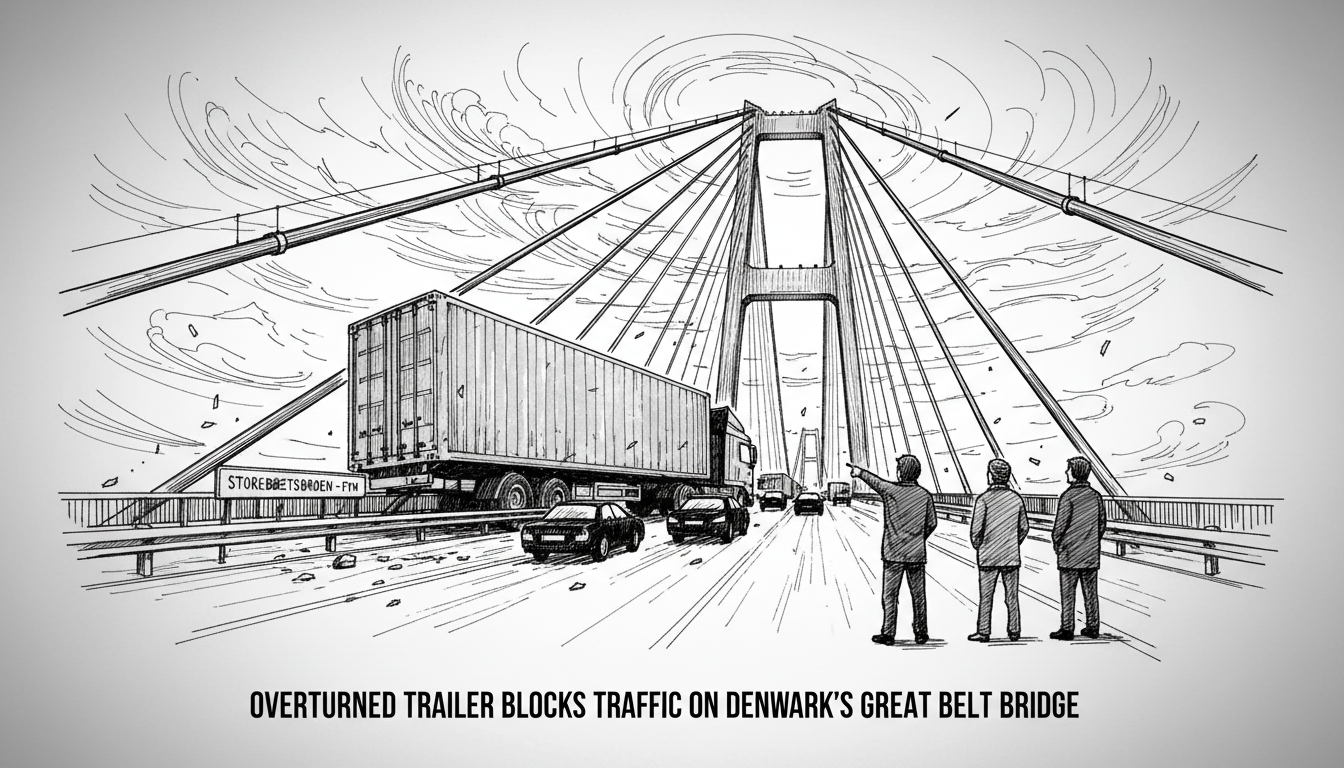
A car towing a trailer that overturned has closed the Great Belt Bridge to all vehicle traffic heading toward Funen. The incident occurred on Monday evening, blocking a critical national transport link. Police confirmed the accident but reported no injuries. Officials attributed the incident to strong winds exceeding ten meters per second. Traffic was halted shortly after 6:40 PM as emergency crews worked to clear the scene.
This disruption highlights the vulnerability of Denmark's vital infrastructure. The Great Belt Bridge is more than just a road. It is the primary physical connection between the country's major islands, Zealand and Funen. Any closure creates immediate logistical and economic ripple effects. Freight transport, daily commutes, and regional business all depend on this corridor. The Danish welfare system relies on efficient mobility to function, making such incidents a matter of public concern beyond simple traffic delays.
From my perspective covering Danish society, events like this test the resilience built into our social systems. How do municipalities and regions coordinate when a main artery is blocked? The response involves police, the bridge operator Sund & Bælt, and towing services. Their efficiency minimizes broader disruption. This integrated response is a hallmark of the Danish model, where public agencies are expected to work in concert. It is a practical example of social policy in action, ensuring safety and restoring normalcy with minimal fuss.
We should consider the human impact behind the headlines. Drivers were stranded, appointments were missed, and families were delayed. For international readers and new residents, understanding these infrastructural dependencies is key to grasping daily life in Denmark. The country's geography of islands and bridges means travel plans can be weather-dependent in a way unfamiliar to many. This reality shapes everything from work culture to family visits, embedding a certain flexibility into the Danish mindset.
The immediate cause was wind, a common challenge in this region. Yet, it prompts a broader question about preparedness. Are vehicles and trailers adequately secured for such conditions? Danish authorities frequently run safety campaigns, especially targeting leisure drivers towing caravans or boats. This incident serves as a real-world reminder of those warnings. The straightforward police statement about the wind reflects a common-sense, no-nonsense approach to public communication here. They state facts, manage expectations, and focus on solutions.
What happens next? Crews will right the trailer and clear the lane. Traffic will slowly resume. The bridge operator will assess any minor damage to the roadway. Life will return to its normal rhythm. But for a few hours, the incident reminded everyone of the delicate balance in a connected society. It showed how a single vehicle can impact thousands, and how coordinated systems work to mitigate that impact. This is the quiet, efficient machinery of Danish social policy and infrastructure management, often unnoticed until something goes wrong.