
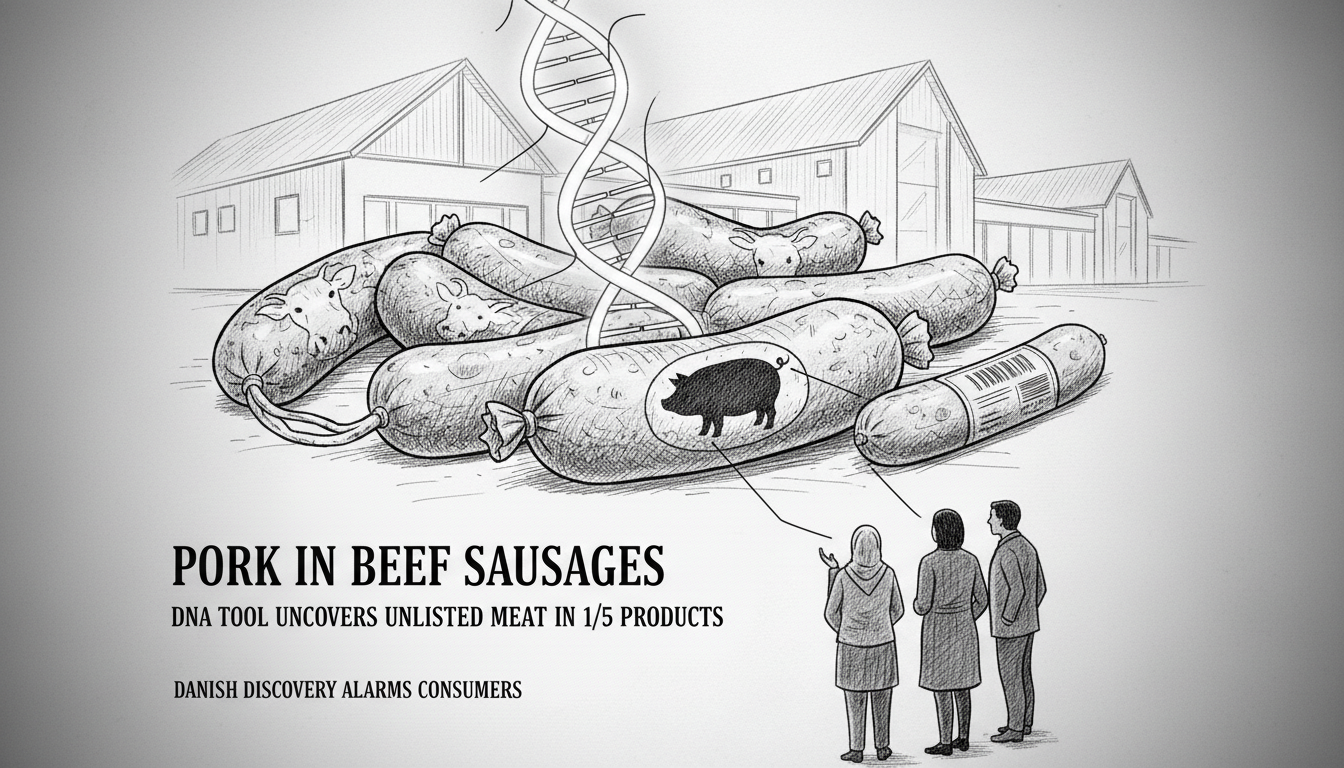
When you buy beef sausages with cheese at the supermarket, you might still end up with pork on your fork. A new DNA testing method from Danish food authorities reveals unexpected animal traces in food products.
Laboratory tests show one in five meat products contains DNA from animals not listed on ingredients labels. The findings affect various supermarket staples.
Ole Søgaard Lund, section manager at the Food Administration Laboratory, explained their discovery process. "This gives us a new lens to examine food with," he said in a statement.
The testing uncovered multiple cases of unlabeled ingredients:
Turkey traces in chicken sausages
Duck and chicken DNA in turkey cold cuts
Beef found in sheep salami
Lamb detected in beef spegepølse
Pork discovered in beef sausages
Multiple undeclared fish species in fish balls
Chicken in duck gyoza
Turkey in beef sucuk sausage
This new method proves far more effective than previous approaches. Older techniques could only search for one animal species at a time.
"Now we can examine all fish species, shellfish species, or mammals simultaneously," Lund explained. "We get answers without needing to know exactly what we're looking for in advance."
The technology makes it easier to identify when food manufacturers aren't thorough with cleaning procedures. "It can detect sloppiness where equipment and machinery used in food production aren't properly cleaned," Lund noted.
The method also strengthens authorities' ability to combat food fraud. "It can obviously reveal deliberate deception when cheaper ingredients are mixed with more expensive ones," he added.
Current findings suggest carelessness rather than intentional fraud. "The discoveries we've made appear to be sloppiness rather than deception," Lund stated. "But we now have a tool that can detect both."
Some product categories show higher risks than others. "The foods where we see this are typically those involving mixtures of different ingredients," Lund observed. "Sausages and fish balls are examples we've examined, and we've definitely found some cases there."
These findings carry particular importance for Muslim and Jewish consumers who follow dietary restrictions. "We found pork in a beef sausage, for example," Lund noted. "This could be problematic for various minority groups."
Fish products revealed equally surprising results. "We found up to 16 different fish species in fish balls," Lund reported. "Many different fish can end up in a fishing boat's net, and they might not necessarily be sorted properly."
Food producers should be more transparent about what they're selling, according to Lund. "Manufacturers should tell consumers what they're actually selling," he argued. "We found salmon in sardines. That's not dangerous, but it should be declared."
He acknowledged that fish eat each other, which could explain some cross-contamination. Still, the scale of undisclosed ingredients suggests broader issues.
The DNA method currently operates as a pilot project, but Lund expects industry consequences. "When producers know we can actually detect these things, they might decide it pays to be more careful," he suggested.
Future applications could extend beyond meat products. "It could be used for plant-based products too," Lund said. "We could check whether there are animal ingredients in products without knowing in advance what to look for."
The real test will be whether this technological advancement leads to cleaner production and more honest labeling for consumers who deserve to know what they're eating.