
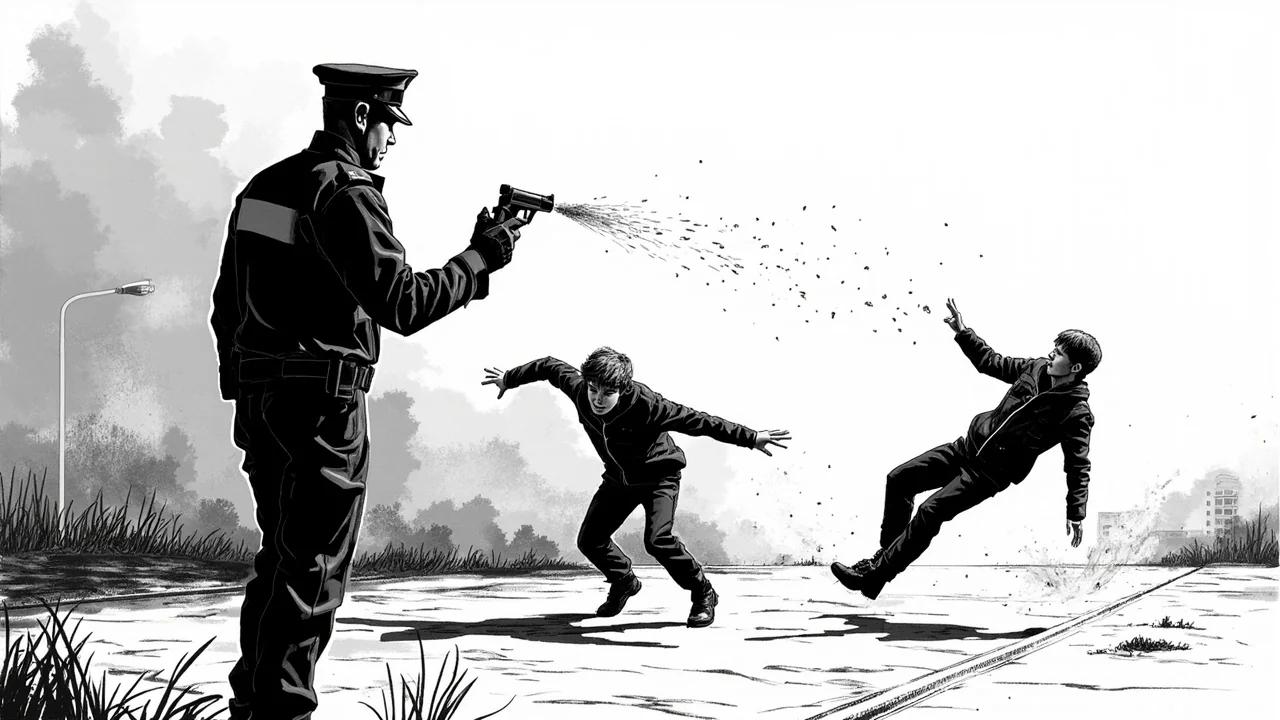
Sweden police have convicted an officer for aggravated assault after he used a Taser on a man's neck outside a Stockholm nightclub. The Stockholm District Court handed the 30-year-old officer a conditional sentence and community service for the unjustifiable use of force, marking a rare judicial rebuke of police violence in the country. The incident, captured on video, shows the officer applying the stun weapon directly to the subdued man's throat, leaving visible burn marks and violating explicit national guidelines.
A Night Out Turns Violent
The事件unfolded on a street in central Stockholm. The victim, attempting to bypass a queue at a nightclub, was first confronted by security guards. They physically removed him and pinned him to the ground. Bodycam footage shows the officer arriving at the scene where the man was already restrained. Despite the man being passive and under control, the officer deployed his conducted electrical weapon (CEW), pressing it against the man's neck and upper back area. "The officer went far too far in his use of violence when he placed the Taser against the neck/throat. The plaintiff was moreover passive," said Chief Prosecutor Marianne Nordström of the Special Prosecution Chamber. The court agreed, noting that while police have legal authority to use force during removals, this specific application was indefensible.
The Clear Rules Violated
Swedish police directives are unambiguous: Tasers must not be used against the face, throat, neck, or genitals. These prohibited zones are considered high-risk areas where the effects can be more severe and potentially life-threatening. "Putting the Taser against the neck where there are many nerve pathways, the effect can be greater even if it is not scientifically proven. The violence against this person is unjustifiable," Nordström stated. The visual evidence presented in court was damning, showing clear burn patterns on the victim's skin consistent with the weapon's prongs. The officer, who completed his Taser training in spring 2024, claimed in interviews that it felt unreasonable that he would have done so, stating he normally targets large muscle groups. The court found his actions criminal regardless of intent.
Legal Repercussions and Career Jeopardy
The conviction carries significant consequences beyond the conditional sentence. The officer was ordered to pay 33,100 Swedish kronor in damages to the victim. Crucially, he now faces likely dismissal from the police force. A final decision on his employment rests with the Police Department's disciplinary board, which routinely terminates officers convicted of serious crimes. Losing his job is a probable outcome. The court indicated that had it imposed a prison sentence, it would have been for four months. This case highlights the legal threshold for police conduct; authorization to use force is not a blank cheque. Every application must be proportionate and necessary in the moment. The ruling reinforces that officers who cross that line into brutality will be held personally accountable in the criminal justice system.
A Broader Conversation on Police Accountability
This case arrives during an ongoing national discussion about police methods and oversight in Sweden. While serious police convictions remain uncommon, this ruling demonstrates the judiciary's willingness to scrutinize use-of-force incidents. Legal experts point to the clarity of the Taser guidelines as a key factor in securing the conviction. The prohibited target areas are defined for a reason, and ignoring them creates clear criminal liability. The victim and his lawyer, Josefine Rasmusson, have declined public comment, a common practice for plaintiffs in such traumatic cases. The officer's legal representative could not be reached for comment following the verdict. The silence from both sides underscores the personal and professional devastation that follows such incidents.
Training and Systemic Scrutiny
The officer's recent training raises questions about the effectiveness of current Taser instruction within the Swedish police. If an officer, freshly trained, deploys the weapon in a categorically forbidden manner during a relatively low-level public order incident, what does that say about protocol reinforcement? Analysts suggest that theoretical knowledge of guidelines is not enough; training must stress instinctual compliance under pressure. This incident was not a split-second, life-or-death decision. It was a choice made during the restraint of a non-resisting individual. The conviction suggests the court saw it as a punitive or reckless act, not a tactical one. This distinction is vital for public trust.
The Scandinavian Context of Police Weaponry
Sweden's approach to less-lethal weapons like Tasers has evolved. Their introduction was debated extensively, with strict regulations put in place to prevent abuse. This case tests those safeguards. Neighbouring Norway and Denmark have their own stringent rules, and a conviction like this would likely have similar professional consequences. The Nordic model of policing emphasizes de-escalation and proportionality. A violation so blatant strikes at the core of that principle. It provides ammunition both for critics who argue police should have fewer weapons and for supporters who say the existing rules, when enforced, work.
What Comes Next for the Victim and the Officer?
For the victim, the financial compensation is a small acknowledgment of a profound physical and psychological violation. The burns will heal, but the experience of being electrocuted by an authority figure while restrained may leave deeper scars. For the officer, a career in public service is almost certainly over. The conditional sentence allows him to avoid prison, but a criminal record for aggravated assault is a heavy burden. The case is now a part of his permanent file and a precedent in Swedish legal archives. It will be cited in future misconduct trials and in police academies as a case study in what not to do.
A Final Verdict on Trust
The Stockholm District Court's decision sends a clear message: a badge is not a shield against prosecution for violence. By convicting the officer, the judiciary has upheld a critical standard. However, one conviction does not fix systemic issues. It requires constant vigilance from prosecutors, internal police oversight units, and the media. Public confidence in law enforcement is fragile. Incidents like this, even if legally rectified, damage it. The true test for the Swedish police is whether this case leads to improved training, stricter supervisory intervention, and a cultural reinforcement that the most restrictive rules apply most stringently when a citizen is most vulnerable—under control and on the ground. The burn marks on one man's neck have left a mark on the national conscience. Will it fade, or will it remind everyone of the line that must never be crossed?