
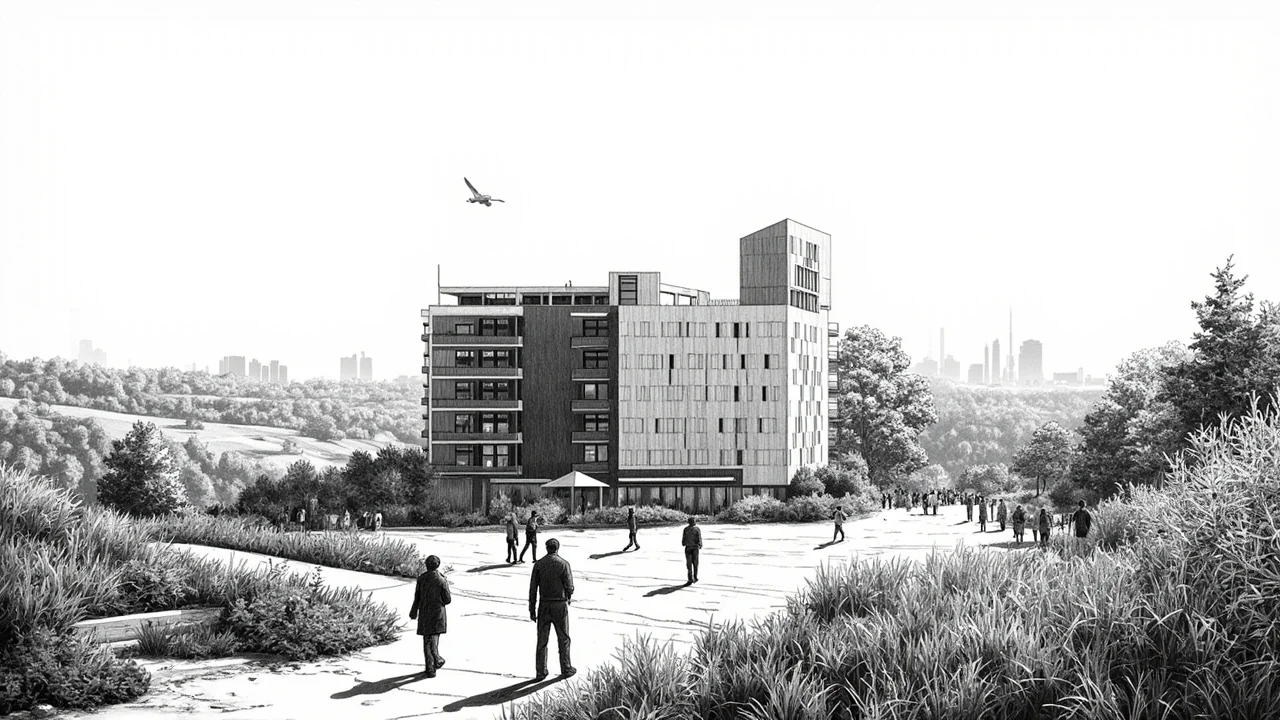
Sweden’s latest urban development in Sundbyberg will soon house students, residents, and small mammals—all within 200 meters of each other. The newly approved Garbo housing project at Franstorpsvägen 21–29, set for completion in 2028, sits directly beside a planned campus for Realgymnasiet, a high school currently based in Hallonbergen since 2022. Just across the street, another building will feature specialized enclosures for small mammals and reptiles—marking one of the most unusual neighbor pairings in recent Swedish urban planning.
A Neighborhood Built on Contrasts
The area around Lilla Alby has long been in transition. Once dominated by the now-demolished Grand Garbo nightclub, the site is being reimagined as a mixed-use zone blending education, housing, and even wildlife conservation. Developer Balder recently secured building permits for the residential portion, though it has remained quiet about the adjacent school plans. Meanwhile, the municipality confirmed that Realgymnasiet is relocating to this more central Sundbyberg location after years in the suburban Hallonbergen district.
This proximity creates a striking juxtaposition: teenagers attending classes steps away from families moving into new apartments, with animal habitats nestled nearby. The wildlife component—a structure designed to shelter small mammals and reptiles—is part of broader ecological integration efforts in new Swedish developments. While such features are increasingly common in eco-conscious projects, placing them so close to both homes and a school is rare.
From Nightlife to Classroom and Nesting Boxes
Grand Garbo once pulsed with music and late-night crowds, its neon lights defining the corner of Franstorpsvägen. Today, excavators sit idle on the cleared lot, awaiting the start of construction scheduled for later this year. The shift from entertainment venue to educational and residential hub reflects Sundbyberg’s push to densify while maintaining green and social infrastructure.
Realgymnasiet’s move signals a strategic effort by the school to improve accessibility. Hallonbergen, though well-connected by metro, lacks the centrality that many families and students now seek. “We’ve wanted a more central location in the municipality for some time,” a school representative said in a statement. The new campus will be built on land adjacent to the Garbo residences, ensuring students can walk to class without crossing major roads.
Meanwhile, the animal-friendly building on the same block adds another layer. Though details remain sparse, the inclusion of habitats for small native species aligns with Sweden’s national biodiversity goals. Urban planners increasingly weave ecological considerations into housing projects, but rarely do these elements end up sharing an entrance—or a sidewalk—with a high school.
Questions About Noise, Safety, and Shared Space
As plans solidify, local residents have begun raising practical concerns. Will classroom noise disturb new homeowners? Could curious students interfere with the wildlife enclosures? And how will traffic flow during school drop-off hours alongside resident parking?
Sundbyberg Municipality has not yet released detailed traffic or zoning studies for the block. Balder, the developer behind the Garbo residences, declined to comment beyond confirming the building permit approval. Still, the co-location appears intentional—a reflection of modern Swedish urban ideals that prioritize walkability, sustainability, and community mixing.
In neighborhoods like Råsunda and Central Sundbyberg, similar blends of housing, schools, and green spaces have succeeded. But the addition of active wildlife habitats introduces a new variable. Unlike decorative green roofs or bird boxes, these enclosures may require maintenance access, monitoring, and possibly public education to prevent interference.
What This Says About Swedish Urban Planning
The Garbo Quarter exemplifies a broader trend in Swedish society: the rejection of single-use zoning in favor of layered, human-centered design. Over the past decade, cities like Malmö, Gothenburg, and Stockholm have championed “15-minute city” concepts where daily needs—school, home, nature—are within short walking distance.
Sundbyberg, though small, is aggressively pursuing this model. With limited land available, the municipality must maximize every square meter. Combining a school, housing, and ecological infrastructure on one city block isn’t just efficient—it’s symbolic of a cultural shift toward integrated living.
Yet success hinges on execution. Poor sound insulation between classrooms and apartments could lead to complaints. Unclear boundaries around wildlife areas might result in safety issues or habitat damage. Community input will be crucial as construction begins.
Read more: Sweden's Deep Freeze Continues Into March.
Read more: 50-Year-Old School Employee Arrested on Rape Suspicion.