
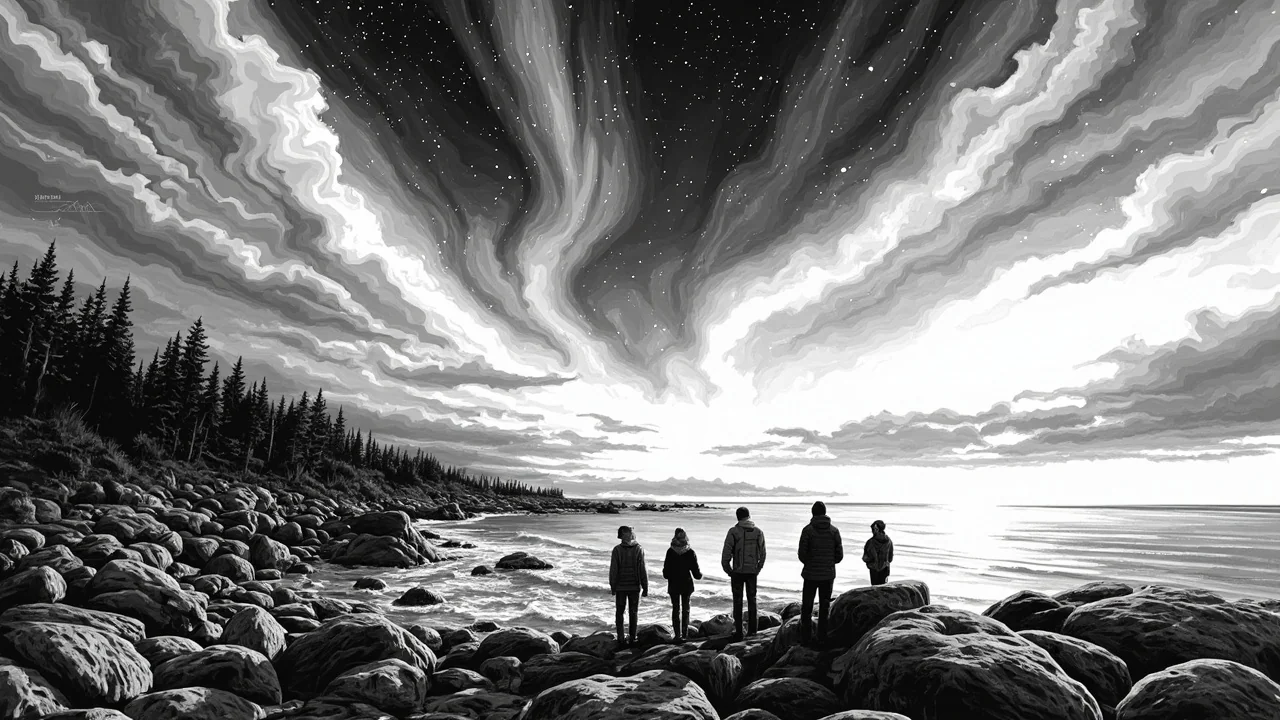
Sweden's west coast residents have a rare chance to see the aurora borealis this week, thanks to a peak in solar activity. Solar researcher Urban Brändström at the Institute for Space Physics (IRF) advises those with clear skies to look north. The heightened chance is tied to the current solar maximum, a period of intense activity in the sun's 11-year cycle that produces powerful solar storms.
Understanding the Solar Phenomenon
A solar maximum marks the phase in the sun's 11-year cycle when its activity is highest. This results in frequent solar storms, which are powerful outbursts of energy. These storms consist of radiation or charged particles ejected from the sun. While they create the spectacular light displays of the aurora, they can also have significant impacts on technology. Urban Brändström notes these storms can pose a life-threatening danger to astronauts. They are also known to disrupt radio communication and can damage or destroy satellites and space probes.
For ground-based infrastructure, the risk appears contained for now. Brändström currently sees no immediate risk of the solar storms causing disruptions to technical systems like power grids. The primary effect for most Swedes, therefore, could be a visual treat rather than a technical headache. The interaction between these charged particles and Earth's magnetic field is what paints the sky with green, red, and purple hues, a phenomenon typically reserved for the northernmost parts of the country.
The Viewing Forecast and Challenges
The best probability for auroral sightings is predicted for the nights leading into Thursday, Friday, and Saturday. The key factor for observers in the Gothenburg region and along the west coast will be weather conditions. Emma Rosengren, the duty meteorologist at the Swedish Meteorological and Hydrological Institute (SMHI), states that cloud cover is very difficult to predict at this range. Clear patches are essential for any chance of seeing the celestial display.
Brändström emphasizes the inherent uncertainty in forecasting these events with precision. He says it is very difficult to say in advance exactly how the situation will develop. His advice is straightforward for those hoping to catch a glimpse. If the solar explosions continue favorably, auroras could appear over the west coast. He urges the public to simply keep a watch on the sky on the indicated nights.
The Science Behind the Lights
The aurora borealis, or northern lights, occurs when charged particles from the sun are channeled by Earth's magnetic field toward the poles. There, they collide with atoms and molecules in the upper atmosphere, exciting them and causing them to emit light. The colors depend on the type of gas being excited and the altitude of the collision. Oxygen typically produces green and red light, while nitrogen yields blue and purple hues.
The current solar cycle, numbered 25, began in December 2019. The progression toward maximum has been faster than initially forecasted by scientists. This increased pace means more frequent coronal mass ejections and solar flares, which are the drivers of both major geomagnetic storms and vivid auroral displays. These cycles have been observed and recorded for centuries, with their effects on Earth's environment a key area of study for space weather physicists.
Historical Context and Modern Monitoring
Sweden has a long history of auroral observation, both as a cultural marvel and a scientific subject. The country's latitude makes it a prime location for study. Research institutions like the IRF in Kiruna are at the forefront of monitoring solar activity and its terrestrial impacts. Their work is crucial for providing early warnings to sectors like aviation, satellite operators, and power companies, which can all be affected by severe space weather.
Historically, extreme solar storms have had notable consequences. The Carrington Event of 1859, for instance, caused telegraph systems across Europe and North America to fail, with some operators reporting sparks and fires. A storm of that magnitude today would pose a severe challenge to our technology-dependent society. This underscores the importance of the monitoring work done by scientists like Brändström, even during periods of lower risk.
Practical Tips for Sky Watchers
For those on the west coast aiming to see the potential display, a few tips can improve the experience. Find a location with as little light pollution as possible, looking north with a broad, unobstructed view of the horizon. Patience is required, as auroras can appear as faint glows that slowly intensify. Using a camera with a long exposure setting can often capture colors more vividly than the naked eye can see.
While the intense displays associated with the Arctic Circle are unlikely, a strong geomagnetic storm can push the auroral oval southward. This is what creates these rare viewing opportunities in southern parts of Sweden. The event is a reminder of the dynamic connection between our planet and its star. Will clear skies and continued solar activity align to give west coast residents a memorable natural light show this week?