
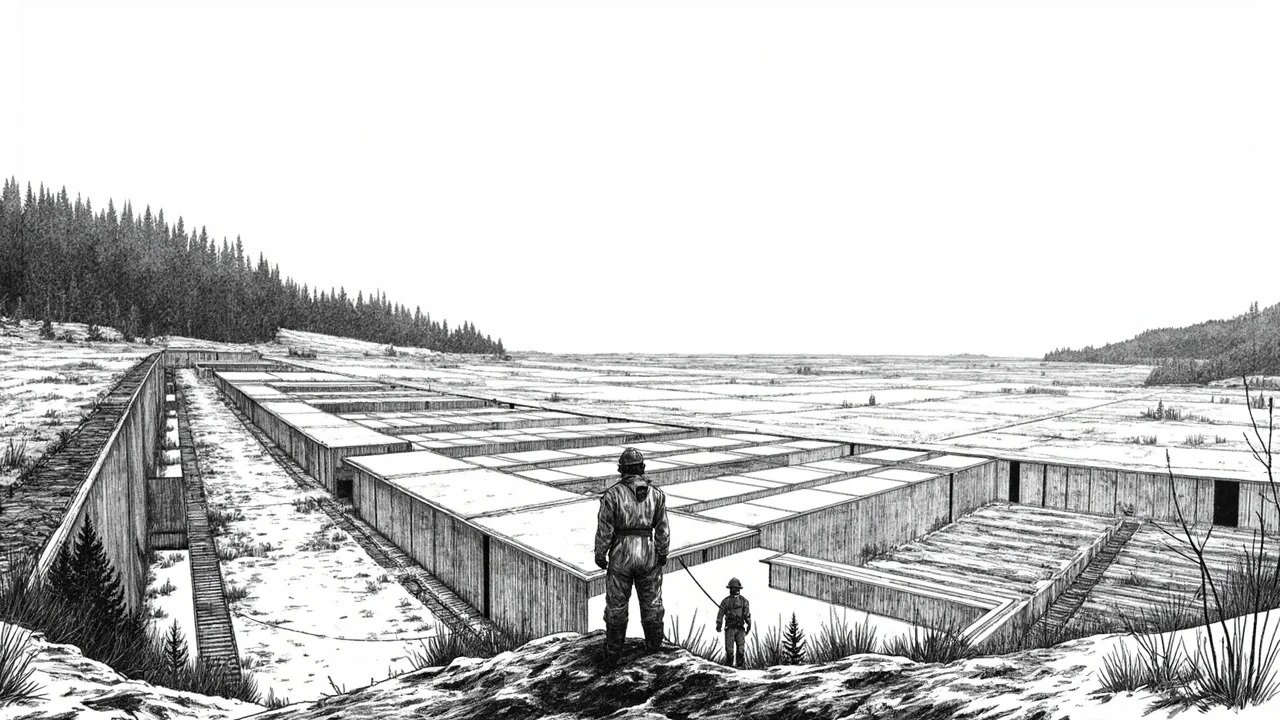
Sweden's government faces a critical 1 trillion kronor financial blockade as state-owned Vattenfall demands a new solution for nuclear waste costs before it will build new reactors. The dispute, centered on funding for a permanent repository, directly threatens the coalition's flagship energy policy and its goal of expanding nuclear power.
Anna Borg, Vattenfall's Chief Executive, stated the company's position clearly. 'There must be a solution for the final repository of spent nuclear fuel where our project only needs to bear its share,' Borg said. Her statement references high-level negotiations currently underway between the energy giant and officials at the Government Offices in Rosenbad. At stake is the plan to construct between three to five new small modular reactors at the Värö peninsula, adjacent to the existing Ringhals nuclear plant.
The Core Financial Dispute
The current framework for financing Sweden's nuclear waste management is proving incompatible with plans for new reactor construction. Existing rules, established through previous Riksdag decisions, require new nuclear power projects to fully cover their future waste management costs. Vattenfall argues the planned scale of its new project is too small to viably cover the immense upfront costs for a final repository, a facility whose total lifetime cost is estimated to approach one trillion Swedish kronor. The company is not satisfied with how the cost burden is currently distributed and is seeking a revised national model.
This financial deadlock has moved the issue from the boardroom to the heart of Stockholm politics. Senior government ministers, including likely Energy Minister Ebba Busch from the Christian Democrats, are now directly involved. The outcome will test the Swedish government's ability to translate its pro-nuclear platform into tangible policy results. A failure to resolve the waste funding issue could delay or derail the first new nuclear construction in decades, a key pillar of the government's energy security strategy.
Historical Context of Nuclear Waste Policy
Sweden's approach to nuclear waste is one of the most developed in the world, born from a long political consensus. The process is managed by the Swedish Nuclear Fuel Fund, a state-administered system financed by fees on nuclear electricity production. This system was designed for the existing reactor fleet. The planned final repository for spent fuel, developed by the Swedish Nuclear Fuel and Waste Management Company (SKB), has undergone decades of research and democratic review, receiving a crucial government approval in 2022.
The current impasse reveals a flaw in forward planning. Previous Riksdag decisions created a robust system for legacy waste but did not fully anticipate the financial mechanics of a new build program with different private and state actors. The principle that the polluter pays is enshrined in law, but applying it to a new generation of reactors, which the state itself is championing, creates a circular financial challenge. Vattenfall's project cannot proceed if it must bear a disproportionate share of infrastructure costs meant for a larger national fleet.
The Bureaucratic Pathway Forward
Resolving this issue requires navigating complex bureaucratic and legislative channels. Any new agreement or legislative change must originate from the Government Offices in Rosenbad, be formalized into a government bill, and then secure a majority in the Riksdag. This process involves the Ministry of Climate and Enterprise, the Swedish Radiation Safety Authority (SSM), and the finance committee within the parliament.
Potential solutions under discussion could involve state guarantees, a revised fee structure spread over a longer timeframe, or the creation of a separate funding vehicle for new build waste. Each option carries significant implications for state finances and must align with European Union state aid rules. The negotiations are therefore not merely commercial but deeply political, touching on fiscal responsibility, energy sovereignty, and the state's role in industrial policy.
Stakes for Sweden's Energy Future
The implications extend far beyond Vattenfall's balance sheet. Sweden's Parliament has set ambitious goals for electricity production to meet soaring demand from industry electrification and the green transition. The government's policy roadmap envisions nuclear power as a stable baseload complement to wind and hydro. A failure to launch new nuclear projects would force a rapid reevaluation of how to meet those national targets, potentially increasing reliance on intermittent renewables and electricity imports.
Furthermore, the credibility of the Swedish model for managing nuclear technology is in play. Sweden has long been cited internationally for its methodical, consensus-driven approach to radioactive waste. A protracted public dispute between the state and its own energy company over financing undermines that narrative and could affect investor confidence in the entire energy sector.
The coming months will be decisive. The Swedish government must broker a deal that satisfies Vattenfall's legitimate financial concerns while upholding the 'polluter pays' principle for the Riksdag and the public. If no solution is found, Sweden's nuclear renaissance may stall before a single reactor is ordered, leaving a one trillion kronor question unanswered.