
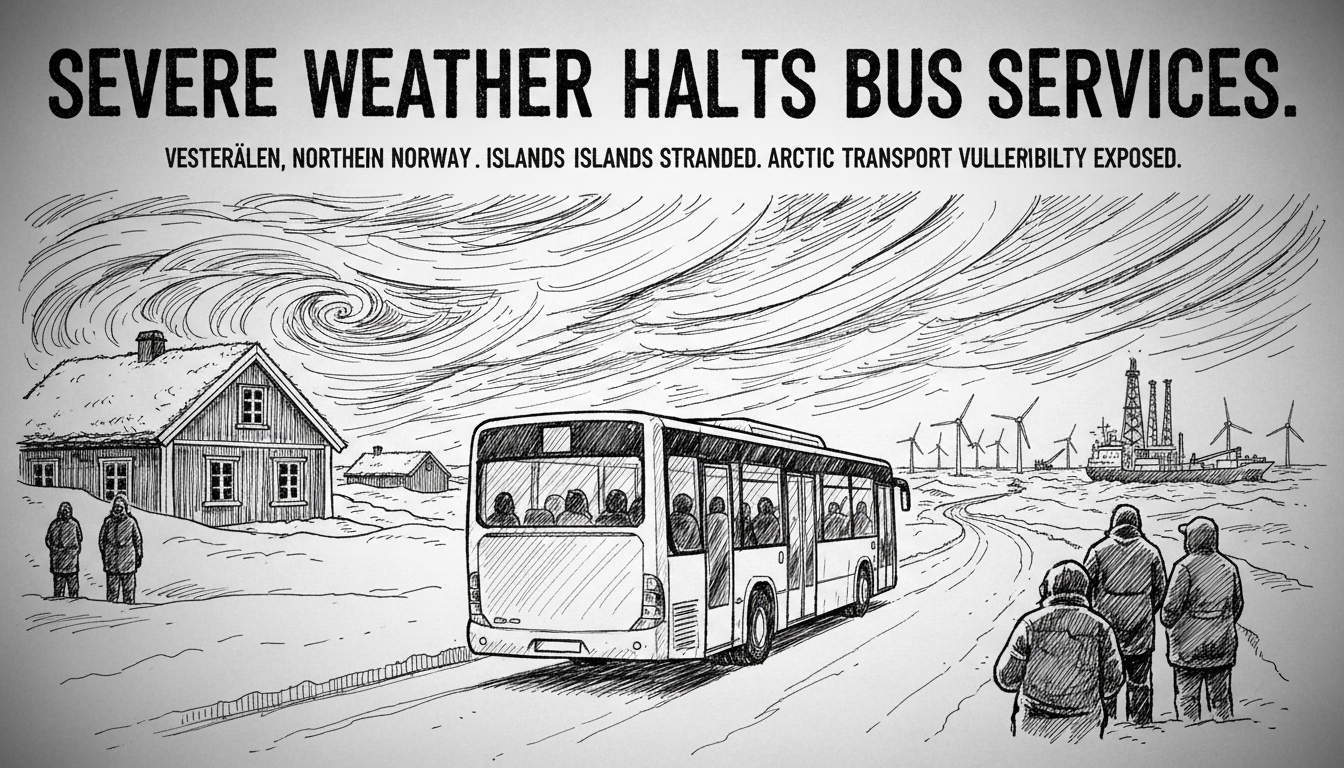
Nordland County officials suspended all bus traffic across the Vesterålen archipelago starting at 2:00 PM local time on Wednesday. The decision came as a direct response to deteriorating weather conditions. This shutdown impacts all major regional routes connecting key island communities. The affected lines include services from Stokmarknes to Melbu, Sortland to Lødingen, and the critical Sortland-Stokmarknes-Melbu corridor.
This is not an isolated incident for Northern Norway. The region's transport infrastructure remains highly vulnerable to Arctic weather systems. Local governance falls to the Nordland County Municipality, which holds responsibility for public transport decisions. These sudden suspensions highlight a recurring challenge for remote Nordic communities. They depend on a single transport link that can be severed by storms.
For international observers, this event underscores the practical realities of life above the Arctic Circle. Norway invests heavily in its northern territories, particularly for strategic and resource-related reasons. The Norwegian Sea off Vesterålen is a crucial maritime zone for fisheries and offshore energy. Reliable transport is essential for the workforce supporting these industries. A bus stoppage can strand workers and disrupt supply chains for offshore installations.
The political dimension is also clear. The Storting, Norway's parliament, continually debates funding for northern infrastructure. Proposals often involve hardening roads and ferry connections against extreme weather. These debates intersect with broader Arctic policy and national energy security. Norway's oil and gas production, a cornerstone of its economy, relies on stable logistics to remote coastal communities. Facilities near Melbu and Sortland service offshore platforms in the Norwegian Sea.
What happens next? County authorities will monitor conditions closely. Services typically resume once wind speeds drop and visibility improves. The economic cost of such stoppages is real but rarely quantified. Local businesses lose customers, and workers lose paid hours. This incident serves as a stark reminder. Norway's northern prosperity, fueled by oil and gas revenues, still battles against fundamental natural forces. The government's ability to mitigate these disruptions remains a key test of its Arctic commitments.