
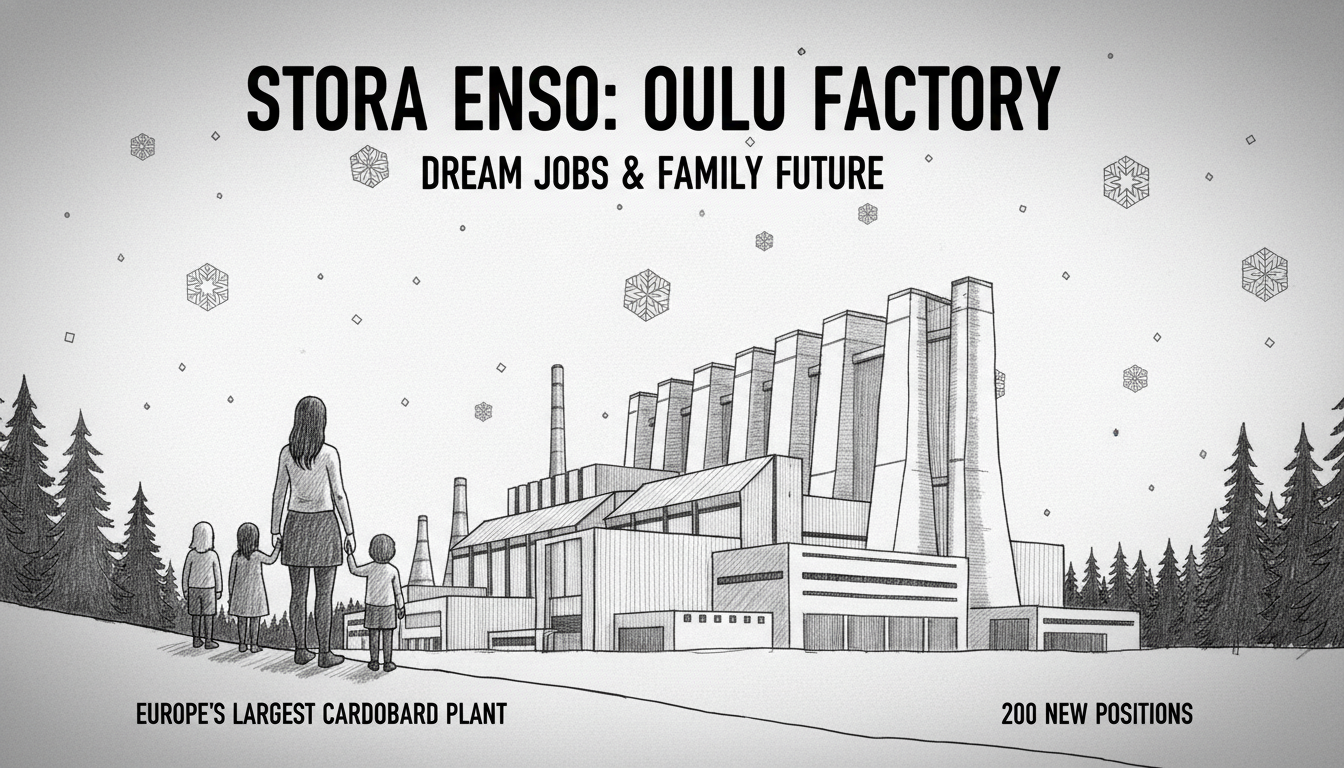
Stora Enso's new cardboard factory in Oulu has hired 200 new workers in a short time. The facility represents a €1 billion investment, making it the company's largest production plant in Europe.
Heli Heikkinen, a 41-year-old mother of seven, landed a process operator position at the factory. She describes it as a dream job for someone with a family. "It felt like winning the lottery," Heikkinen said. "This job is a dream for a family person."
The plant produces consumer packaging board for the global food industry. Its products include banana boxes, pizza boxes, cereal packaging, and beverage cartons.
Factory director Matti Lielahti explained the transition from paper to cardboard production. "We used to make premium paper here, the best on the market," Lielahti stated. "Now we aim for the same quality with cardboard."
The factory's city-center location helps recruitment. Situated just one kilometer from Oulu's central core, it's easily accessible for workers.
Heikkinen finds the shift rotation perfect for family life. The schedule includes morning shifts followed by night shifts and then five days off. "I can schedule appointments on days off and keep work separate from family time," she noted.
After working in school kitchens, Heikkinen retrained as a process operator during the pandemic. She completed three years of studies in just 18 months while managing her large household.
The factory currently employs about 600 people, with 200 recently hired. While the industry is male-dominated, women make up 15% of the Oulu plant's workforce.
Current market demand for consumer cardboard remains weak. Stora Enso's recent results showed a clear decline, affected by both market conditions and the Oulu factory's startup phase.
For Heikkinen, the massive machines and learning opportunities make the job rewarding. The salary also represents a significant improvement from her previous work in cleaning and restaurants.
The factory's central location presents noise and odor control challenges that require careful management. Yet for workers like Heikkinen, the urban accessibility outweighs these concerns.
This expansion shows how major industrial investments can create meaningful employment opportunities even in developed Nordic economies, particularly for workers willing to retrain for new industries.