
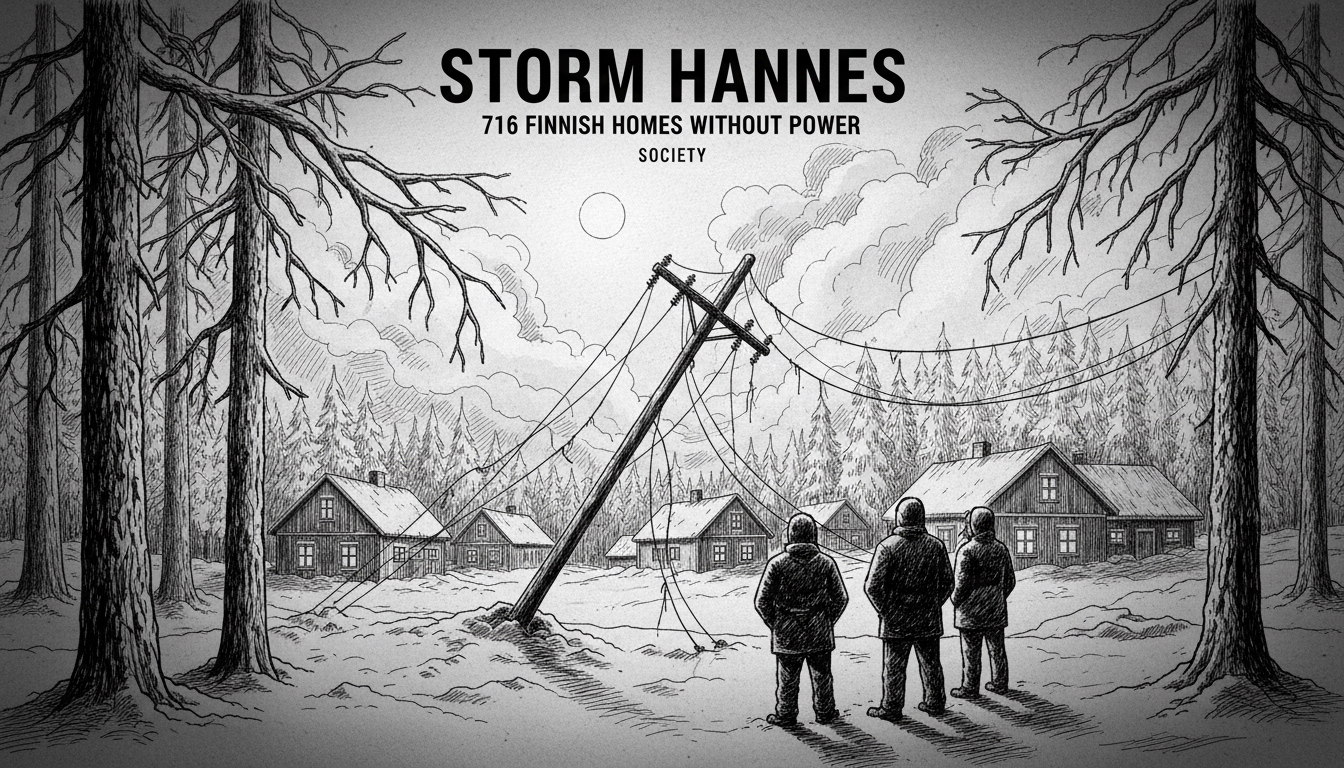
Finland storm Hannes caused power outages for 716 households across four municipalities on Sunday morning. The storm, which swept through the Aamuposti region north of Helsinki, brought high winds that downed trees and power lines, though authorities reported only minor property damage. The relatively contained impact has been attributed to the storm's path and Finland's well-maintained emergency response systems.
As of 9 a.m. Sunday, the most severe disruption was in Loppi, where 650 homes sat in darkness. Hyvinkää reported 20 households affected, Hausjärvi had 40, and Riihimäki counted 6. Rescue services across Keski-Uusimaa were engaged in scattered, small-scale damage control operations throughout the morning. Power companies worked swiftly to repair the grid, a common autumn task in a country battered by 10-20 major storms annually.
Assessing the Aftermath in Keski-Uusimaa
The regional rescue service confirmed a busy but manageable morning. Teams responded to isolated incidents involving fallen trees and minor structural damage in Hyvinkää and Hausjärvi, with one additional call in Loppi. No injuries were reported. The scene contrasted sharply with more destructive storms like November's Janika, which left tens of thousands without electricity. Hannes appears to have skirted the most densely populated areas, focusing its energy on rural Loppi.
Meteorologists at the Finnish Meteorological Institute (Ilmatieteen laitos) had issued standard warnings. Their data shows such events are a routine, if disruptive, part of Finnish life, especially from late summer through winter. The geography of forests and lakes creates long, exposed power lines vulnerable to gusting winds. The Institute's forecasts are critical for municipal preparedness and for citizens to secure loose items on their properties.
Infrastructure Under Pressure and Policy Response
This localised event opens a window into national infrastructure challenges. The outage map maintained by Energiateollisuus ry, the energy industry association, provides real-time public data. For Members of Parliament on the Commerce Committee, even small-scale outages trigger questions about grid investment. Finland's electricity network is vast and expensive to maintain against climatic forces.
‘Our grid must be reliable year-round, not just in calm weather,’ said Minister of Economic Affairs Wille Rydman (Finns Party) in a recent parliamentary debate on energy security. The government's long-term climate and energy strategy acknowledges the need to harden infrastructure. This involves both physical resilience and strategic deployment of repair crews. The EU's updated Electricity Directive also pushes member states to improve continuity of supply, a factor in Helsinki's funding calculations.
The High Cost of Finnish Storms
Finland's storm damage bills run into millions of euros each year. Costs are split between state-backed compensation for forest owners, municipal cleanup budgets, and utility repair investments. A single severe event can cause over €50 million in damages to forests alone. While Hannes was a minor episode, it serves as a live exercise for response protocols.
Energy experts note that the shift toward decentralised renewable sources and microgrids could offer future resilience. Local solar and battery storage can keep critical services running when the main grid fails. The Ministry of Economic Affairs and Employment is evaluating incentives for such solutions. For now, the model relies on the rapid response of centralised utilities like Helen and Fortum, whose crews were dispatched across the affected region on Sunday.
Expert Analysis on Preparedness and Climate
‘Every storm is a test,’ said Professor Laura Kolehmainen, a risk management expert at the University of Helsinki. ‘The low damage from Hannes shows our warning systems and public awareness work. But we cannot be complacent. Climate models suggest we may face more intense precipitation and wind patterns.’ She emphasises individual preparedness: having flashlights, backup power for phones, and an emergency supply of water and food.
From the utility perspective, the challenge is logistical. ‘Our priority is restoring power to the largest number of customers first,’ explained a network operations manager for a major Finnish energy firm, speaking on standard practice. ‘Hospitals and critical infrastructure are always top, then we move to areas with the highest customer density. A storm like Hannes, affecting scattered rural homes, presents a different operational puzzle than an urban blackout.’
Looking Ahead: Resilience in Government Strategy
The incident, though minor, will be logged and analysed. Data from such events feeds into the National Emergency Supply Agency's (NESA) models. In the Eduskunta, the Finance Committee scrutinises annual budget allocations for infrastructure maintenance against these real-world results. The goal is a network that can withstand the increasingly volatile weather predicted for the Nordic region.
For now, residents in Loppi, Hyvinkää, Hausjärvi, and Riihimäki have seen their power restored. The passage of Hannes was a brief autumn inconvenience, not a catastrophe. It underscores a quiet, ongoing reality: maintaining a modern society in Finland's demanding environment is a constant, costly effort. As darkness falls earlier each day, the question for policymakers is how to fund a grid that won't leave citizens in the dark. Will future storms find Finland better prepared, or will aging power lines prove a growing vulnerability in the climate era?