
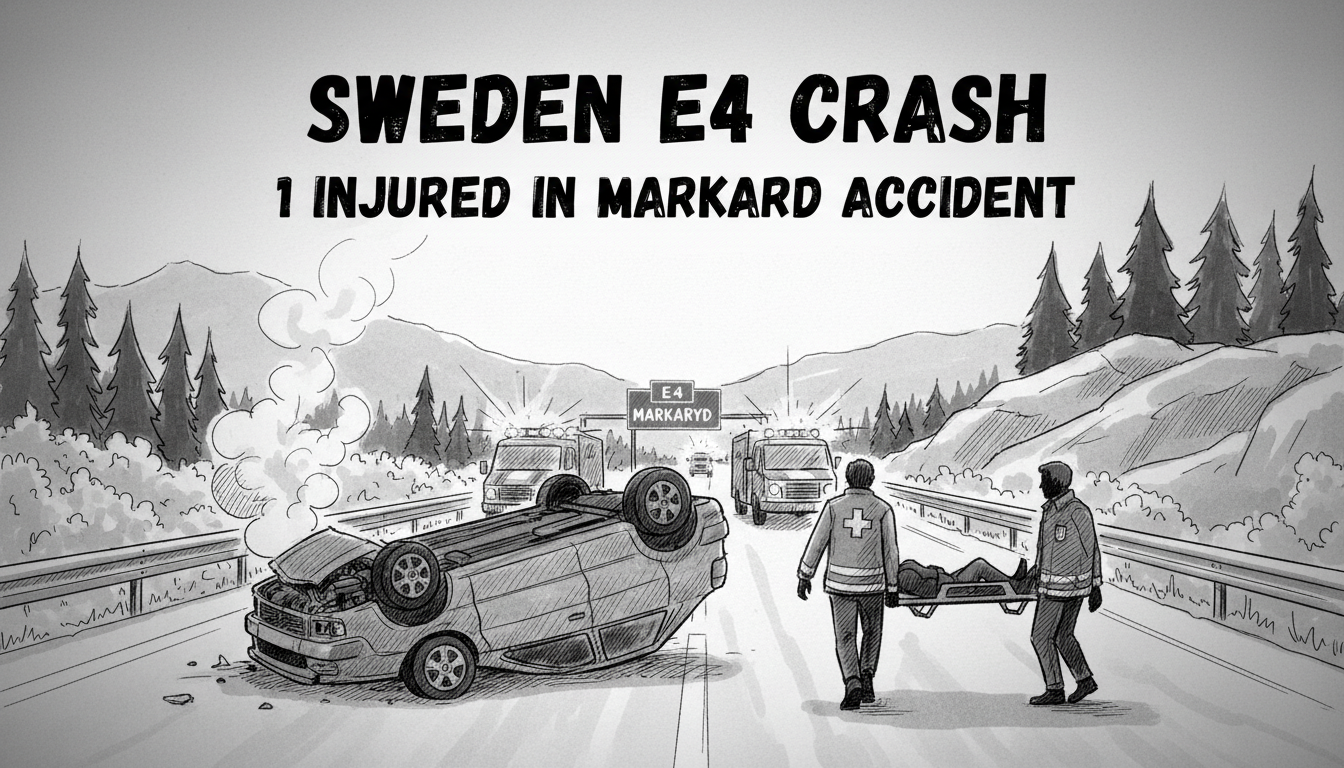
Sweden's E4 highway saw another serious accident Tuesday morning near Markaryd, leaving one person hospitalized. The single-vehicle crash occurred just after 8 AM near the Markaryd Norra interchange, a stretch of road familiar to thousands of daily commuters and freight transporters. Police and ambulance services rushed to the scene where a car had collided with the guardrail heading southbound. The injured person was transported by ambulance to hospital, their condition currently unknown. Authorities have since left the scene, stating no crime is suspected.
For residents of the quiet Småland municipality, the sound of sirens cutting through the morning air is an unwelcome reminder of the road's constant danger. The E4 here carves through dense forests and past serene lakes, a landscape that belies the highway's relentless traffic flow. This accident is not an isolated event but part of a troubling pattern on one of Scandinavia's most vital transport corridors.
The Human Cost of Highway Travel
While statistics tell one story—334 fatal road accidents in Sweden in 2022—the human impact is felt in communities like Markaryd. Each siren represents a life interrupted, a family waiting for news, and local emergency crews springing into action. The driver involved in Tuesday's crash becomes another entry in Sweden's road safety data, but their experience is profoundly personal. Was it a local resident heading to work? A long-haul trucker on a delivery run? A family on an early summer holiday? The police report provides none of these details, leaving the human story untold.
Road safety experts point to multiple factors behind single-vehicle accidents like this one. "On long, straight stretches of highway like the E4 through Småland, driver fatigue and momentary distraction become significant risks," explains a traffic safety analyst I spoke with. "The monotony of the landscape, combined with high speeds, means any error can have severe consequences. A split-second glance at a phone, adjusting the radio, or simply daydreaming can lead to drifting out of the lane."
Understanding Sweden's Accident Patterns
Single-vehicle accidents represent a substantial portion of Sweden's serious traffic injuries. These crashes often involve cars leaving the roadway and striking fixed objects like guardrails, trees, or light poles. Unlike multi-vehicle collisions, they typically involve just one driver's actions and vehicle condition. Weather can play a role too—though Tuesday morning was clear, this region experiences rapid weather changes that can catch drivers unprepared.
Sweden has been a global leader in road safety through its Vision Zero policy, aiming to eliminate traffic fatalities and serious injuries. The country has implemented extensive safety measures: 2+1 roads with barrier separation, lower urban speed limits, and advanced vehicle safety requirements. Yet highways like the E4 present ongoing challenges due to their age, design variations, and immense traffic volume.
"The E4 is essentially Sweden's backbone," says Lars Bengtsson, a retired transport planner I met in Stockholm. "It was built and expanded over decades, meaning some sections have modern safety standards while others don't. Upgrading it completely is a massive, continuous project. When an accident happens, we must look at that specific section—was the guardrail design optimal? Was the road surface adequate? Could better signage have helped?"
The E4: Sweden's Essential Artery
Stretching over 1,600 kilometers from Helsingborg in the south to Haparanda on the Finnish border, the E4 connects Sweden's major cities and industrial centers. It carries not just personal vehicles but a huge portion of the country's freight—everything from Norwegian salmon heading to continental Europe to Swedish timber and machinery exports. This commercial pressure means the road rarely sleeps, with heavy trucks operating through the night.
The section near Markaryd has seen improvements in recent years, including the Markaryd Norra interchange itself. Yet accidents persist. Local fire and rescue services train regularly for highway extrications, knowing the specific challenges of these crashes: potential fires, hazardous materials from trucks, and difficult access to vehicles that have left the roadway.
For the injured person from Tuesday's crash, the journey now moves from highway to hospital. Sweden's healthcare system will provide treatment, while insurance companies will begin their assessments. If the person is a professional driver, their employer faces operational disruptions. If they're a parent, children might need care arrangements. The ripple effects of a few seconds of inattention or mechanical failure spread far beyond the crumpled guardrail.
A Community's Relationship with the Road
Markaryd, with just over 4,000 inhabitants, has a complicated relationship with the E4. The highway brings economic activity and connectivity, placing the town within reasonable commuting distance of larger cities like Växjö and Helsingborg. But it also brings noise, pollution, and the ever-present risk that divides communities physically and psychologically. Parents teach children never to attempt crossing it on foot. Homeowners accept that property values are affected by the constant hum of traffic.
"You grow accustomed to it, but never comfortable," says Anna, a café owner in Markaryd who asked me not to use her last name. "Every time the emergency vehicles go past, we all look up. We wonder if it's someone we know. We wonder if it's tourists who took a curve too fast. Today it was quiet for a moment after the sirens—that collective pause where everyone thinks about how fragile we all are on that road."
This cultural awareness of road danger is distinctly Swedish, nurtured by decades of safety campaigns. From school programs to television advertisements, Swedes are constantly reminded of traffic risks. The Swedish Transport Administration (Trafikverket) publishes detailed accident statistics and invests heavily in research. Yet human behavior remains the most unpredictable variable in their equations.
Looking Beyond the Crash Report
Police have indicated no crime is suspected in Tuesday's accident, which typically means no evidence of intoxication, reckless speeding, or intentional action. This points toward the more common, yet no less devastating, categories of accident causes: fatigue, distraction, medical emergency, or simple error. Modern vehicle safety systems—electronic stability control, lane departure warnings, automatic emergency braking—have reduced accidents significantly, but cannot eliminate them entirely.
The next steps will involve traffic investigators examining the vehicle for mechanical faults and reviewing any available camera footage. The hospital will work to stabilize and treat the injured person. The Swedish Transport Administration may add this location to their database for future infrastructure improvements.
For the rest of us who use Sweden's roads, this accident serves as another sobering reminder. The E4 will continue to carry millions of journeys this year—commutes, deliveries, holiday trips, and family visits. Each driver bears responsibility not just for their own safety, but for how their momentary decisions affect everyone sharing that asphalt ribbon through the Småland forest.
As the summer travel season approaches, with more cars, caravans, and foreign tourists on Swedish roads, will we see the collective vigilance needed to prevent the next call to emergency services? Or will the statistics of 2024 simply record another number where today there is still a person, a story, and a community holding its breath?