
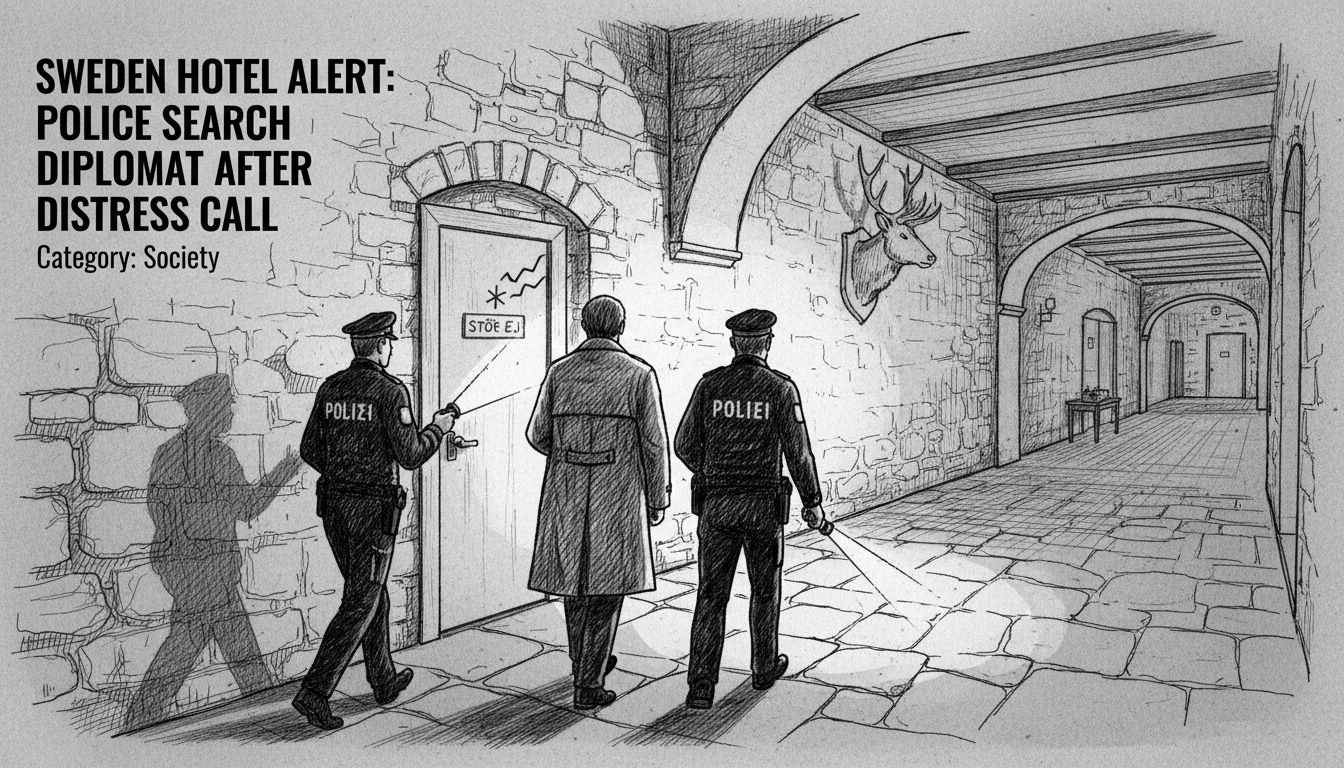
Swedish police launched a major operation at the luxury Hotel Diplomat on Stockholm's exclusive Strandvägen boulevard. The response followed a woman's emergency call reporting she had been assaulted in a hotel room. Officers swarmed the prestigious address, a scene of calm elegance now disrupted by flashing blue lights and urgent police activity.
"We received an alarm that a person was in distress," said police press spokesperson Mats Eriksson. "But so far, we have not found anyone in need of help or anyone injured. We are searching for the person who called in and confirming that something actually happened."
The woman reportedly told emergency operators she had been subjected to violence. Multiple police units converged on the hotel, located in the affluent Östermalm district. The swift, visible deployment on one of the city's most famous streets highlighted the priority Swedish law enforcement places on potential violent crime, even from a single, unverified report.
A Jarring Scene on Stockholm's Most Prestigious Street
Strandvägen is the epitome of Stockholm sophistication. Lined with majestic 19th-century buildings, it houses embassies, multimillion-kronor apartments, and designer boutiques. The Hotel Diplomat, with its ornate facade overlooking the Nybroviken bay, is a landmark. It's a place associated with discreet luxury, celebrity guests, and high-society events—not police tape and forensic teams.
For residents and passersby, the sight was unsettling. "You see the police cars and your mind immediately jumps to the worst," said Anna, a local resident walking her dog. "This is such a quiet, safe-feeling area. It's a shock to see this level of police activity here." Her sentiment reflects a common perception in Sweden: serious violent crime feels distant from the ordered beauty of neighborhoods like Östermalm.
Yet, the police response underscores a fundamental principle. "The legal and operational mandate is clear: a report of a person in imminent danger triggers an immediate and comprehensive response," explains security analyst Lars Pettersson. "The location doesn't dilute the protocol. If someone says they are being hurt, we must act as if it's true until we prove otherwise."
The Complex Reality of Crime Reporting and Response
Initial reports of violent incidents, especially those originating from stressful, chaotic situations, can sometimes be unclear or unreliable. Criminologists note that this does not diminish the necessity of the response. "The first priority is always to secure the safety of individuals," says Dr. Elin Mårtensson, a criminologist at Stockholm University. "What might later be clarified as a misunderstanding or a false alarm begins as a potential life-or-death situation. The police cannot afford to be cynical on arrival."
This incident also puts a spotlight on security within Sweden's hospitality industry. Luxury hotels like the Diplomat balance an open, welcoming atmosphere with the need for discreet security. Protocols for handling guest emergencies, coordinating with police, and managing the privacy of other guests are critically tested during such events.
"A hotel room is a private space, but it is also commercial premises," Pettersson notes. "Staff are trained to observe and report concerns, but direct intervention is complex. This is why a swift police partnership is so crucial. They have the authority to enter and secure a room that hotel staff do not."
The Broader Picture: Safety and Perception in Sweden
Statistically, Sweden maintains a relatively low crime rate compared to many European nations. However, media and public attention intensely focuses on reports of violence, particularly in unexpected settings. An incident on Strandvägen challenges the subconscious map of safety many Stockholmers carry—where risk is perceived to be higher in certain suburban areas rather than the affluent inner city.
This dichotomy can be misleading. "Crime does not respect postal codes," Dr. Mårtensson states. "Isolated violent incidents can occur anywhere. The significant difference in a neighborhood like Östermalm is often the density of resources—more private security, faster police response times, greater surveillance coverage. This shapes the experience and outcome of crime, not its absolute possibility."
The police search of the Hotel Diplomat was ultimately a contained operation. After a thorough search of relevant areas and interviews with staff, no victim or crime scene was found. The woman who made the emergency call was not located on the premises. The case was reclassified for further investigation to trace the caller and understand the circumstances of the report.
After the Blue Lights Fade: Questions and Community Pulse
For the hotel, the immediate crisis transitioned into reputation management. The Diplomat, like any high-end brand, relies on an aura of security and exclusivity. A public police operation, splashed across news sites, presents a communications challenge. A hotel spokesperson later offered a brief comment: "We cooperated fully with authorities to ensure the safety of all our guests. The matter is now with the police."
In the surrounding community, the event leaves a subtle residue. It serves as a reminder that safety is dynamic, not a permanent condition granted by wealth or a good address. For visitors and locals alike, it punctuates the serene Stockholm narrative with a question mark.
Does a rapid police response to an ultimately unverified report represent a system working well—erring on the side of caution—or a drain on resources? Most security experts argue the former. "The one time you respond slowly because you suspect a report might be unreliable could be the one time someone dies," Pettersson says. "The cost of an unnecessary deployment is financial. The cost of a slow response to a real crime is human."
As evening fell on Strandvägen, the police cars departed. The elegant facade of the Hotel Diplomat was once again lit by golden ambient light, not flashing blue. The city moved on, but the incident entered the local memory. It becomes a story told over coffee: about the day the peace was broken, the system was tested, and the thin line between perceived safety and vulnerability was made visible, if only for an hour, on one of Stockholm's most perfect streets.
What remains is the enduring Swedish commitment to a simple idea: every distress call must be treated as real. In a society built on trust and collective security, that principle, even when it leads to a fruitless search on a sunny afternoon, is what residents ultimately rely upon.