
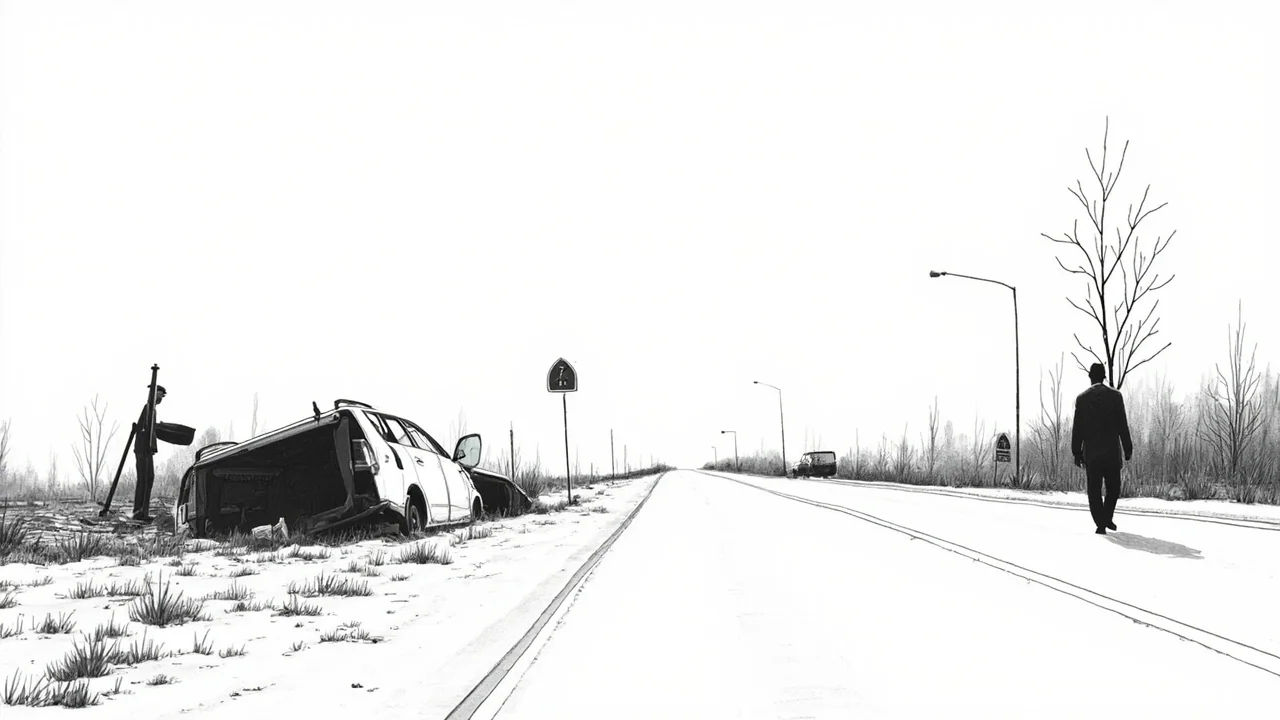
Swedish police confirmed one man in his thirties died in a multi-vehicle crash on the E6 motorway near Vellinge in Skåne on Friday evening. Four other people were taken to hospital, one with serious but non-life-threatening injuries, after treacherous road conditions led to several accidents across the region.
The emergency call came in just after 7:30 p.m. Police are investigating the incident as careless driving. The collision involved two vehicles, causing two other cars traveling in the same direction to veer off the road. Difficult driving conditions, with slippery ice patches known as 'drivbildning,' were reported across southern Sweden.
A Friday Night Turned Tragic
The E6, a major arterial route connecting Malmö to Trelleborg, became the scene of sudden chaos. For the families involved, a routine Friday drive transformed into a nightmare. The specific circumstances leading to the fatal collision remain under investigation by the Ystad police. Initial reports point to the hazardous road surface as a significant factor. Such conditions are notoriously dangerous, creating an invisible threat that can catch even experienced drivers off guard.
Ted Eriksson, the police duty investigation manager in Ystad, confirmed the victim's age and gender. His brief statement carries the weight of a procedure that repeats itself across Sweden every year. Each statistic represents a life cut short and a circle of family and friends plunged into grief. The other injured parties, whose conditions range from serious to less critical, now face recovery both physical and psychological.
The Silent Hazard of 'Drivbildning'
The police report specifically cited 'drivbildning' as a widespread issue in Skåne that evening. This Swedish term refers to a specific and dangerous winter road condition. It occurs when snow is blown across an already cold road surface, forming hard, polished ice patches. Unlike fresh snow, these patches are often smooth, transparent, and extremely slippery. They offer little warning to drivers, especially at night or in low light.
This phenomenon is a well-known seasonal hazard in Scandinavian countries. It demands heightened awareness and adjusted driving behavior. Speed becomes a critical factor; reducing velocity is the most effective defense against losing control on an unexpected ice patch. The accident on the E6 serves as a grim, annual reminder of winter's power over even our most modern infrastructure.
Local drivers in Skåne often discuss the peculiar challenges of their regional weather. The flat, open landscapes can allow wind to sweep snow across roads with little obstruction. This creates perfect conditions for 'drivbildning,' particularly on major highways like the E6. It’s a cultural touchpoint in winter—a shared understanding of a specific risk that binds communities together in caution.
A Broader Pattern of Winter Risk
This single fatal accident was not an isolated event that Friday. Police noted several other traffic incidents occurred across Skåne during the evening, all linked to the difficult road conditions. This pattern highlights a systemic seasonal challenge. Every winter, Swedish authorities and media launch campaigns urging safe driving, yet tragedies persist.
The investigation into 'vårdslöshet i trafik'—carelessness in traffic—is standard procedure in such fatal accidents. It seeks to determine whether excessive speed for the conditions, a failure to adapt driving, or a vehicle technical fault played a role. The goal is not just to assign blame but to understand causes and potentially prevent future losses.
From a societal perspective, these incidents spark recurring debates. Are winter tire regulations sufficient? Should public advisories be more aggressive when 'drivbildning' is forecast? How do we balance personal responsibility with collective safety measures? There are no easy answers, only the somber reality of the annual death toll on winter roads.
The Human Cost Behind the Headline
Beyond the police bulletin lies a profound human story. A man in his thirties is gone. He may have been commuting from work, visiting friends, or simply running an errand. His story ended abruptly on a stretch of asphalt many use daily. For the other four individuals hospitalized, the crash marks a before and after in their lives. Their recovery journeys begin in hospital wards in Malmö or Ystad.
These events ripple through small communities like Vellinge. News travels fast in close-knit areas. The victim might have been a local, known at the grocery store or the football club. The shock is personal, even for those not directly involved. It fosters a collective pause, a reminder of shared vulnerability.
Swedish society has a deep, pragmatic relationship with its harsh climate. We prepare for it, dress for it, and build for it. Yet, the interaction between machine, human, and ice remains a point of acute danger. Our cultural confidence in navigating winter is sometimes shaken by events like this. It prompts a necessary, if sorrowful, reflection on our own preparedness behind the wheel.
Navigating the Invisible Threat
So, what can be done? Experts consistently point to a few key actions. First, heeding weather and road condition warnings from the Swedish Transport Administration is crucial. Second, fitting proper winter tires—and not just any tires, but high-quality studded or friction tires suited for ice—is a legal and practical necessity. Third, dramatically increasing following distance and reducing speed when ice is reported provides a critical margin for error.
Technology offers some assistance. Modern cars with stability control and advanced warning systems can help, but they are not infallible on sheer ice. The primary safety feature remains the alert, cautious driver. This incident underscores that the transition to autumn and winter requires a mental shift as much as a change of tires.
As the investigation continues, the focus for the authorities will be on piecing together the final seconds before the collision. For the public, the takeaway is simpler and more immediate. Winter is coming, or for some parts of Sweden, it has already arrived. The first severe ice of the season has already claimed a life. It is a stark signal to every driver to slow down, pay attention, and respect the invisible dangers that 'drivbildning' presents.
The tragedy on the E6 near Vellinge is a single data point in Sweden's annual road safety statistics. But for those affected, it is everything. It is a life ended, families shattered, and a community reminded of the thin line between a normal journey and a catastrophic one. As the first snow and ice grip the country, this event asks us all a simple, vital question: are we truly driving for the conditions, or just for our convenience?