
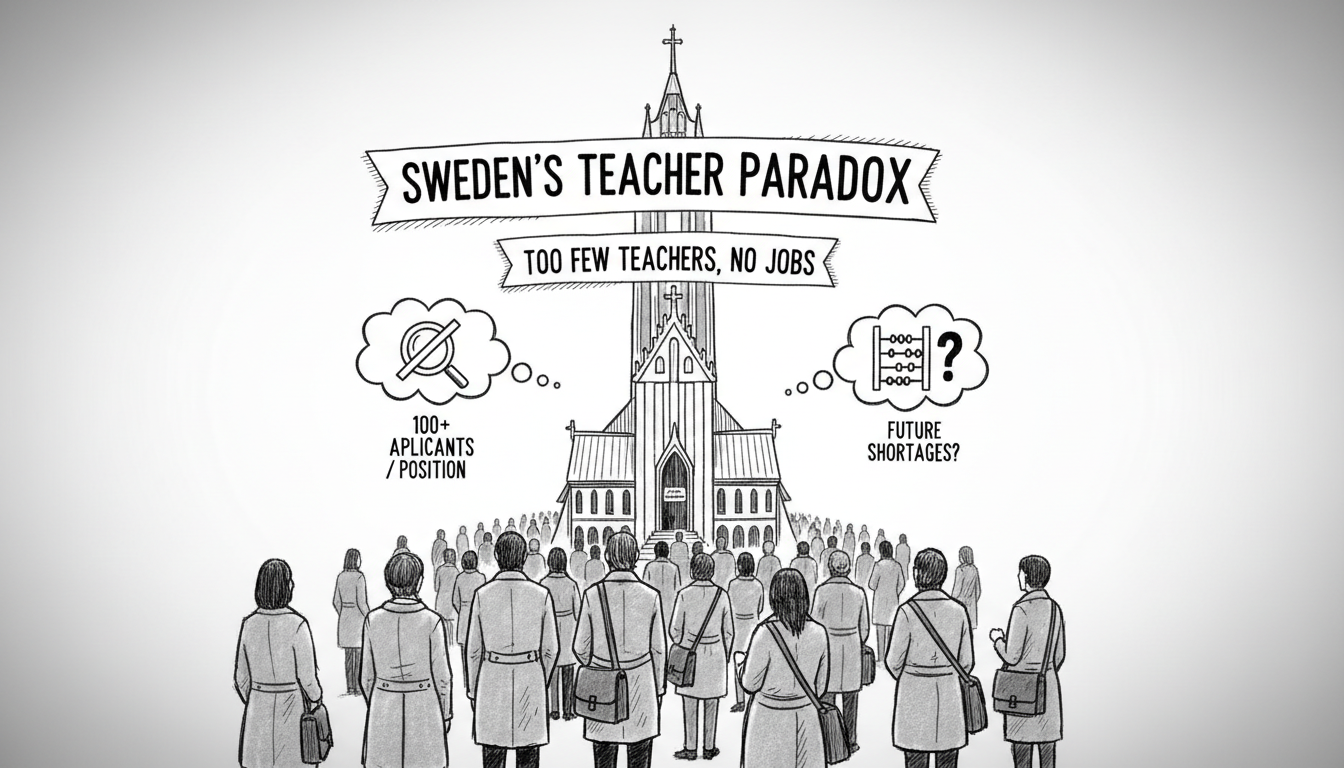
Over 100 applicants compete for a single teaching position in Sweden. Meanwhile, unions warn about teacher shortages. What explains this teacher paradox?
Stockholm University recruits teacher students by highlighting the city's growth and constant need for educators. The National Agency for Education predicts Sweden will lack 10,600 qualified teachers and preschool teachers by 2038.
But other numbers tell a different story. Newly graduated teachers cannot find work. In ten years, Sweden will have 172,000 fewer elementary school-aged children. This decrease equals the need for about 700 elementary schools.
Anna thought she did everything right. Still, things went wrong. She trained as an elementary teacher mid-career. With a fresh diploma in her pocket, she was ready for new challenges.
She applied for ten teaching jobs but received no responses. She has now sent 20, 30, even over 60 applications. This resulted in only one interview.
She said, "It was for a job in a special small teaching group for disruptive students, which I also didn't get."
Anna lives in a larger city and has professional experience from other fields. She also has previous college credits.
"I'm not the most pitiful case, but this wasn't what I expected when I wanted to switch from my quite insecure job to something more stable," Anna explained.
She fears using her name and photo might further reduce her chances of finding a teaching job. Right now, it's an uphill battle.
"I'm still prepared to commute up to 1.5 hours each way," Anna said.
But she is far from alone.
David Gustafsson, an elementary teacher and union chairman, knows the situation well.
"To have studied four or five years and then get no job is terrible. Yet we need educated staff," he stated.
The competition is fierce.
"We recently had 133 applicants for one advertised elementary teaching position. Then it's hard to get employment as a newly graduated teacher," he added.
Several school principals confirm this picture. One advertised job brings piles of applications.
A report from earlier this year shows three out of ten teacher students found it tough to get jobs after graduation. For some groups, like elementary teachers, it's even harder, especially in big cities where job competition is high.
Perhaps the answer to the teacher paradox lies in the National Agency for Education's teacher forecast.
The much-discussed shortage mainly concerns preschool, secondary, and special education teachers. The forecast is opposite for special educators and subject teachers in high school, as well as for teachers in preschool classes and elementary levels.
Teacher student Tove Sjösvärd works on her thesis in one of Stockholm University's most remote buildings. She will qualify to teach up to sixth grade as a finished teacher in 2027.
She is passionate about her future profession, though she has already wondered if she made the right choice.
"I will hardly be able to choose jobs, but at best take what I get," she said.
When asked about every tenth student expected to disappear from Stockholm's elementary schools, she responded, "It's of course worrying. Recently there was a teacher shortage, now there's a child shortage. It's strange that we talk so little about this in our education."
The weak demand for certain teacher groups also relates to another factor.
Today, 78 percent of Stockholm's teachers have teaching qualifications, a figure above the national average. The proportion of unqualified teachers varies between just over 10 and almost 90 percent across different school types. Differences between municipalities are large.
Unqualified staff are often cheaper than educated teachers.
The union wants to use the situation with shrinking student numbers to increase teacher density in classrooms and reduce group sizes. They also want to increase the number of educated staff in schools.
Sweden's Teachers union believes this is a "golden opportunity."
David Gustafsson explained, "We have a chance to ensure more qualified teachers per student, which would increase quality. But then we have the school funding system that complicates things."
He hints that fewer students lead to less money for schools and municipalities. They often try to compensate for revenue loss by hiring cheaper, uneducated staff.
"In Stockholm, there's no work shortage, and schools try to adapt as student numbers drop. But it's hard to balance the budget when costs for premises remain," Gustafsson said.
In today's competitive school system, supply and demand simply aren't balanced.
Tove Sjösvärd graduated high school with good grades and could have chosen a more "prestigious" education. But she followed her heart.
"I want to influence children's self-image in a positive way. If you have good teachers during your schooling, it increases your chance to understand society yourself," she shared.
The future teaching profession isn't obviously easy, even for the most ambitious students. According to a business school forum, only one-third of newly graduated teachers feel their education prepared them for their profession.
Tove Sjösvärd wants to become the teacher children remember, the person who opened their minds. She dreams of working at a school with strong staffing, motivated children, and engaged parents.
But she still has some way to go.
"I already work extra at a school, because it's about getting a foot in the door," she noted.
Anna tries to do the same.
"I think it's about getting in so they realize 'yes, you seem normal and capable.' But if I get no teaching job, I'll have to work in a store - or get a PhD," she concluded.
The situation reveals a fundamental mismatch between Sweden's education planning and actual classroom needs. Schools face budget pressures while qualified teachers struggle to find work, creating a paradox that serves neither students nor educators well.