
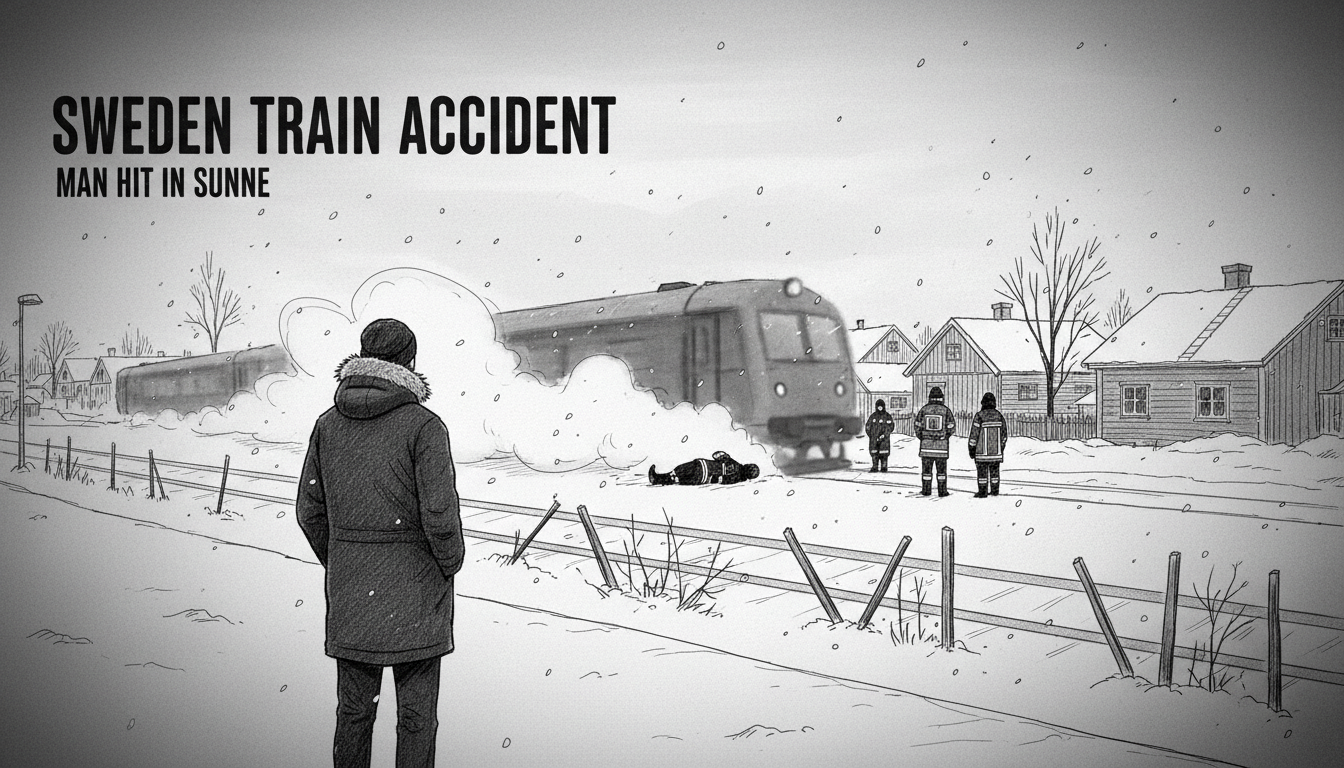
Sweden train accident investigations are underway after a man was struck by a train in Sunne on Saturday evening. The man, whose identity has not been released, was conscious and able to speak when emergency services found him. He was transported to a hospital, though the extent of his injuries remains unknown. Police have stated there is no suspicion of a crime, indicating they are treating this as a tragic accident.
For residents of Sunne, a picturesque town in Värmland County known for its connection to author Selma Lagerlöf, the incident is a jarring reminder of the dangers that exist alongside daily life. The railway line cuts through the serene landscape of forests and lakes. It is a vital artery for both freight and passenger travel, connecting this part of rural Sweden to the broader national network. The quiet of a Saturday evening was shattered by the sound of emergency sirens, a noise that resonates with a particular dread in small communities.
A Community Reacts to Sudden Tragedy
News of the accident spread quickly through Sunne. In close-knit towns, such events are felt personally, even by those not directly involved. "You hear the sirens and your heart just drops," said local shopkeeper Erik Lundström, who has lived in Sunne for forty years. "The tracks run right through our lives here. Everyone crosses them, waits at the crossings. It makes you stop and think." This sentiment reflects a universal tension in Sweden between the efficient, high-speed infrastructure the country relies on and the human-scale communities it serves. The incident immediately shifted focus from weekend routines to concerns for an unnamed neighbor's welfare.
Police spokesperson Torbjörn was clear in his initial assessment. "Everything points to this being an accident. We have no suspicion of a crime," he told local media. This preliminary conclusion is crucial. It directs the investigative focus away from intentional acts and toward a complex web of potential factors: momentary distraction, a misjudgment of distance or speed, or perhaps an environmental condition. The investigation will now involve multiple agencies piecing together the final moments before the impact.
The Complex Landscape of Swedish Railway Safety
When a person is hit by a train in Sweden, a detailed investigative machinery swings into action. The Swedish Accident Investigation Authority, known as Statens haverikommission (SHK), will likely examine the incident. Their role is not to assign blame but to understand the systemic causes and recommend safety improvements for the future. Simultaneously, the Swedish Transport Administration, Trafikverket, which owns and maintains the national rail network, will conduct its own review of the specific site.
Railway safety experts consistently highlight two major areas of concern. The first is level crossing safety. The second is preventing unauthorized access to the tracks themselves. "Each accident is a profound tragedy and a failure of the system to protect life," explains a railway safety analyst who wished to remain anonymous. "Investigations look at everything from sight lines and signage to the behavior of the individual. Was the crossing properly lit? Could the train driver have done anything differently? There are rarely simple answers."
The statistics provide a sobering backdrop. According to Trafikverket data from 2023, there were 128 accidents at level crossings across Sweden. In the same year, there were 194 recorded suicides or suspected suicides on the railway network. The Sunne incident, treated as an accident, would fall into a different category, but these numbers underscore the constant vigilance required. Every incident represents a collision between immense kinetic force and human vulnerability.
The Human Cost Beyond the Statistics
Behind the official statements and the launch of investigations lies a human story with deep ramifications. The injured man is now in a hospital, facing a difficult recovery. His family and friends are grappling with shock and worry. The train driver, an often-overlooked figure in such events, will receive crisis support. Being at the controls during such an incident is a traumatic experience that can have lasting effects.
In Sweden, there is a strong cultural emphasis on collective responsibility and trygghet – a sense of security and safety. Incidents like this one in Sunne puncture that sense of trygghet. They force a public conversation about how safety is maintained in shared spaces. Are there enough fences? Are warnings clear enough? Is public education sufficient? While initial police findings point to an accident, the community and the authorities will still ask these hard questions.
For Sunne, the aftermath involves a return to normalcy that will feel different. The crossing where the incident occurred may become a somber local landmark, a place where people pause and look both ways a second longer. The rhythm of train whistles, once a neutral feature of the soundscape, may now carry a heavier note for some. This is the lingering impact of such events – they alter the emotional geography of a place.
Looking Ahead: Prevention and Remembrance
The journey from tragedy to prevention is long. The findings from the SHK and Trafikverket will eventually contribute to national safety databases. They may influence future infrastructure spending, the design of warning systems, or public awareness campaigns. Sweden has invested heavily in railway safety for decades, leading to significant reductions in certain types of accidents. Yet, as this event shows, the risk can never be fully eliminated where human activity intersects with high-speed rail.
In the coming days, the focus in Sunne will slowly shift from the immediate emergency response to the longer-term support for those affected. The man's medical prognosis will become clearer. The community will, in its own way, absorb the event into its history. There will be quiet discussions in the konditori (coffee shop) and concerned inquiries at the local grocery store. This is how small towns process shared trauma.
Sweden's railway network is a symbol of modern connection and efficiency. It carries commuters to work, tourists to holiday cottages in Värmland, and goods to market. But Saturday's accident in Sunne is a stark reminder that this system exists in a human context. It is operated by people, used by people, and sometimes, tragically, it intersects with human lives in the most devastating way possible. The ultimate question that hangs in the air, as the investigation proceeds, is one every society must ask repeatedly: How do we live safely alongside the powerful systems we build?