
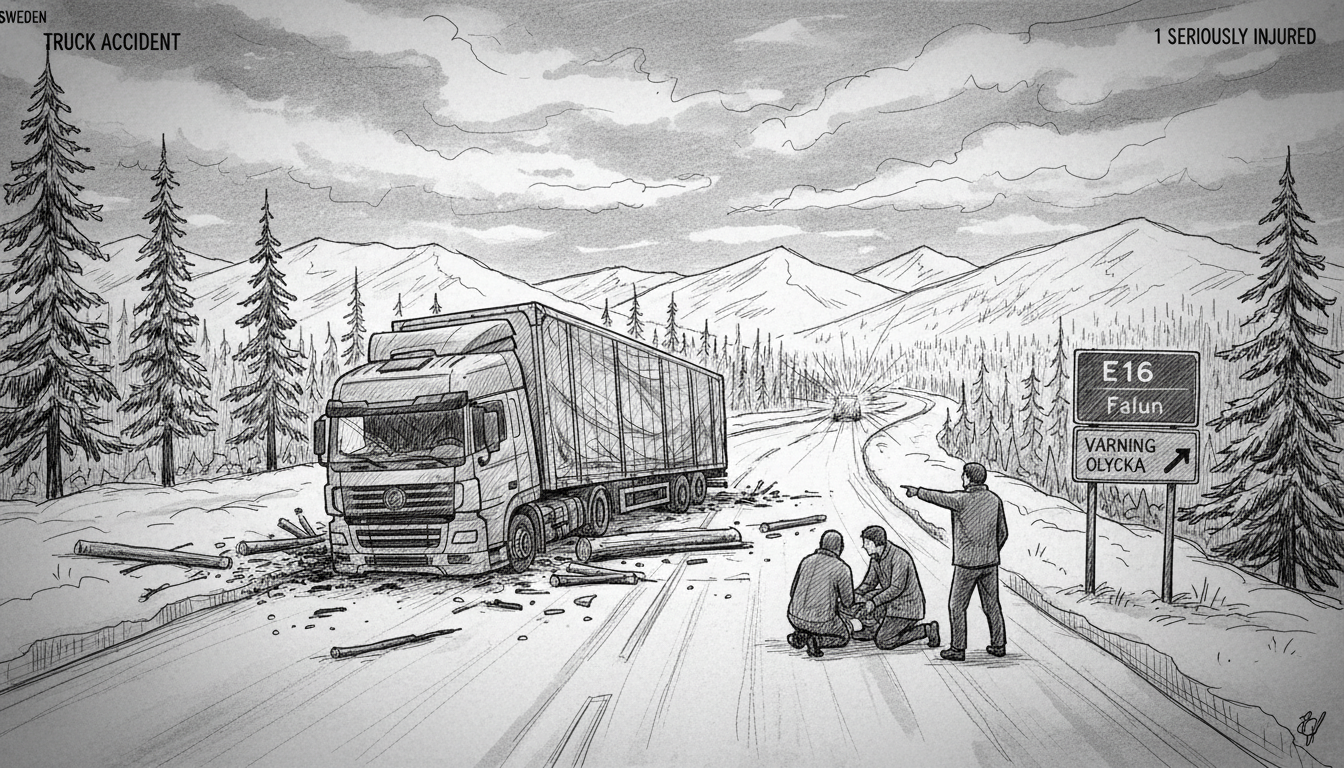
Sweden road accident investigators are piecing together the events of a serious collision on the E16 highway near Sandviken. A person was hit by a truck on Tuesday morning, sustaining serious injuries that required urgent hospital transport. The incident has shut down a key freight route, diverting traffic through the heart of the Gävleborg county town and raising immediate questions about pedestrian safety on major highways.
It was just after 8 AM on an ordinary Tuesday. Commuter traffic mixed with long-haul freight on the E16, a vital artery linking Sweden's interior to the Norwegian coast. Then, the normal hum of the highway shattered. Emergency services rushed to the scene near Sandviken, where a person had been struck by a truck. The initial assessment was grim—a serious injury situation. An ambulance, its lights cutting through the morning grey, raced the victim to hospital. Police quickly closed the road in both directions, a drastic but necessary measure that sent ripples through the regional transport network. Traffic was rerouted through Sandviken's streets, swapping the highway's flow for urban congestion.
A Route of Commerce and Risk
The E16 is more than just a road on a map. For Sweden, it's a crucial economic corridor. It carries timber from the northern forests, steel from the Bergslagen region, and consumer goods across the border to Norway. This constant flow of heavy goods vehicles is a fact of life for towns like Sandviken, which have grown alongside these transport routes. The highway represents connection and commerce, but Tuesday's accident casts a stark light on the inherent risks. When a multi-tonne truck and a pedestrian collide, the physics are brutally unforgiving. The Swedish Transport Agency, Transportstyrelsen, continuously works on road safety campaigns, yet statistics show the persistent danger. In 2022, Sweden recorded 273 fatal road accidents. Heavy goods vehicles, like the one involved today, are part of approximately 15% of those fatal incidents.
The Human Cost Behind the Headline
Behind the police statements and traffic reports lies a human story. A person started their day, perhaps a local resident on their way to work, a pedestrian using a roadside path, or someone whose vehicle had broken down. The specifics are not yet public, guarded by privacy and the ongoing investigation. But the outcome—serious injuries—speaks to a life suddenly and violently altered. For the truck driver, too, this is a traumatic event that will have profound personal and professional repercussions. These moments fracture the routine of a community. In Sandviken, a town known for its steel heritage and tight-knit community, news of such an accident travels fast. It prompts uneasy conversations around dinner tables about the roads that skirt their homes.
Expert Focus on Visibility and Infrastructure
Road safety experts, when analyzing incidents like this, will focus on a cluster of critical factors. Visibility is paramount. Was it dawn, with low sun blinding drivers? Were there weather conditions like rain or fog? The design of the roadway itself will be scrutinized. Are there safe, designated pedestrian crossings in that area, or is there a gap in the infrastructure that forces risky behaviour? Driver fatigue, especially on long freight routes, is another perennial concern for regulators. "Accidents involving pedestrians and heavy vehicles are often devastating," a road safety analyst explained, based on general patterns. "The investigation will look at the entire environment—the vehicle's condition, road markings, signage, and the sequence of events that led to the pedestrian being in the roadway." The goal is never just to assign blame, but to find systemic lessons that can prevent the next tragedy.
The Ripple Effect Through Sandviken
The immediate aftermath of the accident is a logistical challenge. Closing the E16 in both directions is a major decision, disrupting hundreds of journeys. Trucks carrying time-sensitive goods are stalled. Commuters from surrounding villages are late for work. Buses are rerouted. This diversion through Sandviken's city centre isn't just an inconvenience; it changes the character of the town's streets. Quiet lanes become thoroughfares for heavy traffic, posing a different set of safety risks for residents. Local police and transport officials must balance the need for a thorough investigation with the growing pressure to reopen a national highway. Each hour of closure has an economic and social cost, a stark reminder of how fragile our interconnected transport systems can be.
A National Conversation on Shared Space
While the investigation in Sandviken continues, this accident taps into a broader Swedish conversation about shared space. Sweden has long been a global leader in road safety, pioneering the Vision Zero policy that aims to eliminate traffic fatalities and serious injuries. Yet, the coexistence of vulnerable road users—pedestrians, cyclists—with massive freight vehicles remains a complex puzzle. In cities like Stockholm, there are ongoing debates about separating bike lanes from traffic and creating car-free zones. On highways like the E16, the challenge is different. How do you design exits, entrances, and rest areas to keep pedestrians safe when their paths inevitably cross with high-speed, heavy traffic? This incident may prompt a local review of that specific stretch of road, examining whether engineering solutions like better lighting, barriers, or upgraded crossings are needed.
Looking Ahead: Recovery and Reflection
The coming days will bring more clarity. The victim's condition will hopefully stabilise. The police will complete their initial scene investigation and begin the painstaking work of interviewing witnesses and analysing data. The trucking company involved will conduct its own internal review. For the community, the shock will slowly settle into reflection. Road accidents are often treated as statistical blips, but each one is a singular story of sudden change. It reminds every driver to be vigilant, especially at dawn and dusk. It reminds town planners that infrastructure must protect the most vulnerable. And it reminds us all that the roads we share are spaces that demand our constant respect and attention. The E16 will reopen, traffic will resume its flow, but for those touched by this Tuesday morning in Sandviken, the journey back to normalcy will be much longer.