
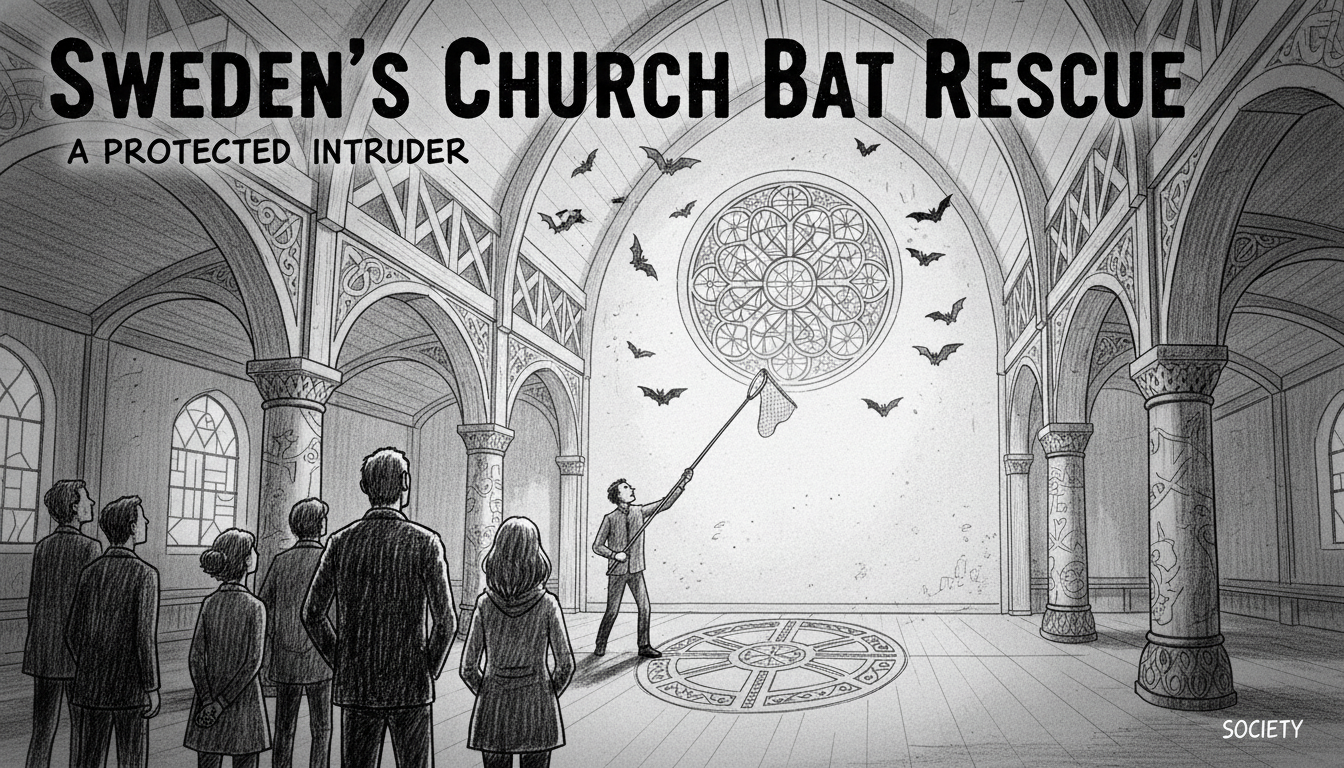
Sweden's protected bat species created an unusual Monday morning task for church caretakers in Östersund. A small bat had somehow found its way into the cellar of Stora kyrkan, the city's main church, prompting a delicate rescue operation guided by wildlife authorities. The incident highlights the unique relationship between Sweden's historic churches and its 19 species of protected bats, all of which are vital insectivores. "We called the County Administrative Board," said Anders Larsson, a caretaker for the Church of Sweden. "They spoke with a bat expert who told us exactly how to proceed."
This was no ordinary pest removal. Under Swedish and European law, all bats are strictly protected. It is illegal to kill, injure, capture, or disturb their roosts. Any action requires special permission from the County Administrative Board, the Länsstyrelsen. For the caretakers at Stora kyrkan, this meant their uninvited guest required careful handling. Their theory was that the bat had wandered down from the church's bell tower, a common hibernation spot for these creatures during Sweden's long winters.
After successfully capturing the bat using the expert's recommended method, the caretakers faced a new question: what next? The solution was a compassionate relocation. They carried the bat back up to the bell tower, its presumed original home, hoping it would settle back in and survive the remaining winter months. This small act in a Jämtland church reflects a larger, nationwide story of coexistence between modern society and protected wildlife in Sweden.
A Sanctuary in the Steeple
Churches across the Swedish countryside and in cities like Stockholm, Uppsala, and Lund often become unintended wildlife sanctuaries. Their towers and attics offer stable, cool temperatures and minimal disturbance—perfect conditions for bats to hibernate. This creates a quiet symbiosis; the bats get a safe haven, and the churches get natural pest controllers. Each of Sweden's 19 bat species consumes thousands of insects nightly. "They are incredibly important for our ecosystem," explains a wildlife biologist familiar with urban bat populations. "A church tower is like a five-star hotel for a bat in winter—it's secure and the temperature rarely fluctuates dramatically."
This isn't just a rural phenomenon. Even in Stockholm, older buildings in neighborhoods like Södermalm or Kungsholmen can host bat colonies. The challenge arises when their paths cross directly with human activity, as happened in Östersund. The law is clear, but its application requires patience and specific knowledge. The County Administrative Board serves as the crucial intermediary, connecting concerned citizens with bat experts to find non-lethal solutions.
The Delicate Balance of Protection
Sweden's strict protection laws stem from real concerns. Bat populations are sensitive to habitat loss, pesticide use, and human disturbance. Their slow reproduction rates—often just one pup per year—make population recovery difficult. The legislation isn't just about preventing cruelty; it's about preserving biodiversity. The expert guidance provided to the Östersund caretakers likely involved using soft nets or containers, avoiding bright lights, and handling the animal minimally to reduce stress.
Public education is a key part of this balance. Many Swedes might not know that all bats are protected, or that harming one can lead to significant penalties. Initiatives by organizations like the Swedish Society for Nature Conservation (Naturskyddsföreningen) aim to spread knowledge. They teach that bats are not aggressive, are vital for controlling mosquitoes and moths, and that simple actions—like preserving old trees with cavities or installing bat boxes—can help.
"The goal is always coexistence," the biologist notes. "Most conflicts can be resolved without harm to the animal. It's about understanding their behavior. For instance, a bat flying indoors is usually disoriented, not attacking. It just wants to get out."
Cultural Coexistence and Future Challenges
The story from Stora kyrkan is a microcosm of a broader Swedish cultural attitude toward nature—one that often prioritizes conservation and seeks pragmatic solutions. It mirrors the national allemansrätten, the right of public access, which comes with a core tenet of responsibility: do not disturb, do not destroy. This ethos extends to protected species like bats.
However, coexistence presents ongoing challenges. Church restorations, for example, must be planned with bat seasons in mind. Renovating a tower during hibernation can be disastrous. Authorities often require surveys to be conducted before work begins. Similarly, as older buildings are modernized or demolished in growing cities, alternative roosting sites need consideration. This is where community projects, like building and installing bat boxes in local parks, become important.
Looking ahead, climate change may further alter this relationship. Milder winters could affect hibernation cycles, and changes in insect populations could impact bat food sources. The quiet, careful work of church caretakers, guided by county experts, represents the front line of this adaptive relationship. It's a hands-on form of conservation that happens not just in remote forests, but in the heart of our communities.
More Than Just a Nuisance
The "break-in artist" of Stora kyrkan was ultimately a guest, not a pest. Its rescue and return to the bell tower is a small but perfect example of Swedish environmental policy in action: protective, practical, and rooted in respect for nature's role in shared spaces. It reminds us that wildlife isn't something that exists only 'out there.' It shares our cities, our historic buildings, and sometimes, our cellars.
Next time you look up at a church spire against the twilight sky in Gamla Stan or hear a faint rustle in a summer cottage attic, consider the unseen tenants. These protected, insect-eating mammals are part of Sweden's living heritage. Their continued survival depends on countless small, informed decisions—like the one made by a few caretakers in Östersund on a cold Monday. Will our ancient buildings continue to serve as shelters for these ancient creatures? The answer lies in our willingness to share space, follow the law, and appreciate the quiet flutter in the rafters for what it truly is: a sign of a healthy, balanced environment.