
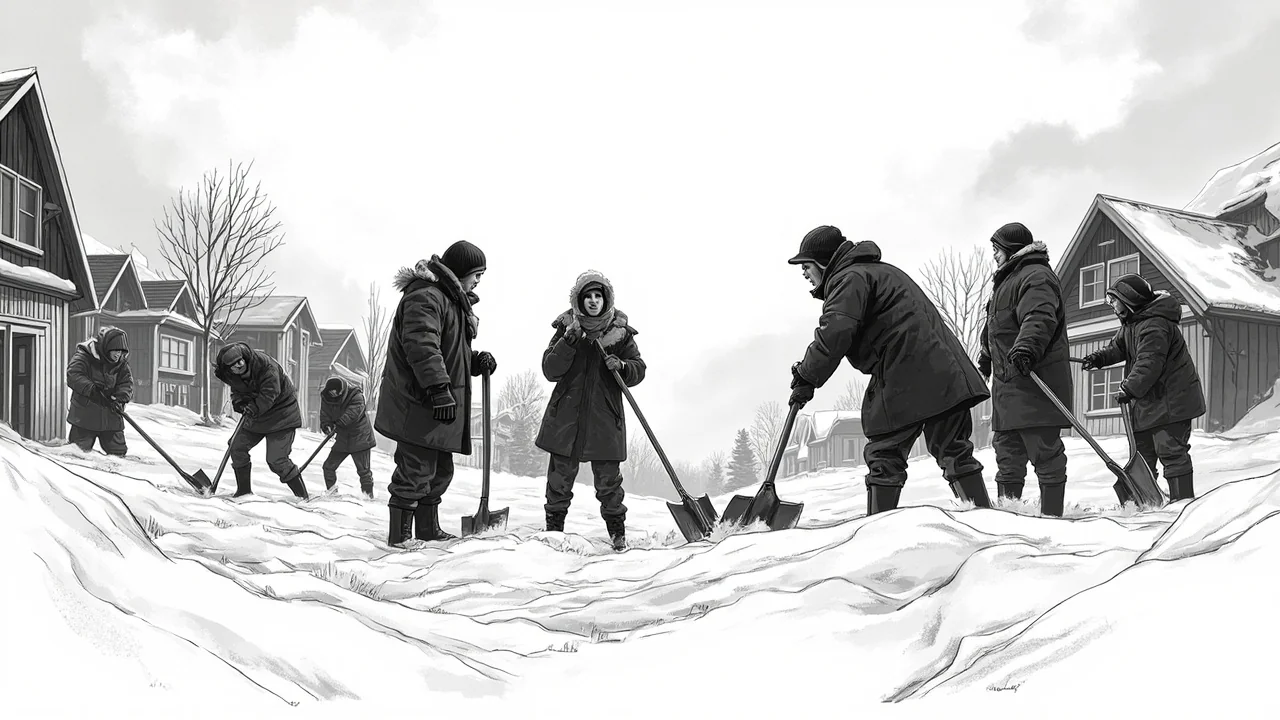
Swedish homeowners face a confusing legal landscape regarding sidewalk snow clearance, with responsibility varying dramatically between municipalities. A patchwork of local regulations places the legal duty to shovel snow and sand sidewalks on private property owners in approximately 60% of Sweden's 290 municipalities. This decentralized system, rooted in historic property law, is now sparking intense debate over safety, fairness, and the role of local government.
"The law is outdated. It doesn't work that people who might be old, sick, or traveling should have the responsibility to shovel," argues Ulf Stenberg, chief legal counsel for the Villaägarna (Homeowners') association. His organization recently mapped municipal regulations, revealing a stark national divide. In cities like Gothenburg, the property owner bears full responsibility for the public walkway adjacent to their land. Conversely, the Stockholm municipality has assumed this duty for its residents.
This inconsistency creates tangible safety hazards and legal uncertainty. A property owner who fails to clear snow and ice from an adjacent sidewalk can, in worst-case scenarios, be held liable for damages if someone slips and is injured. While legal action against individual homeowners remains rare, the threat exists, placing a significant burden on citizens. The system's critics argue it results in poorer overall snow clearance, as many property owners are unaware of their obligations or physically unable to fulfill them.
A Postcode Lottery for Winter Safety
The issue highlights the considerable autonomy Sweden's municipalities exercise in public service delivery. Decisions made in local council chambers in places like Solna or Sundbyberg directly impact daily life and liability for residents. In Solna, just northwest of Stockholm, the formal responsibility rests with the property owner, even as the municipality's own snowplows clear other public sidewalks.
"Yes, formally it is the property owner who is responsible for securing accessibility on the sidewalk. We should perhaps review that," stated David Nordin, Solna's administrative chief. This admission from a local official underscores the growing recognition that the current model may be flawed. The problem is exacerbated in areas bordering multiple municipalities, where homeowners on one street can operate under completely different legal requirements than their neighbors.
Villaägarna contends that the cost of this fragmented system is ultimately borne by society at large. "Municipalities today shift the responsibility onto others. Snow clearance becomes worse, accidents increase, and the costs end up with the regions and the Swedish Social Insurance Agency instead of the municipalities. I don't think it pays off for society," Stenberg explains. This argument suggests that public health costs from fall injuries and administrative burdens on national agencies outweigh any savings municipalities achieve by offloading the duty.
The Call for Legislative Reform
The core of the debate centers on whether Sweden's national parliament, the Riksdag, should intervene to standardize the rules. Villaägarna is advocating for a change in the law to transfer primary responsibility to municipalities nationwide. They argue that municipalities, with their organized resources and contractors, are far better equipped to ensure efficient, consistent, and safe winter maintenance of public footpaths.
Proponents of the status quo, often municipal finance committees, point to the significant expense of universal municipal snow clearance. Taking over sidewalk shoveling from thousands of properties represents a major new budgetary line item, potentially requiring tax increases or cuts to other services. They also cite the principle of property owner responsibility, a long-standing feature of Swedish law that applies to other areas like overhanging branches or dangerous icicles.
Regarding hazards from roofs, the law is unequivocally national and strict. Responsibility for preventing snow and ice from falling from roofs always lies with the property owner or a hired contractor, regardless of municipality. Swedish courts have handed down convictions for involuntary manslaughter in tragic cases where falling ice or snow has caused fatalities, highlighting the serious legal weight property-related winter hazards can carry.
Analysis: A Test for Local Governance
This snow shovel dilemma presents a classic conflict in Swedish public policy: municipal autonomy versus national standardisation. The Swedish government in Rosenbad often hesitates to dictate local service details, respecting the constitutional principle of local self-government. However, when postcode lotteries affect fundamental safety and legal equality, calls for central government action grow louder.
The issue also exposes a gap between formal legal responsibility and practical reality. Many homeowners, especially the elderly or those with disabilities, cannot physically meet the obligation. Others may be traveling during a snowfall. This leads to uneven clearance, turning public sidewalks into obstacle courses and disproportionately affecting pedestrians, the elderly, and parents with strollers—groups most reliant on safe walkways.
From a risk management perspective, the current system is inefficient. Concentrating responsibility with a single professional entity—the municipality—allows for systematic planning, prioritized routes, and economies of scale. The fragmented homeowner model is reactive, unreliable, and shifts the economic risk of accidents from municipal budgets to private homeowners' insurance and the national social insurance system.
Looking Ahead: A Political Snowdrift to Clear
The pressure for reform is likely to increase with every heavy snowfall. As climate patterns shift, intense winter precipitation events may become more common, putting the existing system under greater strain. The question for the Swedish government and the Riksdag is whether this is a matter of local preference or a fundamental issue of public safety and equitable burden-sharing.
Some municipalities may choose to follow Stockholm's lead independently, viewing it as a worthwhile investment in community well-being and attractiveness. Others will resist without a legislative mandate. The coming years will test whether Sweden's famed consensus model can find a solution to this deeply frozen problem, balancing municipal budgets against the simple right to a safe walk home in winter. The outcome will reveal much about who ultimately bears responsibility for the public sphere in modern Sweden—the individual citizen or the collective state.