
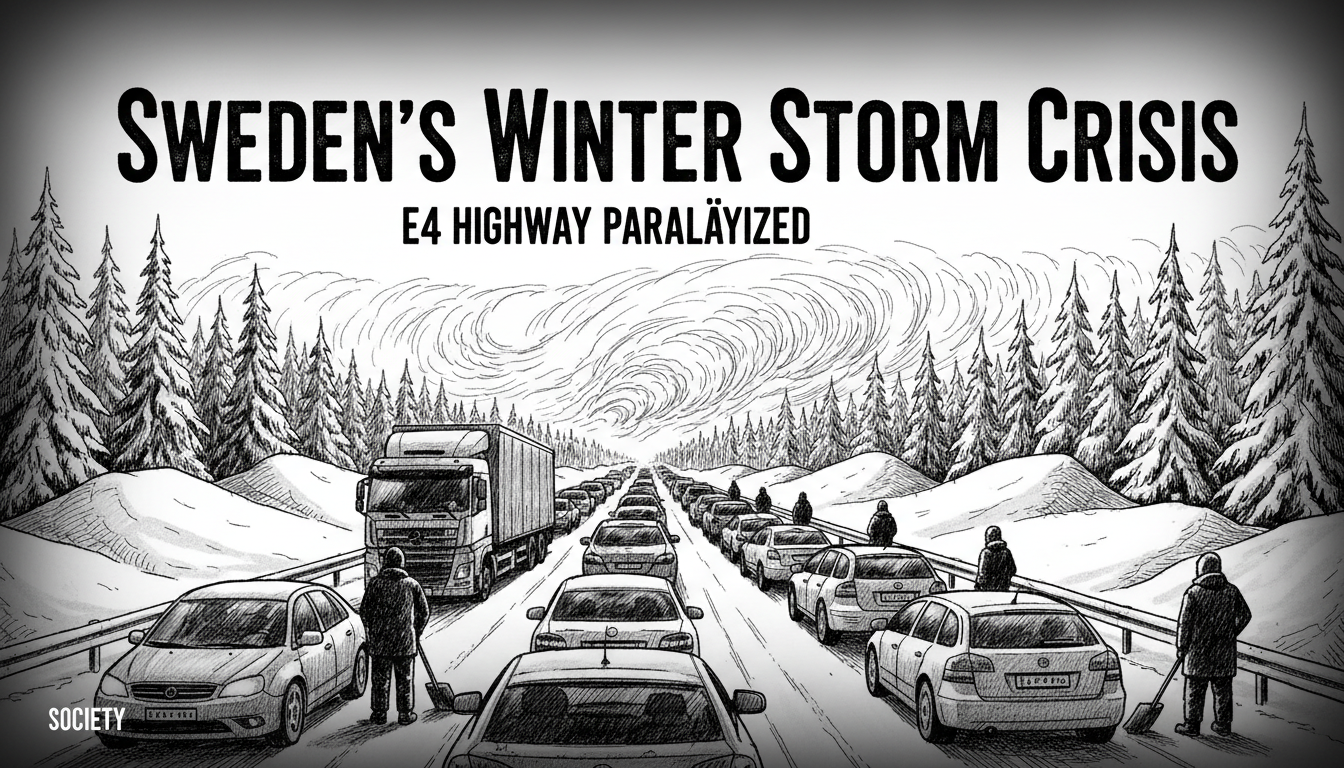
Sweden's transportation network is paralyzed by severe winter storms, with authorities issuing stark warnings for multiple regions. The Swedish Meteorological and Hydrological Institute (SMHI) has active orange weather warnings for Västernorrland County and the Bohuslän/Gothenburg area. An urgent national advisory from the Swedish Transport Administration states, 'Do not go out into traffic in affected areas unless you absolutely must.' This directive follows a night of chaos on the critical E4 highway, where multiple trucks became stuck near Gnarp, creating long queues in both directions between Hudiksvall and Sundsvall. Public transport in Gothenburg has been severely reduced, with operator Västtrafik canceling numerous lines due to dangerous conditions. The situation underscores the annual battle Sweden faces against its harsh winter climate, testing the resilience of infrastructure and emergency response protocols.
A Night of Gridlock on the E4
The E4 highway, Sweden's primary north-south arterial route, became a focal point of the crisis late Wednesday. Near the town of Gnarp in Västernorrland, heavy snowfall and strong winds led to several heavy goods vehicles becoming immobilized. This single incident rapidly cascaded into major disruptions, stranding motorists for hours in both directions. The Swedish Transport Administration's warning extends beyond the official orange zones to surrounding areas under yellow SMHI advisories. This precautionary approach aims to prevent travelers from misjudging the severity of conditions at the periphery of the storm's core. Historical data shows the E4 corridor is particularly vulnerable to coastal weather systems from the Bothnian Sea, which can deposit snow faster than plows can clear it.
Regional Impacts and Official Response
In Västernorrland, the orange warning signifies a high probability of significant snow accumulation, reduced visibility, and considerable transport disruption. Further south, the Gothenburg metropolitan area and the Bohuslän coast face different but equally hazardous conditions, often involving wet snow, ice, and strong winds off the Kattegat sea. The regional public transport authority, Västtrafik, made the operational decision to withdraw services on several bus and tram lines. This proactive cancellation, while inconvenient, is a standard safety protocol to protect passengers and vehicles. Municipal crisis teams in affected regions are likely activated, coordinating snow removal and monitoring vulnerable populations, though the immediate public message remains unequivocal: avoid all non-essential travel.
The Science Behind the Orange Warning
SMHI's two-tiered warning system uses color codes to communicate risk level. A yellow warning suggests the weather may be dangerous, while an orange warning indicates a high probability of severe weather that could pose a threat to public safety and property. The criteria for an orange snow warning are specific, typically involving expected snowfall exceeding 15-20 cm within 24 hours, or 5-10 cm in combination with strong winds. Meteorologists analyze data from coastal and inland stations to predict the track and intensity of low-pressure systems. For coastal regions like Bohuslän, the added complication of near-freezing temperatures can lead to heavy, wet snow that is especially damaging to trees and power lines, compounding transportation issues with potential electricity outages.
Economic and Logistical Consequences
The blockage of the E4 has immediate and severe consequences for national logistics. This highway is a crucial link for freight moving between major population centers and the northern industrial regions. Each hour of closure translates to delayed deliveries, increased costs for haulage companies, and potential supply chain bottlenecks. Port operations in Gothenburg, Sweden's largest port, may also experience slowdowns if truck access is limited and workforce attendance drops. The Swedish Transport Administration must balance the urgent need to clear existing blockages with the strategic deployment of resources to keep other key routes open. This storm event will inevitably be factored into ongoing debates about infrastructure investment and climate adaptation strategies for Sweden's transport network.
Expert Analysis on Preparedness and Public Behavior
'Events like this test the system's resilience,' says a senior analyst at the Swedish National Road and Transport Research Institute (VTI). 'The warnings are accurate, but the public's risk perception and willingness to alter plans are critical variables.' Experts emphasize that the most dangerous period often occurs when people attempt to travel as a storm is intensifying or immediately after it peaks, before plows have completed their work. The explicit instruction from authorities—'unless you absolutely must'—is designed to override casual travel decisions. Historical comparisons show that while Sweden has robust winter readiness, the concentration of incidents on a few key routes, like the E4, reveals systemic vulnerabilities. Investment in more resilient infrastructure, such as improved windbreaks and real-time traffic management, is a recurring topic in post-event analyses.
Looking Ahead: A Recurring Winter Challenge
This storm system will eventually move eastward, but the clean-up and recovery will extend through Thursday and possibly into Friday. The immediate priority for the Swedish Transport Administration is to free the stranded vehicles on the E4 and restore normal traffic flow—a complex operation requiring heavy tow trucks and coordinated plowing. For the public, the aftermath brings hazards of icy patches and piled snow. This event is not an anomaly but part of Sweden's annual winter reality. It reinforces the importance of heeding official warnings, maintaining emergency kits in vehicles, and allowing extra time for any necessary journeys. As climate patterns shift, the frequency and intensity of such precipitation events may change, requiring continuous adaptation from meteorologists, planners, and the public alike. The fundamental question remains: how can a society built for mobility best function when nature dictates a temporary pause?