
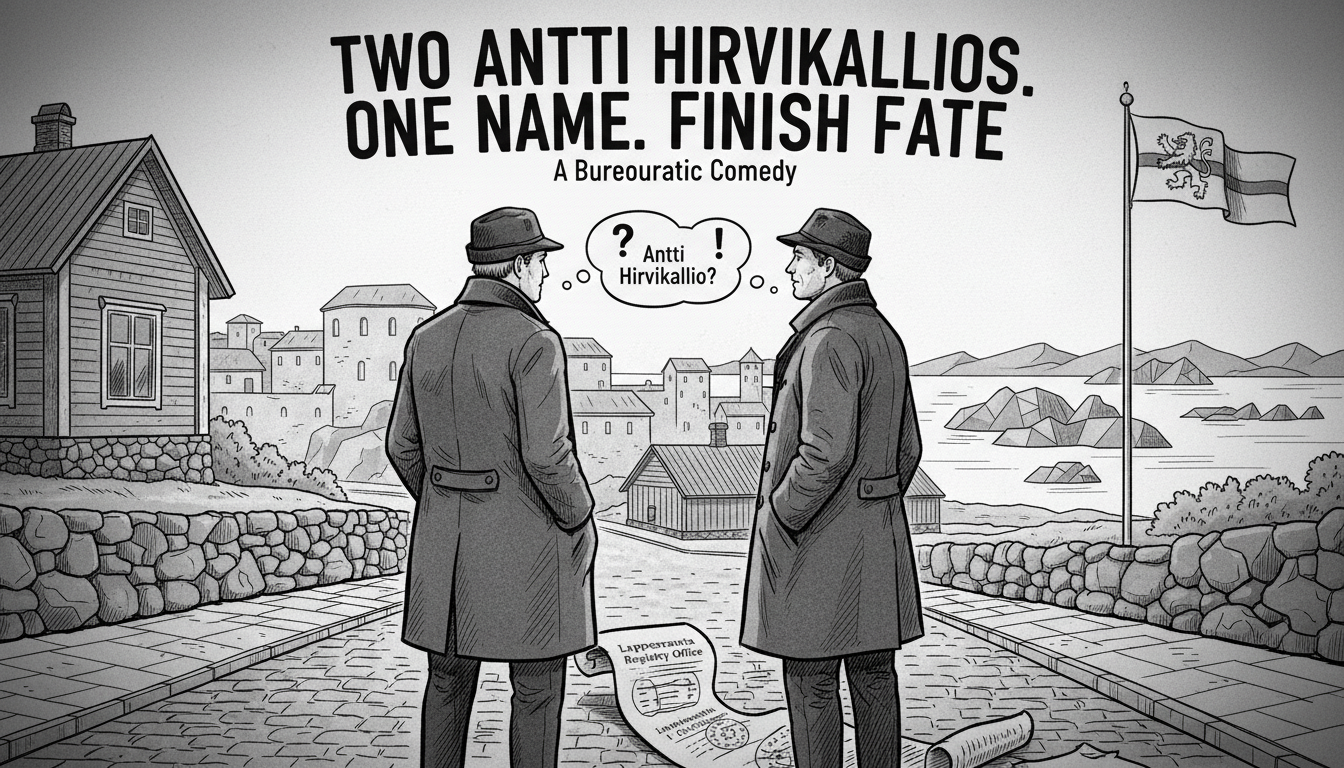
A curious meeting unfolded in the city center of Lappeenranta in southeastern Finland. Two men, both named Antti Hirvikallio, met face-to-face for the first time. One is a 55-year-old land use engineer from Luumäki. The other is a 47-year-old early childhood teacher and bandmaster from Lappeenranta. Their shared name has caused years of administrative mix-ups and mistaken identity.
"Should we swap phone numbers," the elder Hirvikallio asked the younger, both appearing slightly bewildered by the encounter. The meeting was arranged by a local news outlet. It coincided with the Luumäki resident's final workday as a municipal engineer in Kouvola. He has held similar planning roles in Savitaipale and Taipalsaari municipalities. The Lappeenranta Hirvikallio teaches at the Pontus daycare center. He also leads the Ratsuväki heritage band. Meanwhile, his namesake is reviving a consulting business he started over a decade ago.
"Good job offers shouldn't go to waste," both men laughed, checking their phones. The anecdote highlights a uniquely Finnish phenomenon tied to the country's naming conventions and relatively small population. While common surnames like Virtanen or Korhonen number in the tens of thousands, identical full names, including the common first name Antti, still create tangible confusion. This is especially true in professional and municipal contexts where precise identity matters for permits, qualifications, and official correspondence.
The story resonates because it touches on Finnish bureaucracy, a subject of both pride and gentle satire locally. The Finnish system is highly digitized and efficient, yet it relies on accurate personal identification. Cases like this reveal its occasional fragility. For international readers, it offers a lens into Finnish society beyond Helsinki politics. It shows the interconnectedness of communities in regions like South Karelia. It also reflects a cultural tendency to resolve practical mix-ups with dry humor and directness, as seen in the men's immediate discussion of phone numbers and job offers.
What does this mean for public administration? The incident is a minor case study. It underscores the importance of unique personal identity codes, which Finland uses alongside names. Yet, in informal and professional networking, names remain the primary identifier. The two Antti Hirvikallios navigating their doubled identity is a human-scale story. It contrasts with the often-impersonal image of Nordic governance. Their solution is pragmatic, not systemic. They simply agreed to communicate directly to untangle future confusion. This practical, cooperative approach is very Finnish. It solves a problem without unnecessary complication or conflict.
For those following Finnish society, this is more than a quirky news piece. It reflects how a nation of 5.6 million manages the overlaps of a limited pool of surnames. It shows the local character of cities like Lappeenranta, where community ties are strong. The men's professions are also telling. One works in land use planning, shaping the physical environment. The other works in early childhood education and cultural preservation, shaping the social environment. Their accidental linkage is a metaphor for the interconnected facets of Finnish public life, all operating within a framework designed for clarity that sometimes meets human coincidence.