
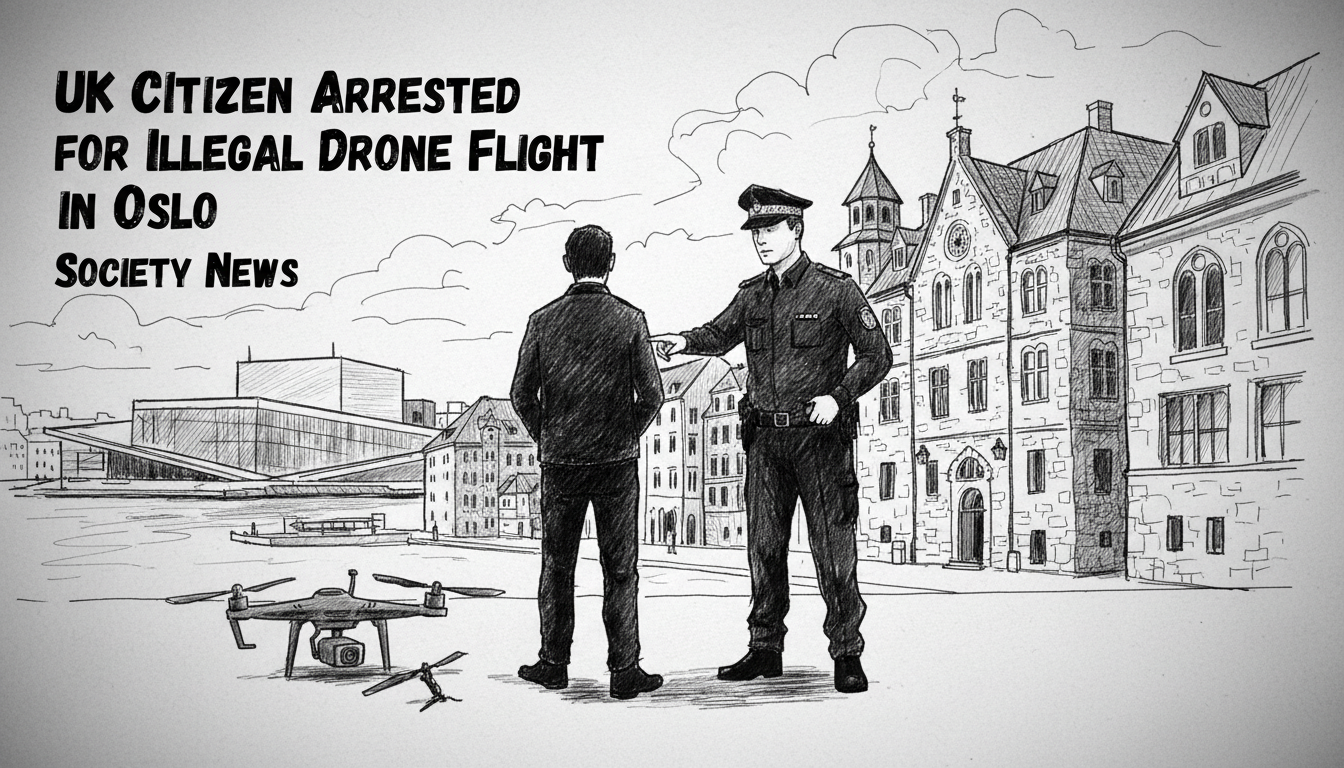
Norway drone laws were enforced with an arrest on Oslo's City Hall Square this week. A British citizen in his thirties was detained by police after flying a drone within the restricted airspace R102, which covers central Oslo. The pilot was taken to a police station, with authorities confirming the seizure of his equipment and potential legal consequences including fines and deportation.
A Clear Violation in the Capital's Heart
Operational commander Eirik Sannes of the Oslo Police District stated the arrest was straightforward. "We have control of a drone pilot who has flown illegally within the restriction area R102 over Oslo," Sannes said in a police log. The pilot was apprehended and driven to custody. The R102 zone is a well-known and clearly marked no-fly area for drones, encompassing the city center from Majorstuen to Gamlebyen. This includes government buildings, the Royal Palace, and critical infrastructure.
Sannes noted that penalties typically involve fines and confiscation of the drone. "Initially, any sanctions usually revolve around fines and confiscation of equipment," he said. However, the foreign nationality of the suspect introduces a more severe potential outcome. "Since the arrested man is a foreign citizen, deportation may also be relevant, but Sannes emphasizes that nothing is decided in the case."
The Expanding Web of Norwegian Drone Regulations
This incident is not an isolated case but part of a broader, tightening regulatory landscape across Norway. Norwegian authorities have progressively strengthened drone rules, driven by global security concerns and domestic privacy protection. The regulations are particularly stringent around airports, military installations, and urban centers like Oslo. The Norwegian Civil Aviation Authority maintains detailed maps and apps for pilots to check flight restrictions.
Legal experts point out that enforcement has become more consistent. "The law is clear, and police are now well-trained to identify and respond to these violations," says legal analyst Henrik Moe, who specializes in transport and technology law. "The key factors are location and intent. Flying a recreational drone over a crowded public square in a restricted zone is a blatant breach that authorities cannot ignore."
For foreign visitors, ignorance of the law is rarely accepted as a defense. Information is available in English, and major drone manufacturers geo-fence restricted areas in their software, often preventing take-off. Prosecutors must decide whether this was a careless mistake or a deliberate act.
Security Implications in a Modern City
Security professionals view drone regulation as a critical component of urban safety. "A drone is not just a camera or a toy," explains security consultant Anna Larsen. "It can be a tool for espionage, a nuisance, or a platform that could cause physical harm if it fails. The rules exist for public safety and national security." Oslo, as the national capital, hosts numerous sensitive sites. The R102 zone exists to protect these areas from unauthorized surveillance and potential threats.
Recent years have seen several high-profile incidents abroad where drones disrupted airports or were used near political landmarks. Norwegian authorities are determined to prevent similar scenarios. The police response in this case—swift apprehension and equipment seizure—sends a deliberate message about enforcement priorities.
The Legal Road Ahead: Fines and Possible Deportation
The immediate consequence for the British citizen is the confiscation of his drone. The next step is a fine, which can be substantial. Norwegian law allows for significant penalties for violating aviation regulations. The final amount depends on the police report and any subsequent court decision.
The more severe question is deportation. The police have confirmed it is "relevant" but not decided. Immigration law allows for the expulsion of foreign nationals who commit offenses perceived as violating public order or safety. A deliberate illegal drone flight over central Oslo could meet that threshold.
"The deportation decision rests on an assessment of proportionality," says Moe. "Was this a one-off act of poor judgment by a tourist, or does it indicate a disregard for Norwegian law that warrants removal? The police and later, potentially, the immigration authorities will weigh this." A deportation order would likely include a ban on re-entering the Schengen area for a period.
A Warning to All Drone Operators
This arrest serves as a public reminder. Norway's drone laws are strict and actively enforced. The rules apply equally to tourists and residents. Key restrictions include maintaining a visual line of sight, staying below 120 meters, and avoiding crowds and built-up areas without special permission. Flying near airports or in designated restriction zones like R102 is always illegal.
Authorities encourage pilots to use official resources like the Avinor Drone Guide and the Norwegian Civil Aviation Authority's website before flight. The contrast between the simple act of buying a drone and the complex web of regulations governing its use is stark. This case highlights that gap, with serious consequences for one individual.
Balancing Innovation and Control
Norway is also a leader in commercial drone technology, using them for infrastructure inspection, agriculture, and filmmaking. The regulatory framework aims to enable this professional use while clamping down on reckless or dangerous flights. The challenge for lawmakers is to keep pace with rapid technological change without creating rules that are impossible to follow.
This incident in Oslo represents the enforcement side of that balance. It underscores that the privilege of flying comes with responsibility. As drones become more capable and widespread, public tolerance for violations in sensitive areas drops. The police action on Rådhusplassen reflects that societal shift.
Will this arrest deter future illegal flights? Authorities hope the combination of financial penalty, equipment loss, and the threat of deportation will make pilots think twice. In an era where airspace is becoming increasingly crowded, clear rules and consistent enforcement are not just bureaucratic hurdles. They are essential for safety in the skies above our cities.
The final outcome for the British man awaits. His case, however, is already etched as a clear example in the ongoing story of how societies adapt to new technologies. The message from Oslo is unambiguous: the city's sky is not unregulated space. Fly at your own risk, and know the law before you take off.