
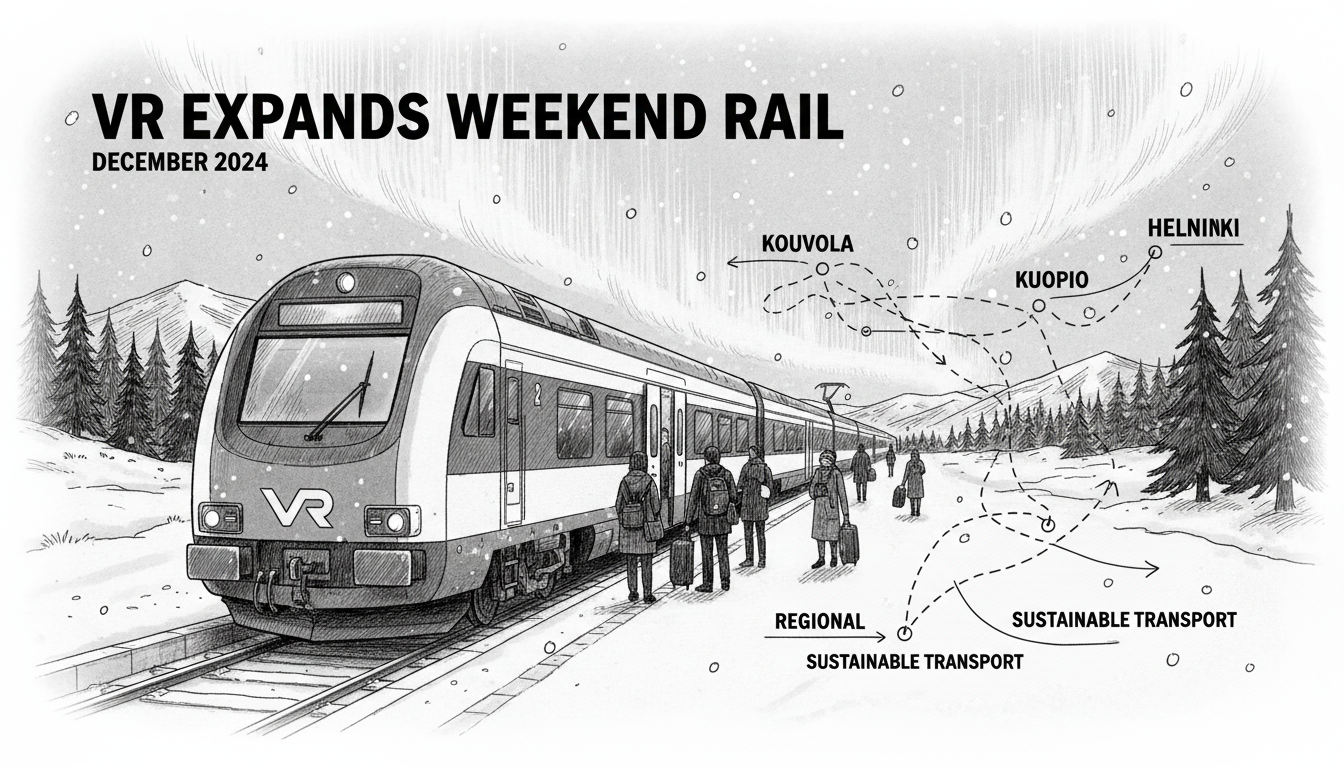
Finland's state-owned railway operator VR has announced a significant expansion of its weekend intercity services, with new direct connections commencing in December. The first additional trains will begin operating on December 14, targeting the most requested travel times between major urban centers. This move directly addresses growing passenger demand for flexible, sustainable transport options outside the traditional weekday commuter schedule. The expansion focuses on enhancing connectivity from the eastern city of Kuopio to the capital region, with eight new departures added between Friday and Sunday. This policy aligns with the Finnish government's broader strategic goals of promoting rail travel, reducing regional inequality, and meeting national carbon emission targets under the European Green Deal. For international observers, this development offers a clear case study in Nordic infrastructure investment prioritizing public transport over private vehicle use.
Specific new departures from Kuopio toward Helsinki will leave on Fridays and Sundays at 9:30 AM via Kouvola and Mikkeli. An additional Friday-to-Sunday service departs at 1:00 PM via Kouvola, and a Sunday departure at 10:06 AM travels via Jyväskylä and Tampere. In the opposite direction, travelers from Helsinki to Kuopio gain new Saturday options departing at 12:00 PM via Tampere and Jyväskylä and at 3:24 PM via Kouvola. Beyond the December launch, the timetable will receive a further supplement starting February 2, adding a Friday and Sunday departure from Helsinki to Kuopio at 3:24 PM via Kouvola. The expansion is not limited to the Kuopio corridor, with additional services planned for the eastern rail line to Joensuu and for Oulu via the new Pendolino Plus trains.
VR officials state that the popularity of rail travel as a mode of transport has grown compared to the previous year. This statement reflects a tangible shift in Finnish travel habits, likely influenced by rising fuel costs, environmental awareness, and sustained investment in rail comfort and reliability. The decision to bolster weekend services is a pragmatic commercial response to clear market signals, but it also serves a public policy function. Improved east-west connectivity strengthens the economic and social ties between Finland's more populous south and the regions of Eastern and Northern Finland, a perennial focus of regional policy debates in the Eduskunta. Transport ministers have frequently cited rail investment as critical for balanced regional development, a principle embedded in both national policy and EU cohesion funding frameworks.
From an EU perspective, Finland's rail investments contribute to the Trans-European Transport Network (TEN-T) goals, aiming to create a seamless, efficient, and sustainable mobility network across the bloc. The focus on connecting Kuopio, a major hub in the North Sea-Baltic Corridor, enhances Finland's logistical position. For residents and visitors, these changes mean greater flexibility for weekend trips, visiting family, or tourism, reducing dependency on car travel for these routes. The expansion demonstrates VR's operational capacity to adjust services based on data and demand, a key factor as Finland works to increase the modal share of rail transport. While a positive step, transport advocates will likely continue to call for more frequent services and further network electrification to fully realize the environmental and social benefits of rail. The real test will be whether passenger numbers on these new services justify the operational costs and lead to a permanent, year-round enhancement of the national timetable.