
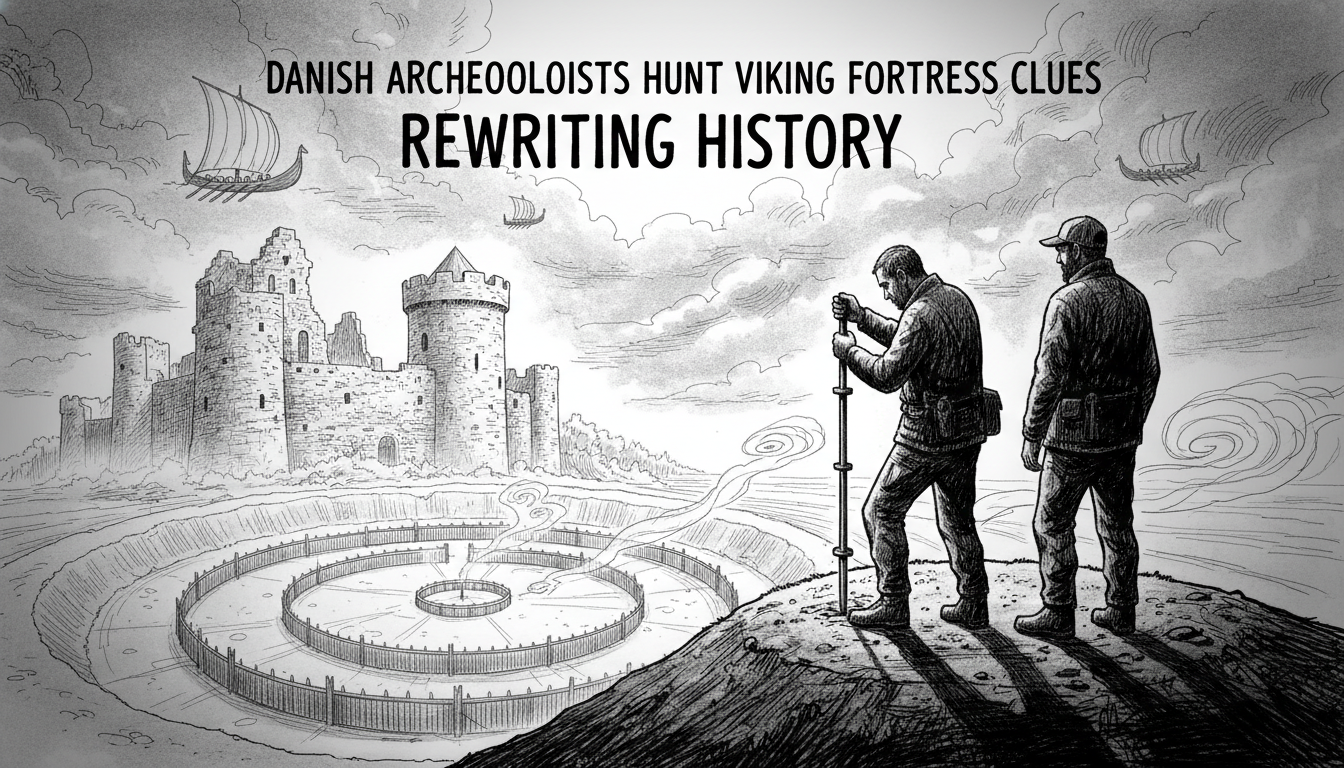
Danish archaeologists are drilling into ancient fortress structures to determine if they date back to the Viking Age. Museum Vestsjælland and the National Museum of Denmark are leading the investigation at several medieval castle sites across western Zealand.
Archaeologists are using core sampling equipment to extract soil samples from three meters below ground. The samples will be dated to establish the true age of these defensive structures.
Archaeologist Trine Borake from Museum Vestsjælland explained their mission. "We have a theory that royal power was centralized into a Danish state during these years. That should have created war and conflict. But we know almost no fortresses from the Iron Age and Viking period. We want to find castles that can be traced back to those periods."
The team is focusing on three medieval castles that show promising signs of older origins. These include Humleore, Vestborgen in Kalundborg, and Pedersborg near Sorø. Each location shows evidence of older defensive systems beneath medieval layers.
Borake noted the strategic importance of these sites. "Vestborgen lies in a strategic position, and written sources mention a Viking army in the area. Pedersborg has a format that suggests something different from classic medieval castles."
Senior researcher Mads Dengsø Jessen from the National Museum recently used similar core samples to redate Lilleborg castle on Bornholm from medieval to Iron Age. He believes finding a Viking fortress on Zealand could reshape historical understanding.
"It changes where we place significant locations from the Viking Age," Jessen said. "We often focus on large fortifications like Borgring and Trelleborg. If a large facility emerges in central Zealand, we need to unravel new local, geopolitical threads. New narratives emerge."
The research could reveal that Sorø served as a traffic hub in late Viking times and throughout the Iron Age. This would shift the understanding of Viking defense networks further inland.
Historical accounts from medieval chronicler Saxo describe Viking Age warfare in the Kalundborg area. While Saxo cannot be trusted as a historical source, these stories provide context for the archaeological investigations.
The core samples will provide definitive answers about the age of these structures. The dating results will determine whether researchers have indeed uncovered Viking Age fortresses that could rewrite Danish history.
This investigation represents a systematic approach to understanding Denmark's early defensive networks. The findings could fill significant gaps in knowledge about how Viking societies organized their territorial control.