
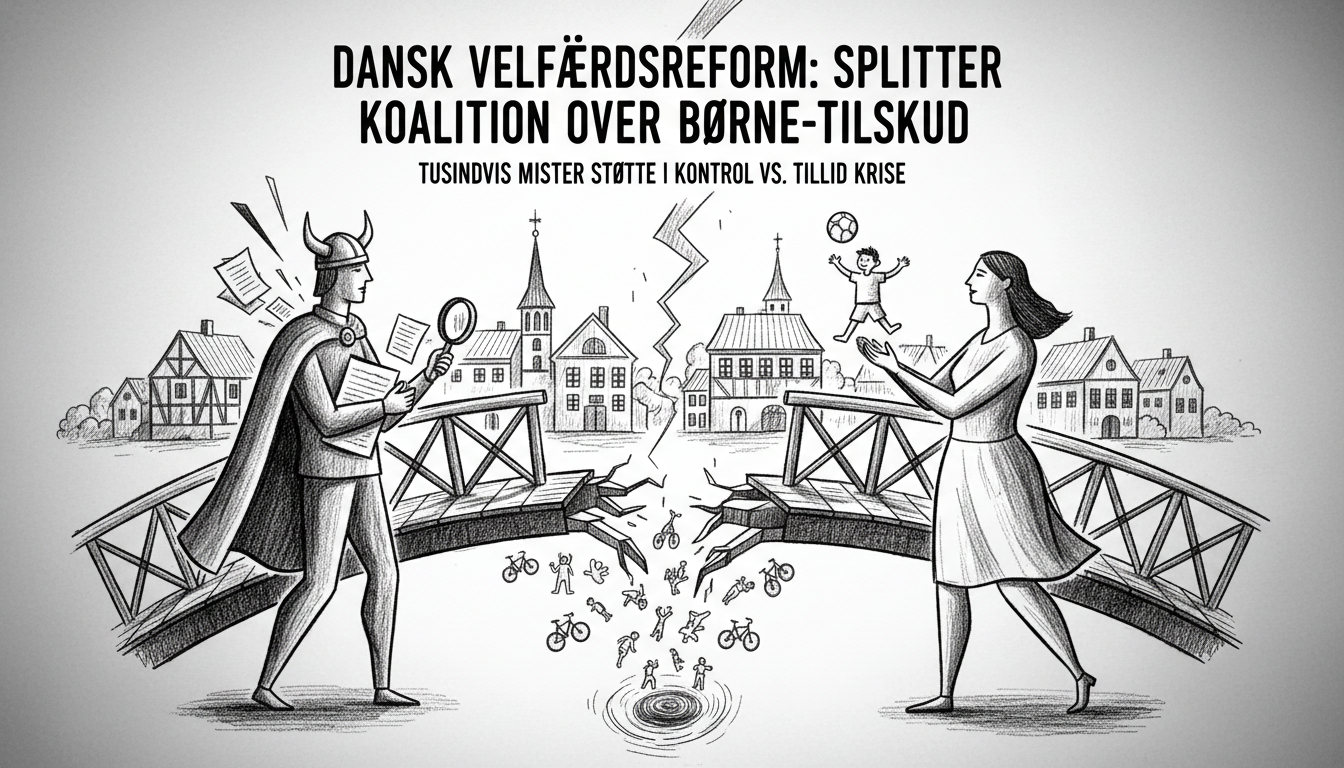
A new Danish welfare policy is creating a significant rift within the governing coalition. The dispute centers on a special subsidy for children in families receiving public assistance. The subsidy of 450 Danish kroner per child per month is intended to cover costs for sports, cultural activities, and social participation. A requirement for families to document one-third of these expenses has now become a major political flashpoint.
Thousands of families have lost this financial support since October because they failed to submit the required paperwork. Official figures show that 13,283 recipients initially received the benefit. After documentation rules were enforced, that number dropped sharply to 5,461, meaning 7,822 people lost the subsidy. This sharp decline has triggered a political debate about bureaucracy versus accountability in Denmark's expansive welfare state.
The Moderate party, part of the government, now advocates for a trust-based model. They propose replacing strict documentation with a simple declaration of use, backed by random spot checks. 'We should turn the model around and make it more trust-based,' said the Moderates' employment spokesperson, Ammar Ali, according to a statement. This position highlights a growing political trend of questioning administrative overhead in social services.
However, the Conservative People's Party firmly rejects this relaxation of controls. Their employment spokesperson, Dina Raabjerg, argued that removing documentation removes any guarantee the funds reach the children. 'We get no assurance the money actually goes to the children's leisure activities,' Raabjerg stated. She also criticized the proposed spot-check system as introducing its own 'huge bureaucracy.' This conflict exposes a fundamental tension in Danish politics between social trust and fiscal responsibility.
The Social Liberal Party and the Socialist People's Party support the Moderates' proposal for a simpler system. The Social Liberals' spokesperson, Samira Nawa, expressed strong support for reducing bureaucracy, noting these are 'families so pressed that in some cases they have skipped meals.' The political split is notable because all these parties originally backed the wider welfare agreement that introduced the subsidy. The disagreement now threatens the cohesion of the coalition on social policy matters.
From a business and economic perspective, this debate has indirect implications. Social stability and child welfare are long-term economic factors. Companies in Copenhagen and the Øresund region rely on a stable social contract and a well-integrated future workforce. Political instability over core welfare issues can create uncertainty. The Minister of Employment has not yet commented on the internal party disagreement. The outcome will signal whether Denmark's famous welfare model is shifting toward greater flexibility or maintaining strict accountability mechanisms. The core question remains: can the state trust citizens to use targeted funds appropriately, or does such trust invite misuse and waste taxpayer money? The answer will shape future social reforms.